Opinion - (2025) Volume 11, Issue 3
Received: 01-Jun-2025, Manuscript No. jssc-26-188271;
Editor assigned: 03-Jun-2025, Pre QC No. P-188271;
Reviewed: 17-Jun-2025, QC No. Q-188271;
Revised: 23-Jun-2025, Manuscript No. R-188271;
Published:
30-Jun-2025
, DOI: 10.37421/2472-0437.2025.11.298
Citation: Hassan, Fatima. ”Steel Corrosion Research: Mitigation,
Protection, and Monitoring.” J Steel Struct Constr 11 (2025):298.
Copyright: © 2025 Hassan F. This is an open-access article distributed under the terms of the Creative Commons Attribution License, which permits unrestricted use,
distribution and reproduction in any medium, provided the original author and source are credited.
The structural integrity of steel infrastructure is constantly under threat from various degradation mechanisms, with corrosion being a primary concern. This pervasive issue necessitates a deep understanding of its causes and effective mitigation strategies to ensure the longevity and safety of bridges, buildings, and other critical assets. Researchers have dedicated significant effort to investigating the multifaceted nature of corrosion and developing advanced protection methods. Abbas et al. provide a comprehensive review of corrosion and protection techniques for steel structures, highlighting common mechanisms and their impact on material properties, leading to reduced load-bearing capacity and service life. They emphasize the role of protective measures like coating systems, cathodic protection, and material selection in extending lifespan [1].
In a related study, Li et al. focus on novel organic coatings designed to prevent chloride-induced corrosion in reinforcing steel. Their research evaluates the development, characterization, adhesion, durability, and protective properties of these advanced coatings under simulated aggressive environments, offering insights into next-generation solutions [2].
The synergistic effects of corrosion and fatigue on steel bridge components are examined by Wang et al., who quantify the reduction in fatigue life due to corrosion damage and explore the complex interactions between these degradation mechanisms. Their work proposes methods for assessing the residual fatigue life of corroded structures, which is crucial for maintaining the safety of aging bridge infrastructure [3].
Prior to coating application, surface preparation is a critical step, and Li et al. investigate the effectiveness of different methods for structural steel. Their study compares techniques such as abrasive blasting and chemical cleaning in terms of their impact on coating adhesion and long-term corrosion resistance, offering practical guidance for optimizing surface treatment [4].
Advanced protective solutions are also being explored through hybrid intelligent coatings, as detailed by Song et al. This research focuses on incorporating smart functionalities like self-healing or corrosion sensing into coatings to provide active and responsive protection, potentially improving longevity and maintenance strategies for steel infrastructure [5].
In marine environments, where steel structures face extreme corrosive conditions, Lu et al. investigate the durability and effectiveness of sacrificial anodes for protection. Their analysis of electrochemical performance and lifespan of different anode materials under constant seawater exposure provides valuable data for designing efficient cathodic protection systems for offshore and coastal infrastructure [6].
Atmospheric corrosion in urban environments is another significant challenge, with Zhang et al. exploring its impact on structural steel. They quantify corrosion rates under various atmospheric conditions, identify key pollutants, and assess the effectiveness of protective coatings in mitigating urban atmospheric corrosion, offering insights for city maintenance [7].
Nanotechnology offers new avenues for enhanced corrosion resistance, as demonstrated by Park et al. Their research examines the use of nanoparticles incorporated into coating matrices to improve barrier properties, adhesion, and mechanical strength, suggesting a significant advancement in protective coating technology for structural steel [8].
Finally, assessing and monitoring corrosion in existing steel structures is vital for proactive maintenance. Li et al. review various non-destructive testing techniques and in-situ monitoring strategies for early detection and evaluation of corrosion damage, which is crucial for developing effective maintenance plans and ensuring the long-term performance of built infrastructure [9].
Understanding these diverse aspects of corrosion, from its fundamental mechanisms to the application of advanced protective technologies and monitoring strategies, is essential for the sustainable management of steel structures worldwide.
The pervasive issue of corrosion poses a significant threat to the structural integrity of steel infrastructure, necessitating comprehensive understanding and effective mitigation strategies. A foundational study by Abbas et al. provides a broad overview of corrosion mechanisms and protective measures for steel structures. They detail how common corrosion processes degrade material properties, reduce load-bearing capacity, and shorten service life, while also exploring various protective solutions including different coating systems, cathodic protection, and strategic material selection aimed at enhancing longevity and safety [1].
Complementing these general approaches, Li et al. delve into the specifics of novel organic coatings for reinforcing steel, focusing on their efficacy against chloride-induced corrosion. This research meticulously assesses the development, characterization, adhesion, durability, and protective capabilities of these advanced coatings under simulated harsh environmental conditions, offering a glimpse into sophisticated future solutions for steel protection [2].
In the context of bridge components, Wang et al. highlight the critical interplay between corrosion and fatigue. Their work quantifies the detrimental impact of corrosion on fatigue life and investigates the complex interactions between these two degradation mechanisms. The study is particularly valuable for proposing methodologies to assess the remaining fatigue life of corroded structures, a crucial aspect for the safety of aging bridges [3].
An essential precursor to effective corrosion protection is proper surface preparation before coating application. Li et al. investigate the comparative effectiveness of various surface preparation techniques for structural steel. Their research evaluates methods like abrasive blasting and chemical cleaning, assessing their influence on coating adhesion and long-term corrosion resistance, thereby providing practical guidance for optimizing surface treatments to improve coating durability [4].
Advancements in coating technology are further explored by Song et al. through the concept of hybrid intelligent coatings. This study examines the integration of smart functionalities within coatings, such as self-healing or corrosion sensing capabilities, to provide active and adaptive protection, indicating a promising direction for improving the lifespan and maintenance of steel infrastructure through responsive materials [5].
For steel structures exposed to harsh marine environments, Lu et al. focus on the durability and performance of sacrificial anodes, a key component of cathodic protection systems. Their investigation meticulously analyzes the electrochemical performance and lifespan of various anode materials when continuously immersed in seawater, furnishing critical data for the design and implementation of effective protection strategies for offshore and coastal steel infrastructure [6].
The impact of atmospheric corrosion, particularly in urban settings, is addressed by Zhang et al. Their research quantifies corrosion rates under varied atmospheric conditions and identifies specific pollutants that contribute to steel degradation. Furthermore, they assess the effectiveness of protective coatings in mitigating urban atmospheric corrosion, offering valuable insights for the upkeep of steel structures in densely populated areas [7].
Emerging technologies like nanotechnology are also being harnessed for superior corrosion resistance. Park et al. investigate the application of nanotechnology-enhanced coatings for structural steel, examining how nanoparticles integrated into coating matrices can bolster barrier properties, adhesion, and mechanical strength. Their findings point towards significant advancements in protective coating technology, offering enhanced performance for structural steel [8].
The ongoing management of existing steel infrastructure relies heavily on robust assessment and monitoring techniques. Li et al. present a comprehensive review of non-destructive testing (NDT) methods and in-situ monitoring strategies for the early detection and evaluation of corrosion damage. This work is instrumental in developing informed maintenance plans and ensuring the sustained performance of built steel assets [9].
Finally, the specific behavior of weathering steel, a material designed to form a protective rust layer, is examined by Wang et al. Their study analyzes the formation and characteristics of this rust layer and its effect on further corrosion under different environmental conditions. This research is crucial for guiding the appropriate utilization and maintenance of weathering steel in various structural applications, ensuring its intended protective mechanisms function optimally [10].
This collection of research highlights the critical importance of understanding and mitigating corrosion in steel structures. Studies cover a wide spectrum of approaches, from fundamental corrosion mechanisms and their impact on material properties to advanced protective strategies. These include the development of novel organic and nanotechnology-enhanced coatings, the application of hybrid intelligent coatings with smart functionalities, and the use of sacrificial anodes for cathodic protection, particularly in marine environments. The research also addresses critical aspects like the effectiveness of surface preparation methods prior to coating, the synergistic effects of corrosion and fatigue, and the challenges of atmospheric corrosion in urban settings. Furthermore, significant emphasis is placed on the assessment and monitoring of corrosion in existing structures using non-destructive techniques, as well as understanding the specific corrosion behavior of weathering steel. Collectively, these findings contribute to extending the lifespan, ensuring the safety, and optimizing the maintenance of steel infrastructure.
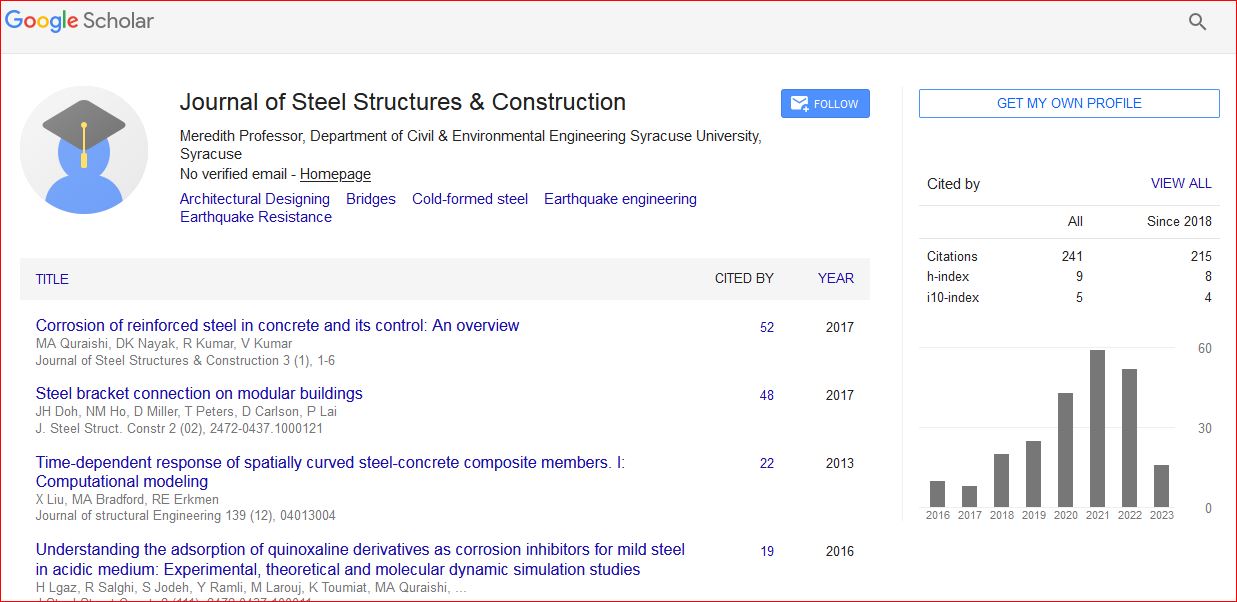
Journal of Steel Structures & Construction received 583 citations as per Google Scholar report