Perspective - (2025) Volume 14, Issue 5
Received: 02-Oct-2025, Manuscript No. jsp-26-182276;
Editor assigned: 06-Oct-2025, Pre QC No. P-182276;
Reviewed: 20-Oct-2025, QC No. Q-182276;
Revised: 23-Oct-2025, Manuscript No. R-182276;
Published:
30-Oct-2025
, DOI: 10.37421/2165-7939.2025.14.744
Citation: Ribeiro, Paula N.. ”Spinal Fusion Bone Graft Substitutes: Advancements and Applications.” J Spine 14 (2025):744.
Copyright: © 2025 Ribeiro N. Paula This is an open-access article distributed under the terms of the Creative Commons Attribution License, which permits unrestricted use, distribution and reproduction in any medium, provided the original author and source are credited.
Bone graft substitutes are fundamental in spinal fusion surgery, particularly when autograft sources are insufficient or contraindicated. These materials are designed to facilitate osteogenesis, osteoconduction, and sometimes osteoinduction, providing a structural and biological foundation for new bone formation. The evolution of these substitutes has been driven by the need for safer, more effective alternatives to traditional bone grafts. Biomimetic materials, including advanced ceramics, biodegradable polymers, and potent biologics, are at the forefront of current research, aiming to improve osseointegration and mitigate risks associated with graft procedures. The selection of an appropriate substitute is a complex decision influenced by the specific surgical scenario, patient-specific factors, and the desired fusion outcomes. Recent advancements have led to the development of synthetically derived bone graft substitutes, such as calcium phosphates and bioactive glasses, which offer predictable resorption profiles and excellent biocompatibility. These materials function as osteoconductive scaffolds, effectively guiding the process of bone formation. Their integration into spinal fusion techniques has grown considerably, presenting a viable alternative to autograft and allograft, especially in minimally invasive approaches where graft harvesting can be problematic. Biologics, notably bone morphogenetic proteins (BMPs), have profoundly impacted spine fusion by exhibiting potent osteoinductive capabilities, actively promoting bone growth. However, their application is not without potential complications and considerable expense. Consequently, research is exploring combination therapies that merge BMPs with bone graft substitutes to achieve optimal fusion rates while managing risks and enhancing cost-effectiveness. The emergence of bioresorbable polymers has introduced sophisticated scaffolds that gradually degrade, allowing for replacement by native bone tissue. These advanced materials can be engineered for controlled release of therapeutics, such as antibiotics or growth factors, providing a dual benefit of structural support and targeted medical intervention. Their potential application in challenging fusion cases, including revision surgeries, shows considerable promise. The development of composite bone graft substitutes, which combine different material types like ceramics with growth factors or polymers with cellular components, is aimed at achieving synergistic effects. These materials seek to harness the osteoconductive properties of scaffold materials alongside the osteoinductive or osteogenic potential of biologics or cells, ultimately leading to superior fusion rates and improved bone quality. The mechanical characteristics of bone graft substitutes are paramount for ensuring immediate spinal stability and withstanding the significant load-bearing demands during the fusion process. Materials exhibiting appropriate stiffness and porosity are crucial for fostering cellular infiltration and vascularization, both indispensable for effective bone regeneration. Navigating the intricate regulatory pathways and economic considerations associated with bone graft substitutes presents a substantial hurdle. Despite the enhanced fusion potential offered by innovative materials, their widespread adoption hinges on factors such as reimbursement policies, seamless integration into surgical practices, and robust evidence from clinical outcomes. The groundbreaking capabilities of 3D printing technology are now enabling the creation of customized bone graft substitutes with complex internal structures and precisely tailored mechanical properties. This personalized approach holds significant promise for optimizing graft integration and achieving fusion success in anatomically challenging situations. Nanomaterials are undergoing extensive investigation for their potential to augment the osteogenic and osteoconductive characteristics of bone graft substitutes. Their remarkably high surface area-to-volume ratio facilitates enhanced cell adhesion, proliferation, and differentiation, thereby accelerating bone healing processes. The clinical effectiveness and long-term results of various bone graft substitutes across a spectrum of spinal pathologies, including degenerative disc disease, trauma, and spinal deformities, are under continuous evaluation. Patient-specific variables and the chosen surgical approach critically influence the selection of the most suitable substitute.
Bone graft substitutes play a pivotal role in enhancing spinal fusion success, especially when autograft material is scarce or inadvisable. These materials are engineered to provide a scaffold that supports osteogenesis, guides bone growth (osteoconduction), and in some cases, actively stimulates bone formation (osteoinduction). Innovations in biomimetic materials, encompassing ceramics, polymers, and biologics, are designed to foster better osseointegration and reduce common complications associated with traditional bone grafting methods. The selection of a particular substitute is tailored to the unique surgical context, individual patient characteristics, and the specific goals for fusion outcomes. Synthetically produced bone graft substitutes, including calcium phosphates and bioactive glasses, are increasingly utilized due to their consistent resorption rates and excellent biocompatibility. They function as osteoconductive frameworks, directing the natural bone healing process. Their growing use in spinal fusion procedures offers a valuable alternative to autograft and allograft, particularly in minimally invasive surgeries where harvesting bone can be challenging. The integration of biologics, such as bone morphogenetic proteins (BMPs), has revolutionized spine fusion by providing potent osteoinductive signals that actively encourage bone formation. Despite their efficacy, BMPs are associated with potential adverse effects and high costs, leading to research into combination therapies that pair BMPs with bone graft substitutes to optimize fusion rates while mitigating risks and improving cost-effectiveness. Bioresorbable polymers have led to the development of advanced scaffolds that gradually degrade and are replaced by the patient's own bone. These materials can be functionalized to deliver drugs, including antibiotics or growth factors, offering a dual therapeutic and structural benefit. Their application in complex fusion scenarios, such as revision surgeries, appears highly promising. The development of composite bone graft substitutes, which combine diverse materials like ceramics with growth factors or polymers with cellular components, aims to create synergistic effects. These advanced materials leverage the osteoconductive properties of scaffolds with the osteoinductive or osteogenic potential of biologics or cells, potentially leading to improved fusion rates and enhanced bone fusion quality. The mechanical properties of bone graft substitutes are critical for providing immediate structural support and withstanding the biomechanical stresses on the spine during the fusion process. Materials with optimized stiffness and porosity are essential for promoting cellular infiltration and vascularization, key elements for successful bone regeneration. The regulatory landscape and the economic viability of bone graft substitutes present significant challenges. While novel materials offer superior fusion capabilities, their widespread adoption is contingent upon factors such as reimbursement policies, ease of integration into surgical workflows, and compelling evidence from clinical studies. The advent of 3D printing technology allows for the customization of bone graft substitutes, featuring intricate pore architectures and precisely controlled mechanical properties. This personalized approach holds great potential for optimizing graft integration and achieving successful fusion in complex anatomical situations. Nanomaterials are a growing area of research for their ability to enhance the osteogenic and osteoconductive characteristics of bone graft substitutes. Their substantial surface area-to-volume ratio can promote cellular adhesion, proliferation, and differentiation, thereby expediting bone healing. Ongoing clinical evaluations are assessing the efficacy and long-term outcomes of various bone graft substitutes in different spinal conditions, including degenerative disc disease, trauma, and deformities. Patient-specific factors and the chosen surgical approach significantly influence the optimal selection of a bone graft substitute.
Bone graft substitutes are crucial for spinal fusion, offering alternatives when autograft is unavailable. They provide scaffolds for bone growth, with advancements in biomimetic materials like ceramics, polymers, and biologics. Synthetic substitutes such as calcium phosphates and bioactive glasses are osteoconductive and widely used. Biologics like BMPs promote bone formation but come with risks and costs, leading to combined therapies. Bioresorbable polymers offer drug delivery and structural support, particularly useful in complex cases. Composite materials combining different types aim for synergistic effects, enhancing fusion rates. Mechanical properties like stiffness and porosity are vital for stability and regeneration. Regulatory and economic factors influence adoption, while 3D printing allows for customized substitutes. Nanomaterials show promise in accelerating bone healing. Clinical outcomes are continuously evaluated across various spinal conditions, with patient factors and surgical approach dictating the best choice.
None
None
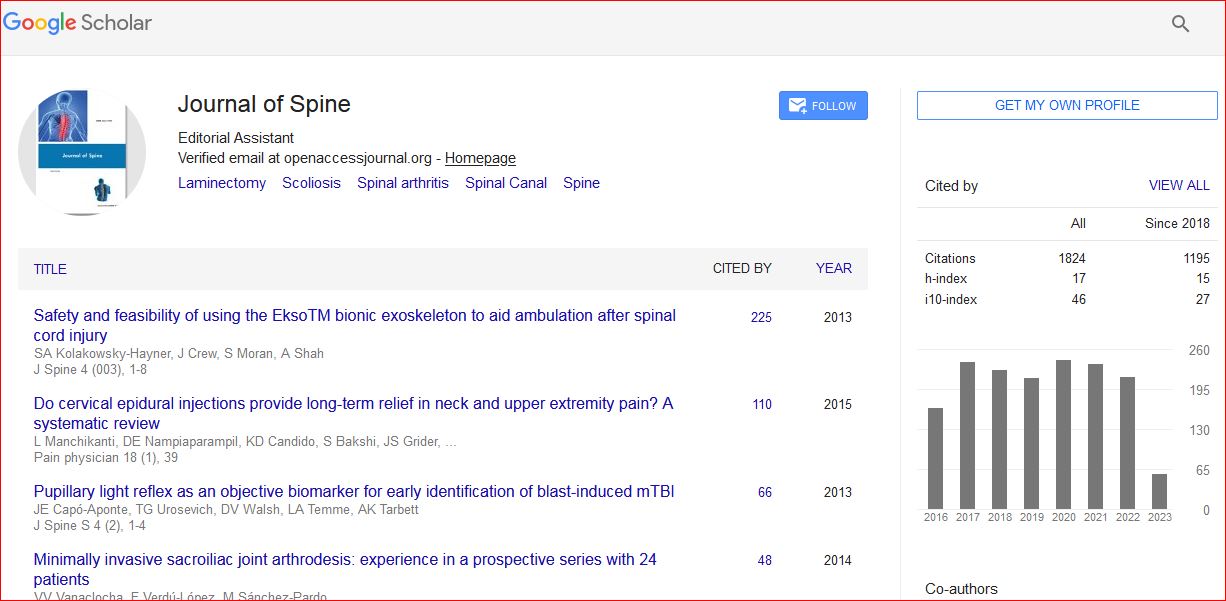
Journal of Spine received 2022 citations as per Google Scholar report