Opinion - (2025) Volume 16, Issue 4
Received: 31-Jul-2025, Manuscript No. gjto-25-176009;
Editor assigned: 04-Aug-2025, Pre QC No. P-176009;
Reviewed: 14-Aug-2025, QC No. QC-176009;
Revised: 21-Aug-2025, Manuscript No. R-176009;
Published:
28-Aug-2025
, DOI: 10.37421/2229-8711.2025.16.460
Citation: Grant, Oliver. ”Smart ITS: AI, V2X, Sensors, Security.” Global J Technol Optim 16 (2025):460.
Copyright: © 2025 Grant O. This is an open-access article distributed under the terms of the Creative Commons Attribution License, which permits unrestricted use, distribution
and reproduction in any medium, provided the original author and source are credited.
Intelligent Transportation Systems (ITS) are at the forefront of modern infrastructure development, striving to create more efficient, safe, and sustainable urban mobility solutions. This body of work provides a comprehensive overview of the transformative technologies driving ITS, from advanced computational methods to sophisticated communication networks and sensor technologies. One significant area of focus is the burgeoning applications of Artificial Intelligence (AI), which includes machine learning, deep learning, and reinforcement learning, in revolutionizing various aspects of ITS such as traffic management, autonomous driving, public transportation, and smart logistics. This field explores key advancements, addresses current challenges, and outlines future research pathways to develop more effective transportation solutions [1].
Advanced Machine Learning (ML) and Deep Learning (DL) techniques are specifically applied within ITS, covering methodologies like supervised, unsupervised, and reinforcement learning. These are specialized for applications in traffic prediction, congestion management, accident detection, and enhancing autonomous driving capabilities. Researchers emphasize the effectiveness of these methods in boosting efficiency, safety, and overall urban mobility, while also discussing crucial challenges like data privacy and model interpretability [2].
The current state and future trajectory of Vehicle-to-Everything (V2X) communication technologies within ITS are also thoroughly reviewed. V2X facilitates real-time data exchange among vehicles, infrastructure, pedestrians, and network entities, thereby enhancing traffic safety, efficiency, and autonomous driving. This review highlights advancements in communication standards, various use cases, security challenges, and the potential for V2X to serve as a foundational element for next-generation smart mobility solutions [3].
Communication systems in ITS play an essential role, relying on various wireless technologies, including 5G, Dedicated Short-Range Communications (DSRC), and cellular V2X, to enable real-time data exchange and connectivity. This domain grapples with critical research challenges such as latency, reliability, security, and scalability, which must be overcome to fully support emerging ITS applications like autonomous driving and cooperative traffic management. Insights into future communication paradigms for smart mobility are also provided [4].
A broader perspective on current developments and future trends in ITS is offered, encompassing topics like smart traffic management, autonomous vehicles, intelligent infrastructure, and data analytics. This view emphasizes how these diverse components integrate to form efficient and sustainable urban mobility solutions, discussing technological advancements, policy implications, and the societal impact of ITS in envisioning a more connected and safer transportation future [5].
Advanced sensors are pivotal in the evolution of smart mobility within ITS. This area examines various sensor technologies, including Light Detection and Ranging (LiDAR), radar, cameras, and Internet of Things (IoT) devices, and their contribution to real-time data collection, environmental perception, and decision-making for autonomous vehicles and smart infrastructure. The integration of these sensors with AI is critical for enhancing safety, efficiency, and sustainability in urban transport systems [6].
Deep Learning (DL) applications, specifically tailored for traffic prediction in ITS, are systematically analyzed. This includes various DL architectures such as Graph Neural Networks (GNNs), Convolutional Neural Networks (CNNs), and Recurrent Neural Networks (RNNs), demonstrating their efficacy in modeling complex spatio-temporal patterns of traffic flow. The discussion covers advancements, challenges, and opportunities for improving prediction accuracy and real-time performance in dynamic urban environments [7].
Blockchain-based solutions for ITS are explored as a means to enhance security, privacy, and trust in various applications, including V2X communications, ride-sharing platforms, and autonomous vehicle management. This survey details different blockchain architectures, consensus mechanisms, and smart contract applications, identifying key advantages and future research directions for integrating this technology into smart mobility ecosystems [8].
Cybersecurity within ITS is addressed as a critical aspect, analyzing various threats and vulnerabilities across components like autonomous vehicles, V2X communications, and smart infrastructure. Existing and proposed security mechanisms, such as encryption, authentication, and intrusion detection systems, are explored with the aim of protecting data integrity, privacy, and system resilience. Significant challenges and future research directions are outlined to ensure the trustworthiness of ITS [9].
Finally, the role of Internet of Things (IoT)-based ITS within smart cities is overviewed, outlining future directions. IoT devices, sensors, and communication networks facilitate real-time data collection and analysis for traffic management, public safety, environmental monitoring, and smart parking. The authors discuss integration challenges, security concerns, and the transformative potential of IoT in creating highly efficient and responsive urban transportation environments [10].
Intelligent Transportation Systems (ITS) leverage a diverse array of advanced technologies to revolutionize urban and interurban mobility, addressing critical challenges such as congestion, safety, and environmental impact. At the core of these advancements are sophisticated computational methods, particularly Artificial Intelligence (AI) and its subfields like Machine Learning (ML) and Deep Learning (DL). These technologies are instrumental in transforming traffic management, enabling more accurate traffic prediction, efficient congestion management, and robust accident detection. For example, specific deep learning architectures, including Graph Neural Networks (GNNs), Convolutional Neural Networks (CNNs), and Recurrent Neural Networks (RNNs), prove highly effective in modeling complex spatio-temporal traffic patterns, significantly improving prediction accuracy and real-time performance in dynamic urban settings [1, 2, 7]. The integration of AI also extends to optimizing public transportation and smart logistics, contributing to a more streamlined and responsive transportation ecosystem [1].
Communication infrastructure forms the backbone of interconnected ITS. Vehicle-to-Everything (V2X) communication technologies are pivotal, facilitating real-time data exchange among vehicles, roadside infrastructure, pedestrians, and network services. This capability is essential for enhancing traffic safety, improving efficiency, and underpinning the functionalities of autonomous driving [3]. Beyond V2X, the broader landscape of wireless communication systems for ITS involves technologies such as 5G, Dedicated Short-Range Communications (DSRC), and cellular V2X. These are crucial for enabling the low-latency, high-reliability connectivity required for advanced ITS applications like cooperative traffic management and fully autonomous vehicles. However, developing these systems effectively requires overcoming significant research challenges related to latency, reliability, security, and scalability [4].
The effectiveness of ITS heavily relies on accurate and real-time data collection, which is primarily achieved through advanced sensor technologies and the Internet of Things (IoT). A variety of sensors, including Light Detection and Ranging (LiDAR), radar, cameras, and general IoT devices, contribute to environmental perception and data acquisition. These sensors feed critical information into AI systems, allowing for informed decision-making in autonomous vehicles and intelligent infrastructure components. The widespread deployment of IoT devices also supports a range of smart city applications, from traffic management and public safety to environmental monitoring and smart parking, ultimately creating highly efficient and responsive urban environments [6, 10].
Security and trustworthiness are paramount concerns for the widespread adoption and reliable operation of ITS. Cybersecurity addresses critical threats and vulnerabilities across all ITS components, including autonomous vehicles, V2X communications, and smart infrastructure. Research focuses on implementing robust security mechanisms, such as encryption, authentication, and intrusion detection systems, to safeguard data integrity, privacy, and system resilience against potential attacks. Ensuring the trustworthiness of ITS requires continuous development and refinement of these security measures [9]. Complementing cybersecurity efforts, blockchain technology offers a novel approach to enhancing security, privacy, and trust within ITS applications. By leveraging distributed ledger technologies, blockchain can secure V2X communications, facilitate transparent ride-sharing platforms, and manage autonomous vehicles with increased integrity and accountability [8].
Collectively, these advancements paint a picture of a future where transportation is not only intelligent but also integrated, responsive, and sustainable. The ongoing research addresses both technological sophistication and practical implementation challenges, moving towards a future where intelligent infrastructure and connected vehicles operate in harmony to deliver unprecedented levels of safety, efficiency, and urban mobility. The comprehensive review of current developments and future trends underscores the dynamic nature of ITS, highlighting the continuous evolution driven by technological innovation and evolving societal needs [5].
The provided research extensively covers Intelligent Transportation Systems (ITS), detailing how various technologies are shaping the future of urban mobility. A central theme is the application of Artificial Intelligence (AI), encompassing Machine Learning (ML), Deep Learning (DL), and reinforcement learning, to revolutionize traffic management, predict congestion, detect accidents, and enable autonomous driving. These AI techniques are proving effective in enhancing overall efficiency and safety. Another significant area explored is communication systems within ITS. Vehicle-to-Everything (V2X) technologies facilitate real-time data exchange between vehicles, infrastructure, pedestrians, and networks, forming a backbone for future smart mobility. This is complemented by discussions on wireless technologies like 5G, DSRC, and cellular V2X, which are essential for low-latency and reliable connectivity, though they face challenges in security and scalability. Advanced sensors, including Light Detection and Ranging (LiDAR), radar, cameras, and Internet of Things (IoT) devices, are critical for real-time data collection and environmental perception, integrating with AI for improved decision-making in autonomous systems and smart infrastructure. The integration of blockchain technology is also reviewed for enhancing security, privacy, and trust in V2X communications and ride-sharing platforms. Finally, the papers address vital concerns like cybersecurity, identifying threats and proposing mechanisms for data integrity and system resilience. Overall, this body of work provides a comprehensive look at current developments, challenges, and future directions for ITS, aiming for more efficient, safe, and sustainable transportation.
None
None
Shanshan C, Jie L, Huimin W. "A Review of Artificial Intelligence Applications in Intelligent Transportation Systems".Sustainability (Basel) 15 (2023):11195.
Indexed at, Google Scholar, Crossref
Mahmoud M, Adib A, Yousef AB. "Advanced Machine Learning and Deep Learning Methods for Intelligent Transportation Systems: A Review".Electronics (Basel) 12 (2023):4426.
Indexed at, Google Scholar, Crossref
Xiaomeng S, Yuanlin Z, Wenjie M. "Research on the Current Status and Future Development of Vehicle-to-Everything (V2X) for Intelligent Transportation Systems: A Review".J Adv Transp 2023 (2023):4725515.
Indexed at, Google Scholar, Crossref
Mohammed AK, Faizan A, Khurram KA. "Intelligent Transportation Systems: A State-of-the-Art Review on Communication Systems and Research Challenges".Sensors (Basel) 23 (2023):7122.
Indexed at, Google Scholar, Crossref
Qun H, Lei F, Weiguang Z. "Intelligent Transportation Systems: A Comprehensive Review of Current Developments and Future Trends".Appl Sci (Basel) 13 (2023):8783.
Indexed at, Google Scholar, Crossref
Shanshan W, Yu S, Jiawei Z. "Exploring the Evolution of Smart Mobility through Advanced Sensors and Intelligent Transportation Systems".J Sensors 2023 (2023):6363297.
Indexed at, Google Scholar, Crossref
Kai Z, Guangmin L, Li-Na L. "A Comprehensive Review of Deep Learning Applications for Traffic Prediction in Intelligent Transportation Systems".Future Internet 14 (2022):326.
Indexed at, Google Scholar, Crossref
Wei L, Feng Z, Guangmin S. "Blockchain-Based Solutions for Intelligent Transportation Systems: A Survey".IEEE Commun Surv Tutor 23 (2021):1740-1761.
Indexed at, Google Scholar, Crossref
M. U, M. NA, M. KK. "Cybersecurity for Intelligent Transportation Systems: A Review".Sensors (Basel) 21 (2021):6499.
Indexed at, Google Scholar, Crossref
F. AA, W. A, K. MAE. "IoT-Based Intelligent Transportation Systems: An Overview of Smart City Applications and Future Directions".Wirel Pers Commun 111 (2020):1045-1065.
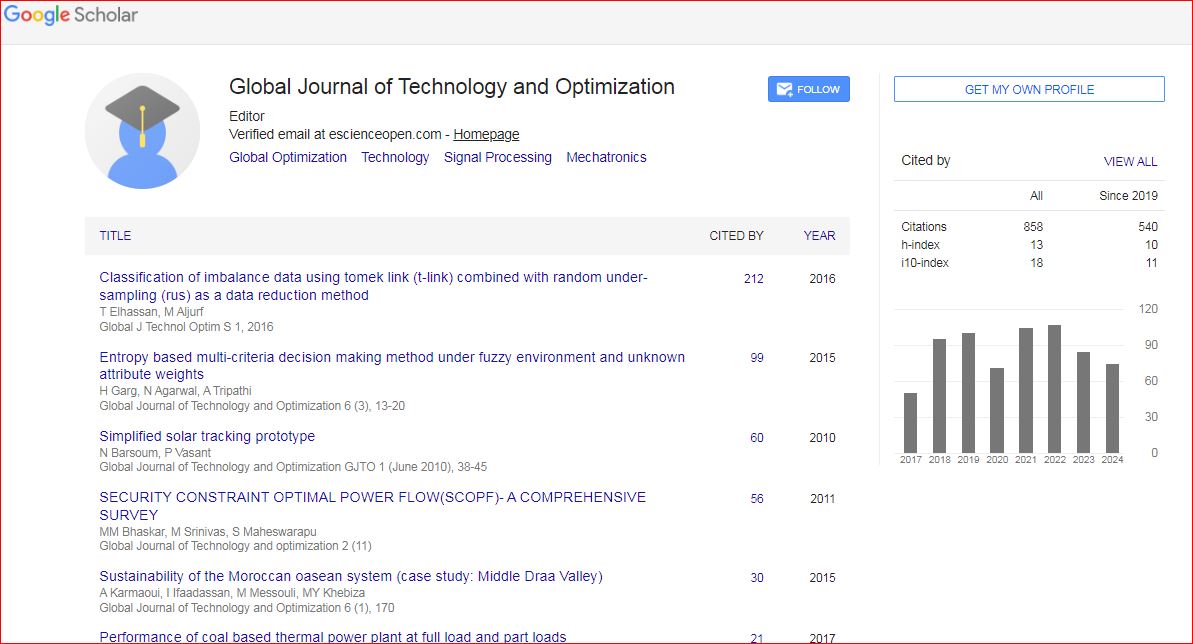
Global Journal of Technology and Optimization received 847 citations as per Google Scholar report