Perspective - (2025) Volume 9, Issue 3
Received: 01-May-2025, Manuscript No. jma-26-184595;
Editor assigned: 05-May-2025, Pre QC No. P-184595;
Reviewed: 19-May-2025, QC No. Q-184595;
Revised: 22-May-2025, Manuscript No. R-184595;
Published:
29-May-2025
, DOI: 10.37421/2684-4265.2025.09.385
Citation: Kowalczyk, Tomasz. ”Sexual Dimorphism: Evolutionary Drivers and Adaptations.” J Morphol Anat 09 (2025):385.
Copyright: © 2025 Kowalczyk T. This is an open-access article distributed under the terms of the Creative Commons Attribution License, which permits unrestricted use, distribution and reproduction in any medium, provided the original author and source are credited.
Sexual dimorphism, the distinct differences in physical characteristics between males and females of the same species, is a pervasive phenomenon across the animal kingdom, driven by a complex interplay of evolutionary forces. This widespread occurrence is particularly evident in morphological traits, where variations in size, shape, and coloration often arise as a consequence of sexual selection and divergent ecological roles that sexes may occupy. The study of these differences is crucial for a comprehensive understanding of evolutionary pathways, especially when interpreting fossil records and tracing the development of lineages, including those within mammalian groups. Researchers have dedicated significant efforts to unraveling the genetic and hormonal mechanisms that underpin these observable sexual distinctions, prompting further investigations into the microevolutionary processes responsible for extreme dimorphic expressions. [1] In avian species, skeletal structures exhibit notable sexual dimorphism, with significant variations observed in limb bone proportions and skull morphology between males and females. These skeletal discrepancies are frequently linked to differential resource utilization and distinct reproductive strategies employed by each sex. Comparative osteology, therefore, emerges as a powerful tool for tracing evolutionary divergence and comprehending adaptive radiation within diverse bird families, while also acknowledging the influence of environmental factors on the manifestation of dimorphism. [2] The study of primate dentition reveals intricate patterns of sexual dimorphism, where dietary niches and social structures play pivotal roles in shaping variations in tooth size and form. Males, in particular, often display larger canines and incisors, a characteristic that may be directly correlated with intraspecific competition for mates or resources. These dental dimorphisms are intrinsically connected to broader evolutionary trajectories and social behaviors in primates, underscoring the dynamic interplay between morphology and prevailing ecological pressures. Furthermore, these findings have significant implications for inferring social systems from the analysis of fossil primate assemblages. [3] Within quadrupedal mammals, musculoskeletal systems present clear evidence of sexual dimorphism, manifested through sex-specific differences in bone density and the precise sites of muscle attachment. Such variations are hypothesized to represent adaptations tailored for distinct locomotive demands or specialized reproductive roles, such as engaging in combat or nurturing offspring. The consideration of sex is therefore paramount when undertaking studies in biomechanics and functional morphology, whether examining extant or extinct species. The influence of hormonal factors on the development of both bone and muscle is also a significant area of exploration. [4] Cranial suture morphology in mammals also exhibits sexual dimorphism, with variations in suture fusion patterns potentially linked to differential brain development trajectories or the influence of hormonal signaling during growth phases. These subtle anatomical distinctions hold the potential to offer valuable insights into evolutionary history and the inherent developmental plasticity of species. The scientific community calls for more in-depth investigations into the precise functional significance of these sex-specific suture morphologies. [5] Focusing on external genitalia, specific avian species demonstrate pronounced sexual dimorphism in phallus morphology, with these pronounced differences being hypothesized to stem from pressures related to sperm competition and the ultimate achievement of reproductive success. Employing detailed anatomical descriptions and rigorous comparative analyses, researchers aim to elucidate the evolutionary pressures that have shaped these intricate structures. It is important to note that the study of genitalic morphology in avian research remains a significantly understudied area. [6] In the realm of extinct marine reptiles, such as plesiosaurs, the vertebral column exhibits sexual dimorphism, characterized by variations in neural spine height and centrum shape. These anatomical distinctions are often interpreted within the context of their potential roles in sexual display or as adaptations for enhanced locomotion within aquatic environments. This research contributes to a more profound understanding of morphological diversification, particularly when driven by sexual selection in prehistoric lineages, and advocates for the integration of sexual dimorphism into paleontological reconstructions. [7] Investigating the inner ear morphology of bats reveals intriguing sex-specific differences in cochlear structure, which may be intrinsically linked to variations in auditory perception and the sophisticated strategies employed for echolocation. Preliminary findings suggest that female bats might possess enhanced auditory sensitivity within specific frequency ranges, potentially correlating with maternal care responsibilities or improved prey detection capabilities. This research underscores the adaptive significance of sensory organ dimorphism and provides insights into the evolutionary trajectory of auditory systems in Chiroptera. [8] In rodents, sexual dimorphism is pronounced within the olfactory epithelium, with documented differences in vomeronasal organ size and olfactory receptor gene expression being directly linked to sex-specific behaviors, including mate-seeking and territorial defense. This research provides a robust anatomical and molecular foundation for understanding how sex fundamentally influences chemosensory perception. It is posited that olfactory dimorphism plays a critical role in mediating social communication and the maintenance of reproductive isolation between species. The study also acknowledges the significant role of gonadal hormones in shaping the development of the olfactory system. [9] Finally, the integumentary system of amphibians exhibits sexual dimorphism, particularly in skin gland distribution and keratinization patterns. These observed variations are proposed to be adaptations related to crucial functions such as thermoregulation, defense mechanisms against predators, or the facilitation of reproductive signaling. This research underscores the imperative of considering sex when conducting ecological studies and formulating conservation strategies for amphibian populations. Moreover, the paper highlights the modulating influence of environmental factors on the expression of integumentary dimorphism. [10]
Sexual dimorphism is a fundamental aspect of animal biology, with significant implications for understanding evolutionary processes. This article provides a broad overview of sexual dimorphism in mammalian morphology from an evolutionary perspective, detailing how differences in size, shape, and coloration between sexes frequently arise due to sexual selection and distinct ecological roles. The authors emphasize the importance of recognizing dimorphism when interpreting fossil evidence and unraveling evolutionary pathways, particularly within mammalian evolutionary history. The underlying genetic and hormonal mechanisms driving these observed differences are explored, alongside suggestions for future research directions focused on the microevolutionary underpinnings of extreme dimorphic expressions. [1] In the avian realm, skeletal dimorphism is characterized by substantial differences in limb bone proportions and skull morphology between male and female species. These skeletal variations are often attributed to differential resource utilization and distinct reproductive strategies. The research highlights the utility of comparative osteology in tracing evolutionary divergence and understanding adaptive radiation within avian families, while also acknowledging the influence of environmental factors on the expression of such dimorphism. [2] Primate dentition reveals complex sexual dimorphism, influenced by dietary habits and social structures, leading to variations in tooth size and shape. Males often exhibit larger canines and incisors, likely a consequence of competition. These dental dimorphisms are linked to broader primate evolution and social behavior, emphasizing the connection between morphology and ecological pressures. The study also discusses the implications for inferring social systems from fossil primate remains. [3] For quadrupedal mammals, musculoskeletal dimorphism involves sex-specific differences in bone density and muscle attachment sites, hypothesized as adaptations for distinct locomotive demands or reproductive roles like fighting or parental care. The authors stress the importance of considering sex in biomechanical and functional morphology studies of both extant and extinct species, alongside exploring hormonal influences on bone and muscle development. [4] Cranial suture morphology in mammals also exhibits sexual dimorphism, with variations in fusion patterns potentially linked to differing brain development or hormonal influences during growth. These subtle anatomical differences can offer insights into evolutionary history and developmental plasticity, with a call for further research into the functional significance of sex-specific suture morphology. [5] In a specific avian species, external genitalia display significant sexual dimorphism in phallus morphology, hypothesized to be related to sperm competition and reproductive success. Detailed anatomical descriptions and comparative analysis are used to understand the evolutionary pressures on these structures, noting that genitalic morphology in birds is an understudied area. [6] Extinct marine reptiles, like plesiosaurs, show vertebral sexual dimorphism through variations in neural spine height and centrum shape. These anatomical differences are interpreted in the context of sexual display or enhanced locomotion in aquatic environments. This research enhances understanding of morphological diversification driven by sexual selection in prehistoric lineages and advocates for integrating sexual dimorphism into paleontological reconstructions. [7] Inner ear morphology in bats demonstrates sexual dimorphism, with sex-specific cochlear structures possibly related to auditory perception and echolocation strategies. Females may have enhanced sensitivity in certain frequencies, linked to maternal care or prey detection, highlighting the adaptive significance of sensory organ dimorphism and its implications for auditory evolution in bats. [8] Rodent olfactory epithelia exhibit sexual dimorphism, with differences in vomeronasal organ size and receptor gene expression linked to sex-specific behaviors like mate-seeking and territoriality. This provides an anatomical and molecular basis for understanding how sex influences chemosensory perception, suggesting olfactory dimorphism is crucial for social communication and reproductive isolation, with gonadal hormones playing a role in olfactory system development. [9] Amphibian integumentary systems display sexual dimorphism in skin gland distribution and keratinization patterns, potentially related to thermoregulation, defense, or reproductive signaling. This research emphasizes the importance of considering sex in amphibian ecology and conservation, and discusses how environmental factors can modulate the expression of integumentary dimorphism. [10]
This collection of studies examines sexual dimorphism across various animal groups, including mammals, birds, primates, marine reptiles, bats, rodents, and amphibians. The research highlights how differences in morphology, such as skeletal structure, dentition, musculoskeletal systems, cranial sutures, external genitalia, inner ear, olfactory epithelium, and integumentary features, are shaped by evolutionary forces like sexual selection, ecological roles, and reproductive strategies. These variations provide insights into dietary adaptations, social behaviors, biomechanics, sensory perception, and reproductive success. The studies underscore the importance of considering sex in evolutionary biology, paleontology, and conservation efforts, and explore the underlying genetic, hormonal, and environmental influences on dimorphic expression. Future research directions are suggested to further unravel the complexities of these sex-specific adaptations.
None
None
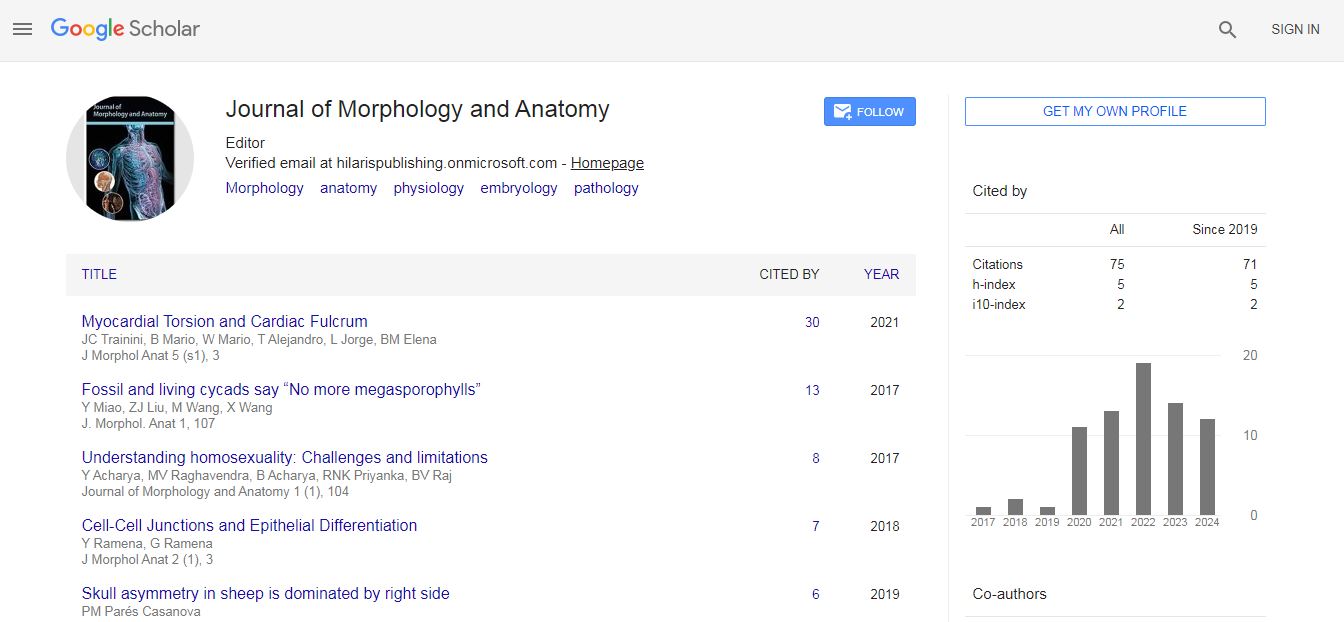
Journal of Morphology and Anatomy received 63 citations as per Google Scholar report