Commentary - (2025) Volume 10, Issue 2
Received: 01-Apr-2025, Manuscript No. arwm-26-182702;
Editor assigned: 03-Apr-2025, Pre QC No. P-182702;
Reviewed: 17-Apr-2025, QC No. Q-182702;
Revised: 22-Apr-2025, Manuscript No. R-182702;
Published:
29-Apr-2025
Citation: Sharma, Priya K.. ”Circular Economy: Sustainable Waste Management Across Sectors.” Advances in Recycling & Waste Management 10 (2025):392.
Copyright: © 2025 Sharma K. Priya This is an open-access article distributed under the terms of the Creative Commons Attribution License, which permits unrestricted use, distribution and reproduction in any medium, provided the original author and source are credited.
The global imperative for sustainable waste management has increasingly highlighted the transformative potential of circular economy principles. This approach fundamentally re-envisions resource utilization by moving away from a linear 'take-make-dispose' paradigm towards systems that prioritize resource efficiency, waste minimization, and the regeneration of natural capital. Strategies such as designing products for longevity and recyclability, coupled with the establishment of robust reverse logistics networks, are central to this transition [1].
The plastics industry, a significant contributor to global waste challenges, is actively exploring circular economy models. Innovations in advanced recycling, the development of bio-based and biodegradable alternatives, and product redesign for easier disassembly and reuse are key areas of focus. Furthermore, policy interventions and shifts in consumer behavior are recognized as crucial enablers for a more sustainable plastic lifecycle [2].
Electronic waste (e-waste), with its complex material composition and growing volume, presents unique challenges and opportunities for circular economy approaches. The exploration of innovative business models, including product-as-a-service and remanufacturing, alongside enhanced material recovery from intricate electronic components, is vital. Strengthening collection systems and implementing extended producer responsibility are advocated for improved e-waste circularity [3].
Industrial symbiosis, a cornerstone strategy within the circular economy, facilitates sustainable waste management by enabling industries to utilize each other's waste or by-products as valuable resources. This creates closed-loop systems that drive environmental and economic advantages, promoting regional waste reduction and optimizing resource utilization [4].
Product design plays a pivotal role in fostering circularity and reducing waste. Incorporating principles of durability, repairability, modularity, and recyclability into the design phase can significantly extend product lifespans and improve end-of-life material recovery. Life cycle assessment and eco-design tools are instrumental in guiding this transition towards sustainable product development [5].
Digital technologies, including the Internet of Things (IoT) and blockchain, are emerging as critical enablers for circular economy waste management. These technologies enhance waste tracking, supply chain transparency, material traceability, and overall resource management, proving essential for the efficient implementation and scaling of circular economy models [6].
Effective policy frameworks and regulatory instruments are indispensable for driving the transition to a circular economy in waste management. Tools such as landfill taxes, extended producer responsibility schemes, and green public procurement can incentivize waste reduction and resource recovery, necessitating integrated policy approaches to accelerate circularity [7].
Urban mining represents a promising circular economy strategy for recovering valuable materials from urban environments, including discarded products, buildings, and landfills. This approach addresses the technical, economic, and environmental aspects of extracting resources from urban waste streams, contributing to more sustainable resource management [8].
Consumer behavior and education are fundamental to the success of a circular economy in waste management. Consumer awareness, purchasing decisions, and active participation in recycling and reuse programs drive demand for circular products and services, underscoring the importance of targeted educational campaigns and incentives for consumer engagement [9].
Construction and demolition waste (CDW) presents significant challenges and opportunities for circular economy implementation. Strategies focusing on source reduction, material reuse, and advanced recycling techniques, coupled with stakeholder collaboration, are crucial for enhancing CDW circularity and minimizing its environmental impact [10].
The current study addresses the pivotal role of circular economy principles in achieving sustainable waste management, moving beyond traditional linear models. It highlights innovative strategies such as designing products for enhanced durability and recyclability, developing efficient reverse logistics, and integrating advanced technologies for material recovery. The core objective is to shift societal and industrial practices from a 'take-make-dispose' mentality to one that emphasizes resource efficiency, waste reduction, and ecological regeneration, thereby minimizing environmental impact and fostering new economic opportunities [1].
Research into the plastics industry's engagement with circular economy models reveals a multifaceted approach to tackling its substantial waste contribution. This includes the deployment of advanced recycling techniques, the exploration and adoption of bio-based and biodegradable alternatives, and the redesign of plastic products to facilitate easier disassembly and material reuse. The study underscores the necessity of supportive policy frameworks and significant shifts in consumer behavior to foster a more sustainable lifecycle for plastics [2].
Investigating the economic viability and environmental benefits of circular economy approaches for electronic waste (e-waste) involves a deep dive into novel business models. Concepts like product-as-a-service and remanufacturing are examined, alongside the challenges and potential rewards of recovering valuable materials from complex electronic components. The research strongly advocates for improvements in collection infrastructure and the robust implementation of extended producer responsibility to bolster e-waste circularity [3].
The application of industrial symbiosis as a key circular economy strategy for sustainable waste management is analyzed. This approach centers on the synergistic utilization of waste or by-products from one industrial sector as resources for another, thereby establishing closed-loop systems. Case studies presented in the paper demonstrate the significant environmental and economic advantages of industrial symbiosis, highlighting its capacity for regional waste reduction and optimized resource utilization [4].
Product design strategies are critically evaluated for their effectiveness in promoting circularity and minimizing waste generation. The research examines how embedding principles of durability, repairability, modularity, and recyclability into product design can substantially extend product lifespans and facilitate effective end-of-life material recovery. The authors also emphasize the importance of employing life cycle assessment and eco-design tools to support the systemic transition towards a circular economy [5].
The study investigates the integral role of digital technologies, specifically the Internet of Things (IoT) and blockchain, in enabling and enhancing circular economy practices for waste management. It details how these technologies can improve the tracking of waste, increase transparency within supply chains, enable precise material traceability, and optimize overall resource management. The research posits that digital solutions are indispensable for the efficient and scalable implementation of circular economy models [6].
An examination of policy frameworks and regulatory instruments deemed necessary for driving the transition towards a circular economy in waste management is presented. The research analyzes the efficacy of various policy tools, including landfill taxes, extended producer responsibility schemes, and green public procurement, in encouraging waste reduction and promoting resource recovery. The authors stress the critical need for coordinated and integrated policy approaches to accelerate the adoption of circularity principles [7].
The concept of urban mining is explored as a circular economy approach aimed at recovering valuable materials from urban waste streams and existing infrastructure. This includes the potential for extracting metals, minerals, and other resources from discarded products, buildings, and accumulated waste in landfills. The article discusses the multifaceted technical, economic, and environmental challenges and opportunities inherent in urban mining for sustainable resource management [8].
The focus on consumer behavior and education as drivers for a circular economy in waste management is investigated. The study examines how consumer awareness, their purchasing decisions, and their engagement in recycling and reuse programs collectively influence the demand for circular products and services. The research suggests that targeted educational initiatives and appropriate incentives are crucial for effectively engaging consumers in adopting circular economy practices [9].
This article addresses the challenges and opportunities associated with implementing circular economy principles for construction and demolition waste (CDW). It explores strategies for waste reduction at the source, the reuse of materials, and the application of advanced recycling techniques specifically for CDW. The study emphasizes the critical importance of fostering collaboration among all stakeholders, including policymakers, industry representatives, and researchers, to advance CDW circularity and reduce its significant environmental footprint [10].
This collection of research explores the multifaceted application of circular economy principles across various sectors to achieve sustainable waste management. Key strategies include product design for longevity and recyclability, robust reverse logistics, and the integration of advanced technologies for material recovery, moving away from linear 'take-make-dispose' models. Specific focus areas include the plastics industry, with advancements in recycling and bio-based alternatives, and electronic waste, through innovative business models and improved collection systems. Industrial symbiosis, where waste from one industry becomes a resource for another, is highlighted as a significant strategy. The role of digital technologies like IoT and blockchain in tracking and optimizing resources, alongside essential policy frameworks and consumer engagement, are emphasized as crucial enablers for widespread circularity. Furthermore, the potential of urban mining for resource recovery and the specific challenges and strategies for construction and demolition waste management are discussed, all contributing to a more resource-efficient and environmentally sound future.
None
None
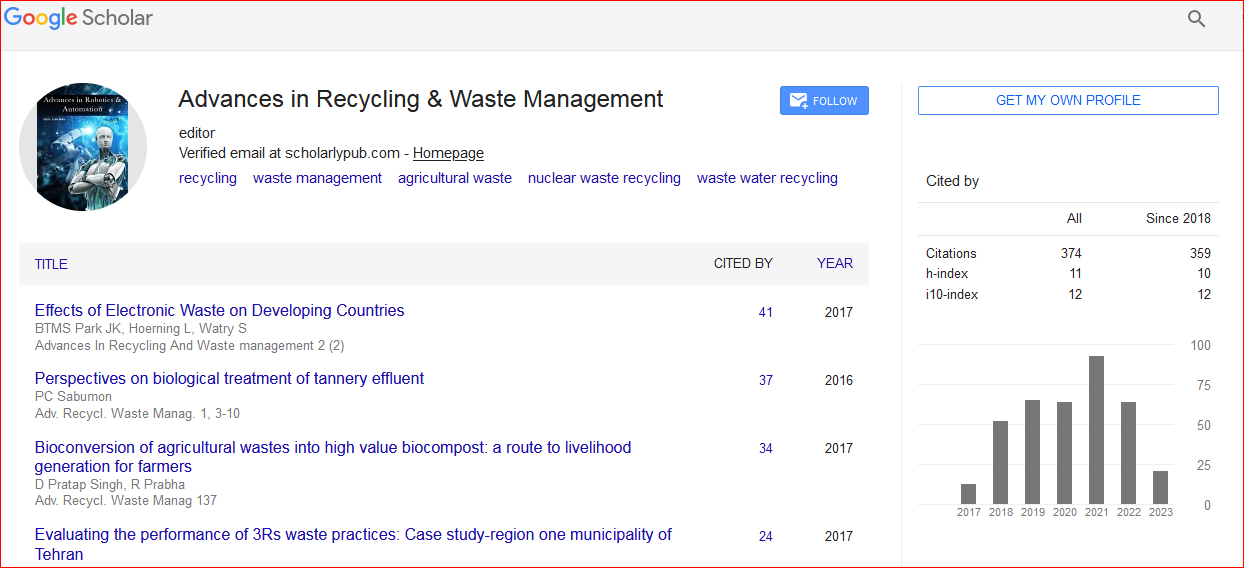
Advances in Recycling & Waste Management received 438 citations as per Google Scholar report