Short Communication - (2025) Volume 14, Issue 5
Received: 02-Oct-2025, Manuscript No. jsp-26-182282;
Editor assigned: 06-Oct-2025, Pre QC No. P-182282;
Reviewed: 20-Oct-2025, QC No. Q-182282;
Revised: 23-Oct-2025, Manuscript No. R-182282;
Published:
30-Oct-2025
, DOI: 10.37421/2165-7939.2025.14.749
Citation: Kowalski, Daniel R.. ”Robotics And AR Revolutionize Spine Surgery Outcomes.” J Spine 14 (2025):749.
Copyright: © 2025 Kowalski R. Daniel This is an open-access article distributed under the terms of the Creative Commons Attribution License, which permits unrestricted use, distribution and reproduction in any medium, provided the original author and source are credited.
The field of spinal surgery has been profoundly reshaped by the integration of advanced navigation systems and robotic technologies, ushering in an era of enhanced precision and improved patient outcomes [1].
These innovations are not merely incremental upgrades but represent a paradigm shift in how complex spinal procedures are planned and executed, aiming to minimize invasiveness and accelerate recovery [1].
Image-guided navigation has emerged as a crucial tool, offering surgeons enhanced visualization and accuracy, particularly in intricate reconstructive surgeries [2].
The ability to precisely track instruments in relation to patient anatomy in real-time has significantly reduced the margin for error and has also contributed to lowering radiation exposure for both patients and surgical teams [2].
Robotic technology has further augmented the capabilities within spinal surgery, especially for minimally invasive approaches [3].
The inherent advantages of robotic systems, such as instrument stabilization and precise trajectory control, directly translate to improved accuracy in procedures like pedicle screw placement, a critical component in spinal fusion [3].
A significant area of research has focused on the accuracy of robotic navigation for pedicle screw placement, with multiple studies demonstrating its superiority over traditional freehand techniques [4].
This improved accuracy is directly linked to a reduced rate of misplaced screws, thereby enhancing the safety and efficacy of spinal fusion operations [4].
Augmented reality (AR) represents another frontier in surgical guidance, with its integration into navigation systems offering a unique overlay of real-time imaging data onto the surgeon's view of the surgical field [5].
This visual enhancement is proving invaluable for surgical planning and execution, especially in challenging cases and revisions [5].
The impact of robotic assistance extends to patient-reported outcomes and overall complication rates [6].
Studies comparing robotic-assisted procedures to conventional methods have indicated benefits such as shorter hospital stays and fewer complications, without negatively impacting patient satisfaction or functional recovery [6].
The evolution of surgical navigation in spine surgery showcases a remarkable progression, moving from basic fluoroscopy to sophisticated 3D intraoperative imaging and robotics [7].
These advancements collectively facilitate minimally invasive techniques, improve anatomical understanding, and ultimately elevate the standard of patient care [7].
Robotic assistance has demonstrated particular utility in complex scenarios, such as spinal deformity correction [8].
Case series highlight improved accuracy in screw placement and reduced operative times, leading to better surgical results and a decrease in intraoperative complications, underscoring its value in challenging reconstructions [8].
Beyond the technical aspects, the adoption of robotic navigation necessitates an understanding of the surgeon's learning curve [9].
Research in this area confirms that with appropriate training and sufficient experience, surgeons can achieve high levels of proficiency, emphasizing the importance of structured educational programs for successful implementation [9].
The ongoing development in robotic surgery for spinal applications is expansive, with emerging technologies poised to further refine its capabilities [10].
The integration of artificial intelligence, machine learning, and haptic feedback promises to enhance both the functionality and the scope of robotic systems in spine surgery, pointing towards a future of even more advanced interventions [10].
The transformative impact of advanced navigation and robotic systems on spine surgery is a subject of extensive research, highlighting their role in enhancing precision and improving surgical outcomes [1].
These technologies facilitate less invasive procedures and promote faster patient recovery by integrating intraoperative imaging, augmented reality, and robotic assistance for critical tasks like pedicle screw placement [1].
Image-guided navigation systems have become indispensable in spinal surgery, offering significant improvements in accuracy and reducing radiation exposure, especially during complex reconstructive procedures [2].
The synergy between navigation and robotics is expected to lead to further workflow enhancements and increased patient safety in the future [2].
Robotic technology is increasingly utilized in minimally invasive spine surgery, providing surgeons with enhanced visualization, improved instrument stability, and precise trajectory control [3].
These benefits contribute to greater accuracy in screw placement and a reduction in operative time, although considerations regarding the learning curve and cost-effectiveness remain pertinent [3].
The accuracy of robotic navigation for pedicle screw placement in spinal fusion surgery has been rigorously evaluated, with meta-analyses confirming high precision and a lower incidence of misplaced screws compared to conventional freehand techniques [4].
This underscores the potential of robotic systems to elevate the safety and effectiveness of spinal fusion procedures [4].
Augmented reality (AR) is being integrated with navigation systems to overlay real-time imaging data directly onto the surgical field, providing surgeons with superior visual guidance [5].
This technology holds promise for refining surgical planning and execution, particularly in complex and revision spinal surgeries where precise anatomical understanding is paramount [5].
Patient-reported outcomes and complication rates are key metrics in assessing the efficacy of robotic-assisted spinal fusion [6].
Studies indicate that robotic assistance is associated with benefits such as reduced hospital stays and fewer complications, while maintaining high levels of patient satisfaction and functional recovery [6].
The evolution of navigation in spine surgery reflects a continuous drive towards more sophisticated tools, from early fluoroscopy to advanced 3D imaging and robotic platforms [7].
These advancements collectively enable less invasive approaches, enhance anatomical visualization, and improve surgical accuracy, leading to better patient care outcomes [7].
Robotic assistance has proven particularly valuable in complex spinal deformity correction cases [8].
Reports from case series demonstrate enhanced accuracy in screw placement and decreased operative times, contributing to improved surgical results and a reduction in intraoperative complications, showcasing its utility in intricate spinal reconstructions [8].
Understanding the learning curve associated with robotic navigation in spine surgery is crucial for its widespread adoption [9].
Research indicates that with structured training programs and accumulated experience, surgeons can achieve high levels of accuracy and efficiency with these systems [9].
Future directions in robotic surgery for spinal applications involve the integration of emerging technologies such as artificial intelligence, machine learning, and haptic feedback [10].
These advancements are anticipated to further expand the capabilities and applications of robotic systems in spine surgery, promising even more sophisticated interventions [10].
Advanced navigation and robotic systems are revolutionizing spine surgery, enhancing precision, improving outcomes, and reducing complications through technologies like intraoperative imaging, augmented reality, and robotic assistance. These systems, particularly for pedicle screw placement in spinal fusion, demonstrate superior accuracy compared to traditional methods, leading to safer and more effective procedures. Robotic assistance is associated with shorter hospital stays and fewer complications, while augmented reality provides enhanced visual guidance for complex surgeries. The evolution of these technologies, coupled with ongoing research into artificial intelligence and machine learning, points towards a future of even more advanced and minimally invasive spinal interventions. Understanding and addressing the surgeon's learning curve through structured training is essential for successful implementation.
None
None
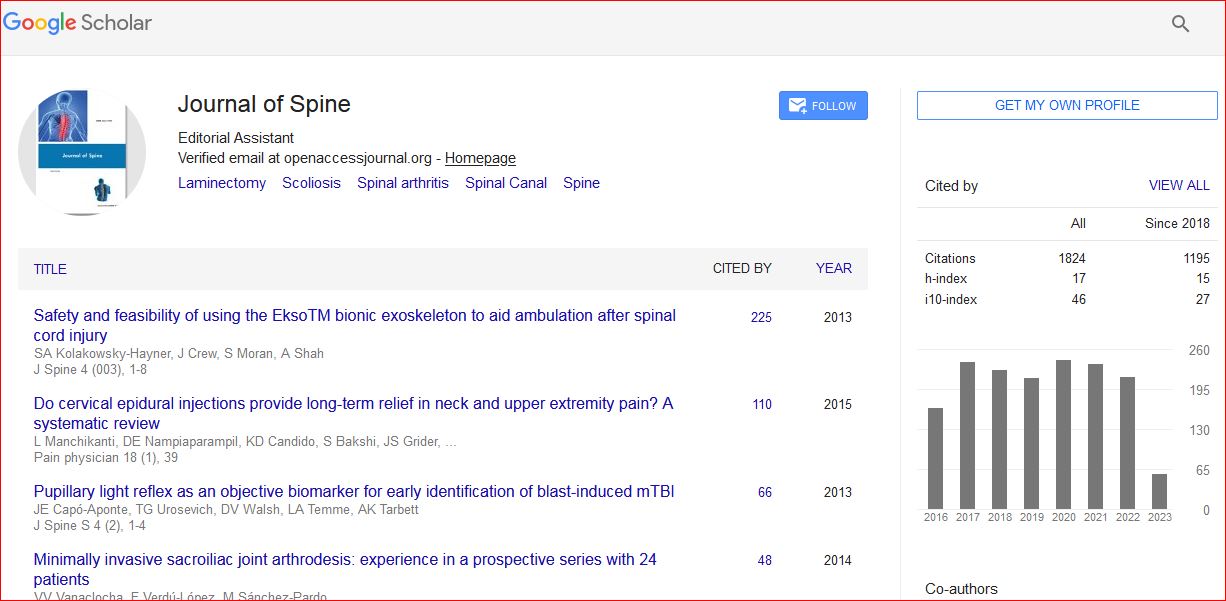
Journal of Spine received 2022 citations as per Google Scholar report