Perspective - (2024) Volume 7, Issue 3
Received: 20-Jul-2024, Manuscript No. POLLUTION-24-142603;
Editor assigned: 23-Jul-2024, Pre QC No. POLLUTION-24-142603 (PQ);
Reviewed: 06-Aug-2024, QC No. POLLUTION-24-142603;
Revised: 14-Apr-2025, Manuscript No. POLLUTION-24-142603 (R);
Published:
21-Apr-2025
, DOI: 10.37421/2684-4958.2025.8.377
Citation: Elaziz, Tarig. "Removal of Various Pharmaceutical Pollutants Using Carbon Nanoparticles Driven by a Brief Ball-Milling Procedure." J Pollution 08 (2025): 377.
Copyright: ÃÂé 2025 Elaziz T. This is an open-access article distributed under the terms of the creative commons attribution license which permits unrestricted use, distribution and reproduction in any medium, provided the original author and source are credited.
Pharmaceutical pollutants, including antibiotics, analgesics, hormones and other drugs, have emerged as significant environmental contaminants. These compounds can enter water bodies through various pathways such as pharmaceutical manufacturing, hospital waste and improper disposal of medications. Conventional water treatment methods often fall short of completely removing these pollutants, leading to their accumulation in the environment and posing risks to human health and aquatic ecosystems.
Pharmaceutical pollutants • Pathways • Water treatment • Human health
Nanotechnology offers promising solutions for the efficient removal of pharmaceutical contaminants, with Carbon Nanoparticles (CNPs) being particularly effective due to their high surface area, adsorptive capacity and reactivity. This article explores the removal of pharmaceutical pollutants using carbon nanoparticles synthesized through a brief ball-milling procedure.
Overview of pharmaceutical pollutants
Pharmaceutical pollutants are a diverse group of chemicals used for medical purposes, including antibiotics, painkillers, hormones and antidepressants. These compounds are designed to be biologically active, making their persistence in the environment particularly concerning. They can disrupt endocrine systems, promote antibiotic resistance and harm aquatic organisms.
Common pharmaceutical pollutants
Antibiotics: Ciprofloxacin, tetracycline, and sulfamethoxazole.
Analgesics: Ibuprofen, acetaminophen and diclofenac.
Hormones: Estradiol and ethinylestradiol.
Antidepressants: Fluoxetine and sertraline.
These pollutants can be detected in surface water, groundwater and even drinking water, necessitating effective removal strategies.
Carbon nanoparticles: Characteristics and applications
Carbon nanoparticles (CNPs) are a versatile class of nanomaterials with unique properties such as high surface area, tunable surface chemistry and excellent adsorption capabilities. These properties make them suitable for environmental remediation applications, including the removal of pharmaceutical pollutants from water.
Types of carbon nanoparticles
Carbon Nanotubes (CNTs): Cylindrical nanostructures with high mechanical strength and electrical conductivity.
Graphene and Graphene Oxide (GO): Single or few-layer carbon sheets with large surface areas and functional groups that enhance adsorption.
Fullerenes: Spherical carbon molecules with unique electronic properties.
Activated carbon nanoparticles: Highly porous carbon particles with extensive surface areas for adsorption.
Ball-milling procedure for synthesizing carbon nanoparticles
Ball milling is a mechanical process that involves grinding materials into fine powders using rotating balls in a milling jar. This technique can produce carbon nanoparticles from bulk carbon materials through shear forces and impact energy.
Brief ball-milling procedure
Material preparation: Bulk carbon sources such as graphite, carbon black or activated carbon are selected as starting materials.
Ball-milling setup: The carbon material is placed in a ball mill along with grinding media (usually stainless steel or ceramic balls).
Milling process: The ball mill is operated at a specific speed for a brief duration (typically 1-2 hours), causing the carbon material to break down into nanoparticles.
Post-milling treatment: The resulting carbon nanoparticles are collected and subjected to further treatments if necessary, such as surface functionalization or purification.
The brief ball-milling procedure is advantageous due to its simplicity, cost-effectiveness and scalability.
Mechanisms of pharmaceutical pollutant removal
The removal of pharmaceutical pollutants using carbon nanoparticles involves several mechanisms, primarily adsorption and degradation.
Adsorption mechanisms
Physical adsorption: Pharmaceutical molecules are adsorbed onto the surface of CNPs through Van der Waals forces and π-π interactions.
Chemical adsorption: Functional groups on the surface of CNPs interact with pharmaceutical molecules through hydrogen bonding, electrostatic interactions and covalent bonding.
Degradation mechanisms
Photocatalytic degradation: Carbon nanoparticles can act as photocatalysts, generating Reactive Oxygen Species (ROS) under light irradiation that degrade pharmaceutical pollutants.
Electrochemical degradation: CNPs can facilitate redox reactions, leading to the breakdown of pharmaceutical molecules.
Experimental studies on pharmaceutical pollutant removal
Several studies have demonstrated the effectiveness of carbon nanoparticles in removing pharmaceutical pollutants from water. Key findings from these studies are summarized below.
Removal of antibiotics
Ciprofloxacin removal: Graphene Oxide (GO) nanoparticles synthesized via ball milling have shown high adsorption capacities for ciprofloxacin, with removal efficiencies exceeding 90%. The adsorption process was found to be influenced by pH, with maximum removal at neutral pH levels.
Tetracycline removal: Multi-Walled Carbon Nanotubes (MWCNTs) produced by ball milling exhibited strong adsorption of tetracycline, attributed to π-π interactions and hydrogen bonding. The presence of surface oxygen-containing functional groups enhanced adsorption capacity.
Removal of analgesics
Ibuprofen removal: Activated carbon nanoparticles derived from ball milling demonstrated efficient removal of ibuprofen from aqueous solutions. The adsorption kinetics followed a pseudo-second-order model, indicating chemisorption as the primary mechanism.
Diclofenac removal: Fullerenes synthesized by ball milling showed high affinity for diclofenac, with adsorption driven by hydrophobic interactions and electrostatic attractions. The adsorption isotherms fitted well with the Langmuir model, suggesting monolayer adsorption on a homogeneous surface.
Removal of hormones
Estradiol removal: Graphene-based nanoparticles produced via ball milling exhibited excellent removal of estradiol, with adsorption efficiencies up to 95%. The presence of functional groups on the graphene surface facilitated hydrogen bonding and π-π interactions with estradiol molecules.
Ethinylestradiol removal: Carbon nanotubes synthesized by ball milling were effective in adsorbing ethinylestradiol from water. The adsorption capacity was influenced by the surface area and pore structure of the CNTs, with higher surface areas leading to greater adsorption.
Removal of antidepressants
Fluoxetine removal: Ball-milled graphene oxide nanoparticles showed high adsorption capacity for fluoxetine, driven by electrostatic interactions and π-π stacking. The adsorption process was found to be endothermic, with higher temperatures enhancing adsorption.
Sertraline removal: Carbon black nanoparticles produced by ball milling demonstrated efficient removal of sertraline from aqueous solutions. The adsorption kinetics followed a pseudo-first-order model, indicating physisorption as the dominant mechanism.
Using carbon nanoparticles synthesized by ball milling for the removal of pharmaceutical pollutants offers several advantages but also presents certain challenges.
Advantages
High efficiency: Carbon nanoparticles have high surface areas and adsorptive capacities, leading to efficient removal of pharmaceutical pollutants.
Scalability: The ball-milling procedure is simple, cost-effective and scalable, making it suitable for large-scale production of carbon nanoparticles.
Versatility: Carbon nanoparticles can remove a wide range of pharmaceutical pollutants through various adsorption and degradation mechanisms.
Environmental friendliness: The use of carbon-based nanomaterials for pollutant removal is environmentally friendly, reducing the reliance on chemical treatments.
Challenges
Aggregation: Carbon nanoparticles tend to aggregate, reducing their effective surface area and adsorption capacity. Dispersing agents or surface functionalization may be required to prevent aggregation.
Regeneration: Regenerating spent carbon nanoparticles for reuse can be challenging. Techniques such as thermal desorption, chemical washing and photocatalytic regeneration are being explored.
Selectivity: Achieving selective removal of specific pharmaceutical pollutants can be difficult due to the diverse chemical structures of these compounds. Functionalizing the surface of carbon nanoparticles can enhance selectivity.
Environmental impact: The potential environmental impact of carbon nanoparticles, including their toxicity and persistence in the environment, needs to be thoroughly assessed.
The use of carbon nanoparticles synthesized through a brief ballmilling procedure holds great promise for the removal of pharmaceutical pollutants from water. Future research should focus on optimizing the synthesis and functionalization of carbon nanoparticles to enhance their adsorptive capacities and selectivity. Additionally, developing efficient regeneration methods and assessing the environmental impact of these nanomaterials are crucial for their sustainable application.
Innovative approaches, such as combining carbon nanoparticles with other nanomaterials or integrating them into advanced water treatment systems, can further improve the removal of pharmaceutical pollutants. By addressing the challenges and exploring new avenues, carbon nanoparticles can play a vital role in mitigating the environmental impact of pharmaceutical pollutants and protecting water quality.
In conclusion, the removal of pharmaceutical pollutants using carbon nanoparticles driven by a brief ball-milling procedure is a promising and sustainable approach. With continued research and development, this technology can significantly contribute to environmental remediation and public health protection.
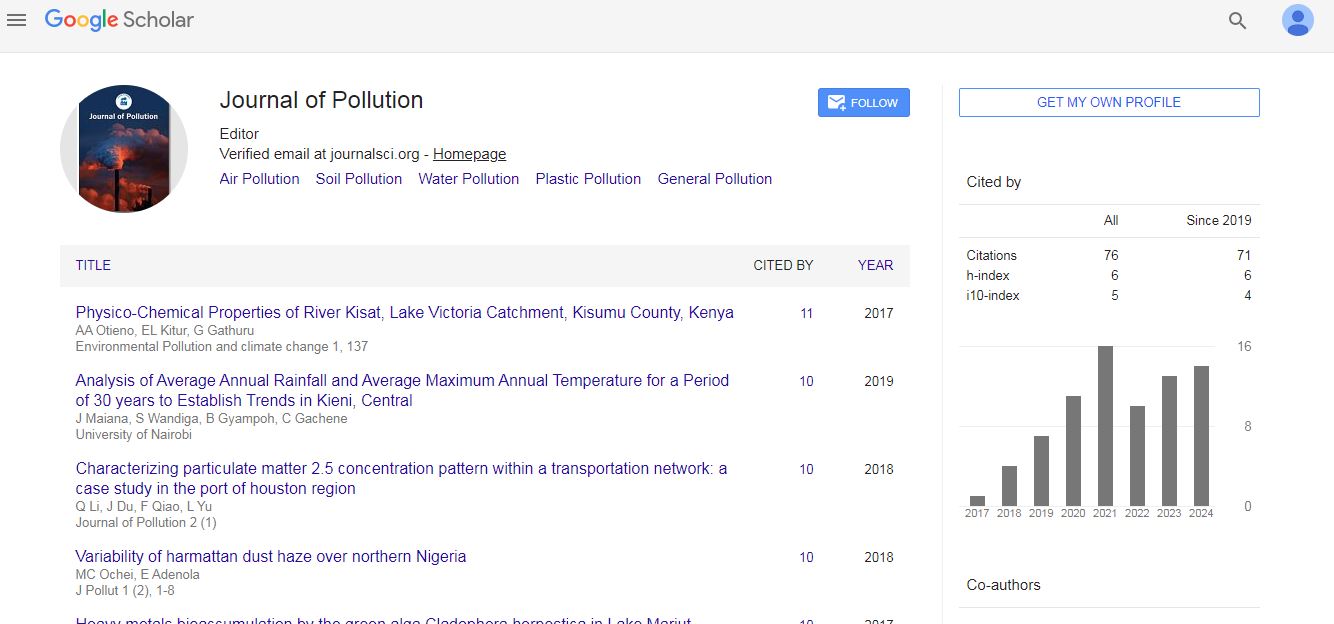
Journal of Pollution received 64 citations as per Google Scholar report