Short Communication - (2025) Volume 11, Issue 5
Received: 02-Sep-2025, Manuscript No. ldt-25-178456;
Editor assigned: 04-Sep-2025, Pre QC No. P-178456;
Reviewed: 18-Sep-2025, QC No. Q-178456;
Revised: 23-Sep-2025, Manuscript No. R-178456;
Published:
30-Sep-2025
, DOI: 10.37421/2472-1018.2025.11.330
Citation: Müller, Anna. ”Rare Lung Diseases: Multidisciplinary Care, Precision, and Hope.” J Lung Dis Treat 11 (2025):330.
Copyright: © 2025 Müller A. This is an open-access article distributed under the terms of the Creative Commons Attribution License, which permits unrestricted use, distribution and reproduction in any medium, provided the original author and source are credited.
The effective management of rare lung diseases is a complex undertaking that necessitates a comprehensive and integrated approach. This involves a multidisciplinary team working collaboratively to address the multifaceted needs of patients, from initial diagnosis through long-term care and support. Early and accurate diagnosis is the cornerstone of effective management, enabling the timely implementation of tailored treatment strategies and the provision of essential supportive care to improve patient outcomes and quality of life. Genetic advancements have profoundly transformed our understanding and therapeutic capabilities for inherited rare lung disorders. The advent of gene sequencing and molecular profiling technologies allows for precise phenotyping of these conditions. This detailed understanding guides the development and application of targeted therapies, offering new avenues of hope for patients afflicted with diseases that were once considered untreatable, thereby ushering in an era of precision medicine in pulmonology. Pulmonary rehabilitation emerges as a critical component in the comprehensive management of individuals living with rare chronic lung diseases. Through carefully designed and individualized exercise programs, coupled with patient education and robust psychological support, individuals can better cope with debilitating symptoms such as breathlessness and functional limitations. This holistic approach significantly enhances their capacity for daily living and overall well-being. The therapeutic landscape for pulmonary fibrosis is undergoing rapid evolution, characterized by the emergence of novel therapies specifically designed to target key fibrotic pathways. Antifibrotic agents and ongoing drug development efforts are demonstrating considerable promise in not only slowing disease progression but also in demonstrably improving patient outcomes in debilitating conditions like idiopathic pulmonary fibrosis and hypersensitivity pneumonitis. Significant advancements have been made in the management of idiopathic pulmonary arterial hypertension (IPAH), primarily driven by the introduction of new drug classes and sophisticated combination therapeutic regimens. A tailored, stepwise treatment strategy, meticulously considering individual patient-specific factors and their responses to therapy, is paramount for optimizing hemodynamic parameters and ultimately enhancing survival rates. The management of rare pediatric lung diseases presents a unique set of challenges that demand specialized expertise and a highly collaborative approach. Close cooperation between pediatric pulmonologists, geneticists, and other relevant specialists is essential for addressing the complexities of these conditions. Early diagnosis and prompt intervention are critically important for optimizing long-term outcomes in conditions such as congenital alveolar dysplasia and primary ciliary dyskinesia. Lung transplantation continues to represent a critical therapeutic option for patients with end-stage rare lung diseases for whom other treatment modalities have proven ineffective. Continuous improvements in surgical techniques, the refinement of immunosuppression protocols, and enhanced perioperative care have collectively contributed to improved survival rates and a better quality of life for individuals who undergo lung transplantation. Specific rare forms of interstitial lung disease, including lymphangioleiomyomatosis (LAM) and sarcoidosis, necessitate highly specialized diagnostic and therapeutic strategies. Sirolimus has gained prominence as a key therapeutic agent for LAM, while the management of sarcoidosis primarily relies on supportive care strategies guided by the specific activity and manifestation of the disease in each patient. Patient registries and meticulous natural history studies are indispensable tools for gaining a deeper understanding of the epidemiology, disease progression patterns, and the true effectiveness of various treatments for rare lung diseases. These vital data resources play a crucial role in informing the design of clinical trials and advocating for policy changes that directly benefit individuals affected by these rare conditions. The psychological burden associated with living with a rare lung disease is substantial, impacting not only the patients themselves but also their families. Comprehensive psychosocial support, encompassing counseling services and facilitated patient support groups, forms an integral part of holistic disease management, effectively addressing issues such as anxiety, depression, and the inherent challenges of navigating chronic illness.
Effective management of rare lung diseases hinges on a multidisciplinary strategy that integrates early diagnosis, personalized treatment plans, and robust supportive care. Advanced diagnostic tools and genetic counseling are indispensable for pinpointing specific rare conditions. Therapeutic interventions frequently combine pharmacological treatments, pulmonary rehabilitation, and, in certain instances, lung transplantation. Continuous research into novel therapeutic targets and improved patient monitoring is essential for advancing clinical outcomes. Genetic breakthroughs are fundamentally reshaping the comprehension and treatment of inherited rare lung disorders. Gene sequencing and molecular profiling facilitate precise phenotyping, which in turn guides the application of targeted therapies for conditions such as cystic fibrosis and alpha-1 antitrypsin deficiency. This paradigm shift towards precision medicine offers renewed hope for patients suffering from previously untreatable diseases. Pulmonary rehabilitation plays a pivotal role in symptom management and enhancing the quality of life for individuals diagnosed with rare chronic lung diseases. Tailored exercise regimens, comprehensive educational programs, and vital psychological support assist patients in effectively managing breathlessness and functional limitations, thereby improving their daily living capacity. The treatment landscape for pulmonary fibrosis is rapidly evolving, with a focus on emerging therapies that target specific fibrotic pathways. Antifibrotic agents and ongoing novel drug development are showing significant promise in decelerating disease progression and improving patient outcomes in conditions like idiopathic pulmonary fibrosis and hypersensitivity pneumonitis. Management strategies for idiopathic pulmonary arterial hypertension (IPAH) have seen considerable progress with the introduction of new drug classes and combination therapies. A personalized, stepwise approach, carefully considering patient-specific factors and their response to treatment, is key to improving hemodynamics and overall survival. Rare pediatric lung diseases present unique clinical challenges, necessitating specialized expertise and a collaborative effort among pediatric pulmonologists, geneticists, and other relevant specialists. Early identification and intervention are paramount for optimizing long-term outcomes in conditions like congenital alveolar dysplasia and primary ciliary dyskinesia. Lung transplantation remains a critical treatment option for end-stage rare lung diseases when all other therapeutic avenues have been exhausted. Advances in surgical techniques, immunosuppression protocols, and perioperative care have collectively led to improved survival rates and enhanced quality of life for transplant recipients. Specialized diagnostic and therapeutic approaches are required for rare interstitial lung diseases such as lymphangioleiomyomatosis (LAM) and sarcoidosis. Sirolimus has emerged as a primary treatment for LAM, while sarcoidosis management is largely supportive and dictated by disease activity. Patient registries and natural history studies are invaluable for understanding the epidemiology, disease progression, and treatment efficacy of rare lung diseases. These data repositories are crucial for informing the design of clinical trials and advocating for policy changes that benefit affected individuals. The psychological impact of living with a rare lung disease is significant, affecting both patients and their families. Comprehensive psychosocial support, including counseling and patient support groups, is an essential component of holistic management, addressing anxiety, depression, and the inherent challenges of managing a chronic illness.
Effective management of rare lung diseases requires a multidisciplinary approach, integrating early diagnosis, personalized treatments, and supportive care. Genetic advancements are revolutionizing the understanding and treatment of inherited lung disorders through precision medicine. Pulmonary rehabilitation is vital for symptom management and improving quality of life in chronic rare lung diseases. Emerging therapies targeting fibrotic pathways show promise for pulmonary fibrosis, while new drug classes and combination therapies are improving outcomes for idiopathic pulmonary arterial hypertension. Rare pediatric lung diseases demand specialized expertise and early intervention. Lung transplantation remains a crucial option for end-stage disease, with improving survival rates. Specific rare interstitial lung diseases like LAM and sarcoidosis require tailored strategies. Patient registries and natural history studies are essential for research and advocacy. The psychological impact of these diseases necessitates comprehensive psychosocial support.
None
None
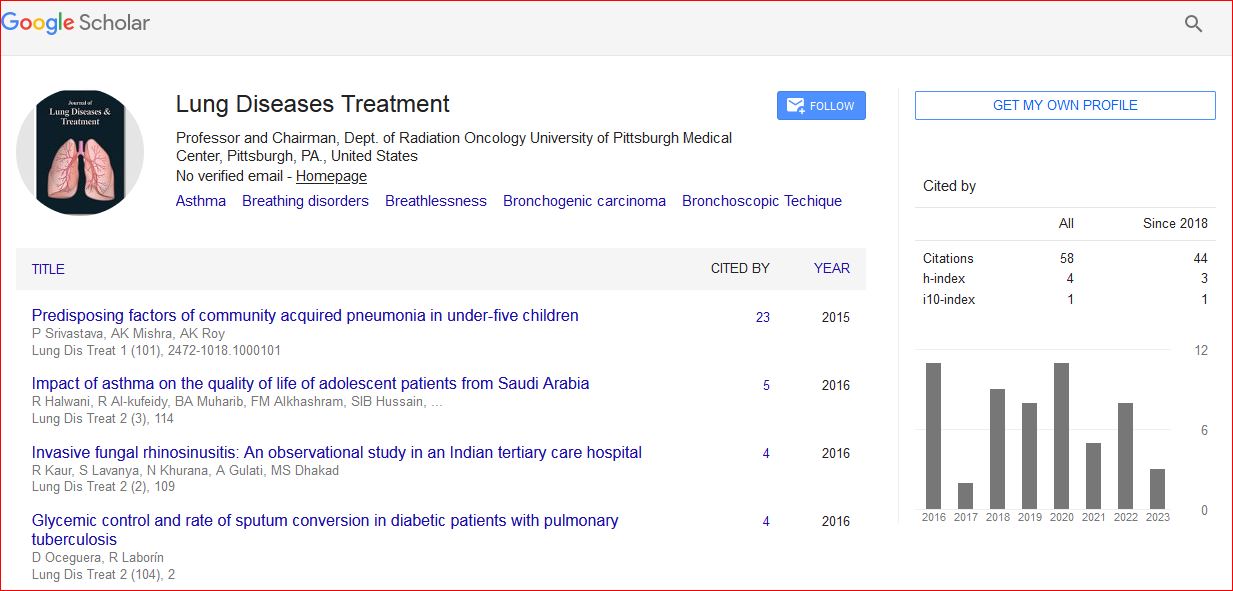
Journal of Lung Diseases & Treatment received 247 citations as per Google Scholar report