Short Communication - (2025) Volume 13, Issue 5
Received: 01-Oct-2025, Manuscript No. jcdd-25-177673;
Editor assigned: 03-Oct-2025, Pre QC No. P-177673;
Reviewed: 17-Oct-2025, QC No. Q-177673;
Revised: 22-Oct-2025, Manuscript No. R-177673;
Published:
29-Oct-2025
, DOI: 10.37421/2329-9517.2025.13.697
Citation: Morales, Pedro. ”Pulmonary Edema: Etiologies, Diagnosis,
Management.” J Cardiovasc Dis Diagn 13 (2025):697.
Copyright: © 2025 Morales P. This is an open-access article distributed under the terms of the Creative Commons Attribution License, which permits unrestricted use,
distribution and reproduction in any medium, provided the original author and source are credited.
Pulmonary edema is a critical medical emergency characterized by abnormal fluid accumulation in the lung interstitium and alveoli. Understanding its diverse etiologies, complex pathophysiology, and multifaceted management strategies is paramount for effective patient care. For example, acute cardiogenic pulmonary edema presents a significant challenge, demanding a detailed understanding of its complex pathophysiology, the nuances of its diagnostic challenges, and the application of current treatment strategies. Rapid diagnosis and immediate interventions are critical for managing fluid overload and improving cardiac function, emphasizing the essential role of timely pharmacological and non-pharmacological approaches to stabilize patients quickly [1].
A key diagnostic hurdle lies in distinguishing between acute respiratory distress syndrome (ARDS) and cardiogenic pulmonary edema (CPE), conditions that often present with strikingly similar clinical pictures. This distinction is crucial as their management pathways diverge significantly. Comprehensive reviews offer vital insights into the differential diagnostic criteria, encompassing clinical presentation, advanced imaging techniques, and precise hemodynamic parameters, all of which are indispensable for guiding appropriate and effective management strategies in critically ill patient populations [2].
In the context of acute heart failure accompanied by pulmonary edema, diuretic therapy plays a central role. Systematic reviews meticulously investigate the efficacy, optimal dosing strategies, and potential adverse effects of various diuretic agents. These reviews provide evidence-based recommendations, which are foundational for managing fluid overload, alleviating symptoms, and ultimately improving patient outcomes in this challenging clinical scenario [3].
Addressing cardiogenic pulmonary edema, specifically, requires a focused approach given its rapid onset and inherently life-threatening nature. A concise overview reveals key aspects of its diagnosis, intricate risk stratification, and the immediate management protocols necessary to stabilize affected patients and prevent further cardiac decompensation, underscoring the urgency of intervention [4].
However, pulmonary edema is not solely a cardiac issue. Neurogenic pulmonary edema, a severe and often under-recognized complication, can arise from acute neurological insults. A comprehensive review delves into the proposed mechanisms, typical clinical presentation, and critical diagnostic considerations, offering invaluable guidance for its timely recognition and effective management within the demanding critical care setting. This highlights the broad spectrum of underlying causes [5].
Similarly, the emergence of COVID-19 introduced novel challenges, with many patients developing pulmonary edema and ARDS. This particular manifestation is linked to unique pathological features associated with SARS-CoV-2 infection, prompting exploration of diverse treatment approaches specifically aimed at mitigating severe lung injury and enhancing respiratory function in these patients [6].
Environmental factors can also precipitate pulmonary edema, as seen with high-altitude climbing. This specific form of pulmonary edema warrants an exploration of its underlying pathophysiology, focusing intently on how a hypoxic environment impacts pulmonary vasculature and fluid dynamics. Crucially, articles detail prevention strategies designed for climbers, enabling them to mitigate the substantial risk posed by this serious and potentially fatal condition [7].
Furthermore, acute kidney injury (AKI) can significantly contribute to pulmonary edema. Research investigates the precise mechanisms by which renal dysfunction disrupts the bodyâ??s fluid balance, increases capillary permeability, and impairs solute clearance. All these factors collectively lead to fluid accumulation in the lungs, exacerbating the patient's respiratory status and overall clinical severity [8].
Given the varied etiologies, advanced diagnostic tools are indispensable. Echocardiography, for example, holds a crucial role in both the evaluation and subsequent management of acute pulmonary edema. It is highlighted how echocardiographic assessments can rapidly differentiate between cardiogenic and non-cardiogenic causes, effectively guide therapeutic interventions, and meticulously monitor treatment response. Such insights are essential for informed clinical decision-making, providing a clear roadmap for patient care [9].
Finally, a broad review of noncardiogenic pulmonary edema in critically ill patients explores various etiologies beyond cardiac dysfunction, including sepsis, acute respiratory distress syndrome, and aspiration. It discusses their distinct pathophysiological mechanisms and outlines appropriate, tailored management strategies for each, emphasizing the necessity of a comprehensive diagnostic workup to guide therapy effectively [10].
Pulmonary edema, a severe condition marked by fluid accumulation in the lungs, can stem from various underlying causes. Acute cardiogenic pulmonary edema (CPE) is a prominent form, characterized by its complex pathophysiology, significant diagnostic challenges, and a range of contemporary treatment strategies. Effective management hinges on rapid diagnosis and immediate interventions designed to manage fluid overload and enhance cardiac function. This often involves a critical combination of timely pharmacological and non-pharmacological approaches to ensure patient stabilization [1]. Further insights into cardiogenic pulmonary edema emphasize its rapid onset and life-threatening nature. Key aspects covered include precise diagnostic methods, robust risk stratification, and immediate management protocols crucial for stabilizing patients and preventing progressive cardiac decompensation [4].
Distinguishing between acute respiratory distress syndrome (ARDS) and cardiogenic pulmonary edema (CPE) is a frequent and critical diagnostic task, as both conditions often present with similar clinical manifestations. This differentiation is paramount for guiding appropriate and effective management, particularly in critically ill individuals. Crucial insights are derived from differential diagnostic criteria that encompass clinical presentation, advanced imaging studies, and comprehensive hemodynamic parameters [2]. Beyond cardiac etiologies, noncardiogenic pulmonary edema presents a complex array of causes in critically ill patients. This broader category includes conditions like sepsis, acute respiratory distress syndrome, and aspiration. A thorough understanding of their distinct pathophysiological mechanisms is essential for developing and implementing tailored management strategies [10]. Specific examples like neurogenic pulmonary edema, a severe complication following acute neurological insults, require precise identification of proposed mechanisms, clinical presentation, and diagnostic considerations to ensure timely recognition and effective critical care management [5].
The landscape of pulmonary edema extends to several specific scenarios and associated conditions. For instance, COVID-19 has been linked to pulmonary edema and ARDS, showcasing unique pathological features stemming from SARS-CoV-2 infection. Research explores various treatment approaches aimed at mitigating severe lung injury and improving respiratory function in affected patients [6]. Environmental factors also play a role, as seen with pulmonary edema induced by high-altitude climbing. This condition requires an understanding of its unique pathophysiology, focusing on how a hypoxic environment impacts pulmonary vasculature and fluid dynamics. Consequently, crucial prevention strategies are developed for climbers to significantly mitigate the risk of this serious condition [7]. Moreover, acute kidney injury (AKI) can profoundly influence pulmonary status. Studies investigating the mechanisms of pulmonary edema in AKI explain how renal dysfunction disrupts fluid balance, increases capillary permeability, and impairs solute clearance, all contributing to fluid accumulation in the lungs and worsening respiratory status [8].
Effective management of pulmonary edema heavily relies on both accurate diagnosis and strategic therapeutic interventions. Diuretics, for example, play a vital role in acute heart failure accompanied by pulmonary edema. A systematic review evaluates their efficacy, optimal dosing strategies, and potential adverse effects, providing evidence-based recommendations for managing fluid overload and enhancing patient outcomes [3]. In terms of diagnostic tools, echocardiography is invaluable in evaluating and managing acute pulmonary edema. It helps rapidly differentiate between cardiogenic and non-cardiogenic causes, guides subsequent therapeutic interventions, and allows for close monitoring of treatment response, providing essential insights for clinical decision-making [9]. These diagnostic and therapeutic approaches are fundamental in navigating the complexities of pulmonary edema, ensuring targeted and effective patient care across its diverse presentations.
Pulmonary edema represents a critical medical condition characterized by fluid accumulation in the lungs, stemming from diverse etiologies. Acute cardiogenic pulmonary edema, for instance, requires swift diagnosis and intervention to manage fluid overload and enhance cardiac function, using both pharmacological and non-pharmacological methods. Differentiating between cardiogenic and noncardiogenic forms, such as Acute Respiratory Distress Syndrome (ARDS), is vital given their often similar presentations. Key diagnostic criteria, including clinical factors, imaging, and hemodynamic parameters, are essential for guiding effective management in critically ill patients. The role of diuretics in acute heart failure with pulmonary edema is significant, with studies evaluating their efficacy, dosing, and potential adverse effects to offer evidence-based treatment recommendations. Beyond cardiac causes, other forms exist. Neurogenic pulmonary edema, a serious complication of acute neurological insults, demands prompt recognition and specific management strategies in intensive care settings. COVID-19 can also induce pulmonary edema and ARDS, presenting unique pathological features that necessitate tailored treatment approaches to mitigate lung injury. Further complicating the picture are conditions like high-altitude pulmonary edema, where a hypoxic environment impacts pulmonary vasculature and requires specific prevention tactics. Acute kidney injury can also lead to pulmonary edema by disrupting fluid balance and increasing capillary permeability. Echocardiography is a crucial tool for assessment, helping to rapidly distinguish between different causes of pulmonary edema, guide therapies, and monitor patient response. Overall, understanding the varied pathophysiological mechanisms, employing precise diagnostic techniques, and implementing tailored management strategies are paramount for improving outcomes across the spectrum of pulmonary edema conditions.
Indexed at, Google Scholar, Crossref
Indexed at, Google Scholar, Crossref
Indexed at, Google Scholar, Crossref
Indexed at, Google Scholar, Crossref
Indexed at, Google Scholar, Crossref
Indexed at, Google Scholar, Crossref
Indexed at, Google Scholar, Crossref
Indexed at, Google Scholar, Crossref
Indexed at, Google Scholar, Crossref
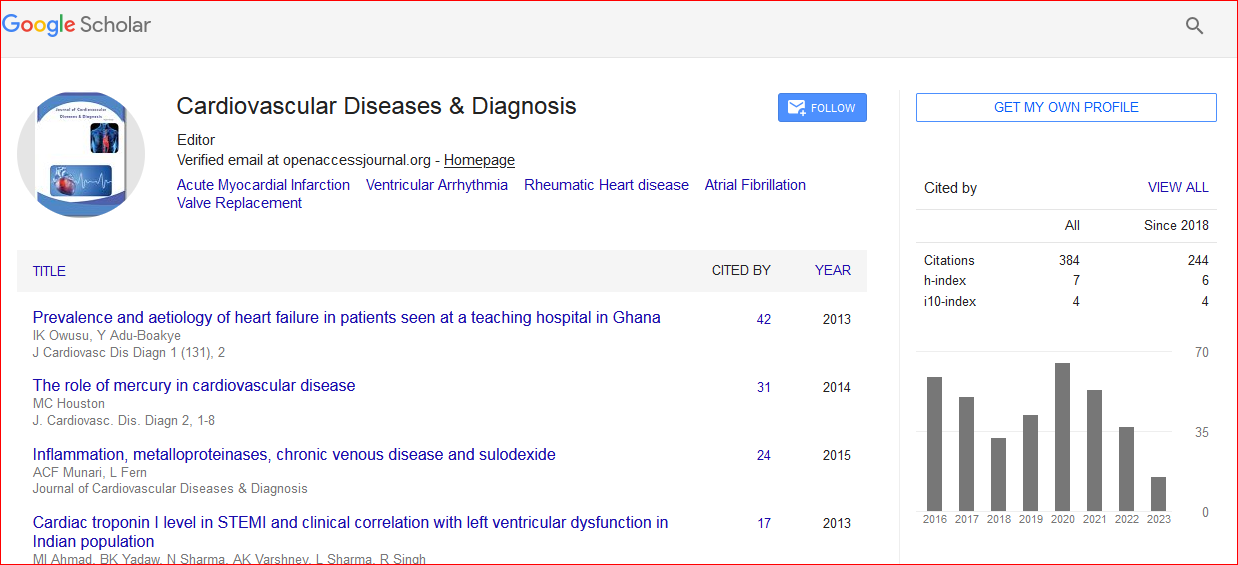
Cardiovascular Diseases & Diagnosis received 427 citations as per Google Scholar report