Case Series - (2026) Volume 15, Issue 3
Received: 15-May-2026, Manuscript No. jtm-26-189548;
Editor assigned: 18-May-2026, Pre QC No. P-189548;
Reviewed: 02-Jun-0205, QC No. Q-189548;
Revised: 09-Jun-2026, Manuscript No. R-189548;
Published:
16-Jun-2026
, DOI: DOI: 10.37421/ 2167-1222.2026.15.737
Citation: Pacôme, Yafoutané Djaba, Adoum Allamine Hassan, Beufoutcham Kachare Cephas and Atchoum Mandjo, et al. “Profile of Orthopaedic and Traumatological Surgical Procedures at a Referral Centre in Chad.” J Trauma Treat 15 (2026): 737.
Copyright: ©2026 Pacôme YD, et al. This is an open-access article distributed under the terms of the Creative Commons Attribution License, which permits unrestricted use, distribution and reproduction in any medium, provided the original author and source are credited.
Surgical Procedures • Orthopaedic and trauma • Osteosynthesis • Sub-saharan africa • Referral centre • Chad
Operating theatres, initially regarded as separate, scattered units under the jurisdiction of each surgical specialty, are now being consolidated and have become one of the main hubs of hospital activity [1]. They are among the most costly facilities within a hospital [2]. Orthopaedic and Trauma Surgery (OTS) is one of the most demanding and delicate specialities, due to the wide range of procedures and surgical indications on the one hand and the rapid evolution of surgical materials and techniques on the other [3]. Assessing these activities provides scientific evidence and enables their documentation, thereby improving the quality of service [4]. In Chad, very few studies have focused on assessing the profiles of surgical procedures in orthopaedics and traumatology, despite the importance of such studies in enabling the organisation of care to be adapted to local realities and in advocating for improvements to technical facilities. The aim of this study was to describe the profile of surgical procedures in orthopaedics and traumatology at the Renaissance University Hospital in N’Djamena, a centre of excellence in Chad.
Patients
The study included 407 patients who underwent surgery in the operating theatre of the Orthopaedic and Trauma Surgery Department at the Renaissance University Hospital in N’Djamena. The study included male and female patients of all ages who underwent surgery in the operating theatre during the study period, whether elective or emergency. The following excluded patients whose scheduled procedures were subsequently cancelled, patients who underwent minor surgical procedures in the A&E department or outpatient clinic and those whose medical records were incomplete.
Methods
This was a descriptive cross-sectional study involving retrospective data collection, conducted in the operating theatre of the Renaissance University Hospital in N’Djamena, covering 18 months of surgical activities in Orthopaedic and Trauma Surgery, from 1 April 2024 to 30 September 2025.
The Renaissance University Hospital operating theatre has five operating theatres, comprising one sterile theatre, two aseptic theatres and two hyper-aseptic theatres. The team of orthopaedic surgeons and traumatologists operates in a dedicated hyper-aseptic theatre equipped with a surgical monitor, reserved for clean surgery and in another so-called septic theatre, shared by surgical specialities and dedicated to dirty surgery.
Data were collected from surgical reports, recovery room records and medical records. The parameters assessed were epidemiological and, above all, surgical. Data were entered using Microsoft Office 2019 (Word and Excel) and processed and statistically analysed using Sphinx software (version 5.1.0.4).
During the study period, 407 patients underwent surgery in the Orthopaedic and Trauma Surgery theatre over an 18-month period, representing 22.6 cases per month. The 21–30 age group was the most common, accounting for 22.90% (n = 93) of cases, with ages ranging from 12 months to 98 years. A male predominance was observed, with 74.70% (n = 304) of cases and a sex ratio (male/female) of 2.95. Traumatic conditions were the most common, accounting for 91.17% (n = 371) of cases, followed by degenerative conditions in 3.93% (n = 16) and neoplastic conditions in 2.21% (n = 9) of cases (Table 1). With regard to traumatic conditions, Road Traffic Accidents (RTAs) and domestic accidents were the most common causes (Table 2), accounting for 68.80% (n = 280) and 8.84% (n = 36) respectively.
| Type of Condition | Staff Numbers | Percentage (%) |
|---|---|---|
| Traumatic pathology | 371 | 91,17 |
| Degenerative diseases | 16 | 3,93 |
| Tumour pathology | 9 | 2,21 |
| Infectious diseases | 5 | 1,22 |
| Others | 6 | 1,47 |
| Total | 407 | 100 |
Table 1. Breakdown of patients by type of condition.
| Causes | Staff Numbers | Percentage (%) |
|---|---|---|
| Road traffic accident | 280 | 68,80 |
| Domestic accident | 36 | 8,84 |
| Playful accident | 26 | 6,39 |
| Ballistic trauma | 18 | 4,42 |
| Workplace accident | 6 | 1,47 |
| Sports injury | 2 | 0,50 |
| Landslide | 2 | 0,50 |
| Rixe | 1 | 0,24 |
| Thermal burn | 1 | 0,24 |
| Others | 35 | 8,60 |
| Total | 407 | 100 |
Table 2. Breakdown of patients by cause of lesions.
Patients undergoing elective surgery accounted for 84% (n = 342) compared with 16% (n = 65) undergoing emergency surgery. With regard to traumatic conditions, the types of procedures performed were dominated by intramedullary nailing, followed by screw-fixed plate osteosynthesis and then pinning, accounting for 20.40% (n = 83), 19.90% (n = 81) and 5.65% (n = 23) of cases respectively (Table 3). Non-traumatic conditions were dominated by the removal of osteosynthesis hardware, followed by total hip replacements and intermediate hip replacements, accounting for 17.70% (n = 72), 3.93% (n = 16) and 2.21% (n = 9) of cases respectively. No knee replacements or arthroscopic surgeries were performed. Operating theatre time (Table 4) ranged between 2 and 4 hours in half of the cases, accounting for 49.14% (n = 200).
| Type of Procedure | Staff Numbers | Percentage (%) |
|---|---|---|
| Trauma Surgery | ||
| Locked or non-locked intramedullary nailing | 83 | 20,40 |
| Osteosynthesis using a screw-fixed plate | 81 | 19,90 |
| Skewering | 23 | 5,65 |
| Screwing | 12 | 2,95 |
| Hoof trimming | 11 | 2,70 |
| Stable elastic intramedullary nailing | 10 | 2,45 |
| Triple percutaneous screw fixation | 7 | 1,72 |
| Hoof trimming + Exofixation | 7 | 1,72 |
| Tenorography | 5 | 1,22 |
| Transcondylar traction | 3 | 0,74 |
| Trimming + Skewering | 3 | 0,74 |
| Amputation | 3 | 0,74 |
| Others | 34 | 8,35 |
| Orthopaedic Procedures | ||
| Removal of osteosynthesis hardware | 72 | 17,70 |
| Total hip replacement | 16 | 3,93 |
| Hemiarthroplasty of the hip | 9 | 2,21 |
| Removal of a synovial cyst | 7 | 1,72 |
| Release of JUDET | 4 | 0,98 |
| Bone biopsy | 4 | 0,98 |
| Realignment osteotomy | 4 | 0,98 |
| Treatment of pseudarthrosis + intramedullary nailing | 3 | 0,74 |
| Replacement of osteosynthesis hardware | 3 | 0,74 |
| Management of the amputation stump | 3 | 0,74 |
| Total | 407 | 100 |
Table 3. Breakdown of patients by type of procedure.
| Operating theatre time | Staff Numbers | Percentage (%) |
|---|---|---|
| Less than 1 hour | 49 | 12,04 |
| 1 to 2 hours | 114 | 28,01 |
| 2 to 4 hours | 200 | 49,14 |
| More than 4 hours | 44 | 10,81 |
| Total | 407 | 100 |
Table 4. Breakdown of patients by duration of surgery in the operating theatre.
We conducted a cross-sectional, descriptive study on the profile of the various surgical procedures performed in the operating theatre of the Department of Orthopaedic and Trauma Surgery at the Renaissance University Hospital in N’Djamena (Chad).
During the study period, 407 patient records were collated, representing 22.6 cases of orthopaedic and trauma surgery per month in the operating theatre. This relatively high frequency of orthopaedic and trauma surgery cases could be explained by the fact that our centre is one of the most sought-after referral centres in the country and by the high incidence of trauma.
The majority of patients were young people, with those aged 21–30 and 31–40 being the most numerous. Indeed, a systematic review of trauma registries in low- and middle-income countries shows that the median age of victims is around 27 years [5]. This is the most active segment of the population and therefore the most exposed to trauma. Males were by far the most affected, with a sex ratio of 2.95. This trend can be explained by men’s greater exposure to high-risk activities, particularly driving vehicles especially motorised two-wheelers as well as daily physical labour.
In terms of the nature of the injuries, traumatic conditions accounted for the majority of operating theatre activities, representing 91.17% of cases (n = 371). Several recent studies, notably in Niger and Burkina Faso, show that limb fractures and trauma resulting from road traffic accidents are the main indications for orthopaedic treatment [6, 7].
Road traffic accidents were the most common cause of these injuries, accounting for 68.80% (n = 280) of cases. In African literature, a recent study conducted in 2024 by Barry A, et al. [4] in Guinea found similar to ours, with road traffic accidents accounting for 53.29% of cases (Figure 1 and Figure 2). A systematic review of road traffic accidents in sub-Saharan Africa showed that road traffic accidents are a major cause of trauma, accounting for a median proportion of approximately 32% of trauma patients [8]. These accidents may be linked to road safety issues, notably speeding, failure to comply with the Highway Code, inadequate infrastructure and the increase in the number of motorised two-wheeled vehicles.
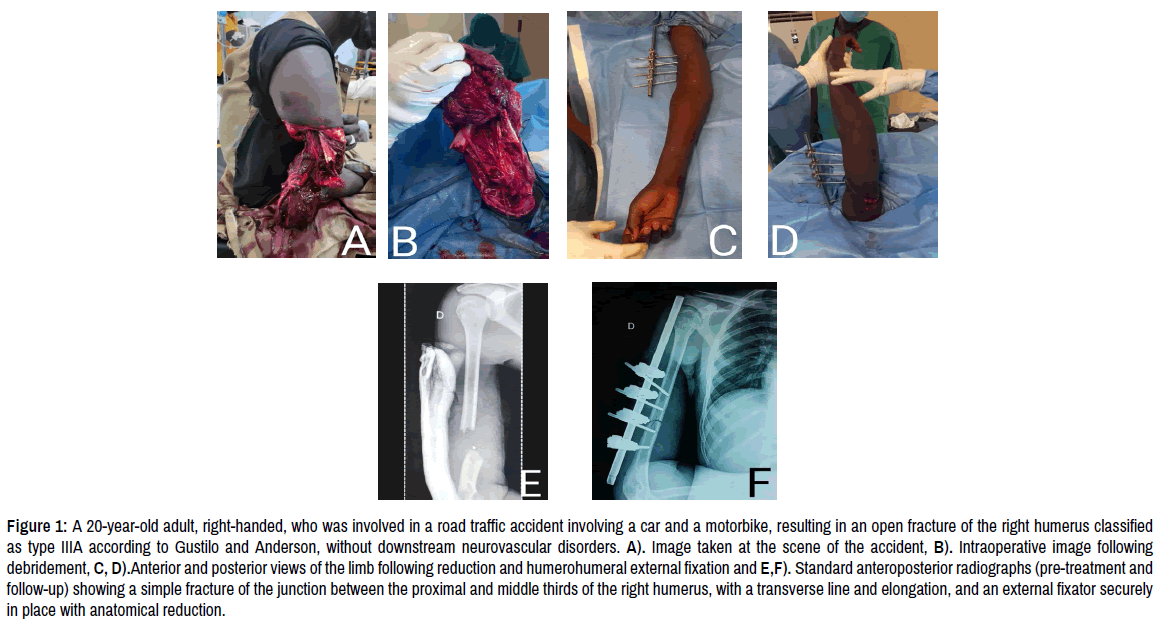
Figure 1: A 20-year-old adult, right-handed, who was involved in a road traffic accident involving a car and a motorbike, resulting in an open fracture of the right humerus classified as type IIIA according to Gustilo and Anderson, without downstream neurovascular disorders. A). Image taken at the scene of the accident, B). Intraoperative image following debridement, C, D).Anterior and posterior views of the limb following reduction and humerohumeral external fixation and E,F). Standard anteroposterior radiographs (pre-treatment and follow-up) showing a simple fracture of the junction between the proximal and middle thirds of the right humerus, with a transverse line and elongation, and an external fixator securely in place with anatomical reduction.
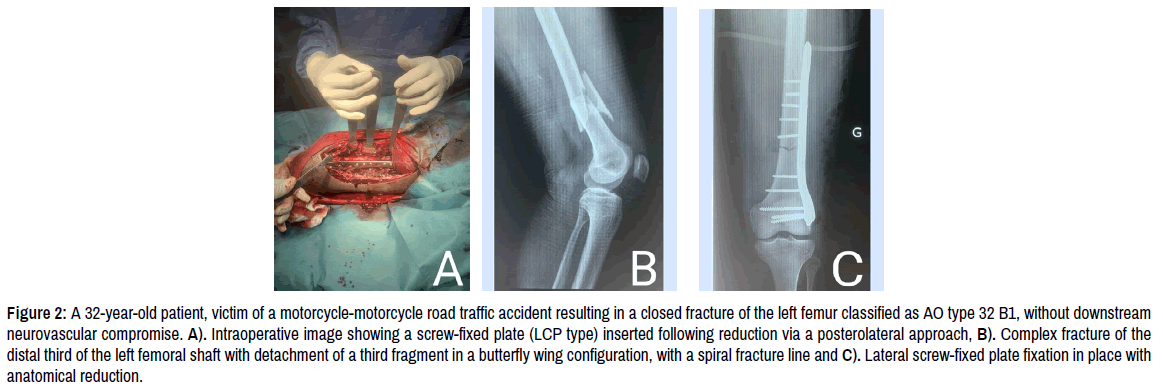
Figure 2: A 32-year-old patient, victim of a motorcycle-motorcycle road traffic accident resulting in a closed fracture of the left femur classified as AO type 32 B1, without downstream neurovascular compromise. A). Intraoperative image showing a screw-fixed plate (LCP type) inserted following reduction via a posterolateral approach, B). Complex fracture of the distal third of the left femoral shaft with detachment of a third fragment in a butterfly wing configuration, with a spiral fracture line and C). Lateral screw-fixed plate fixation in place with anatomical reduction.
In the majority of cases (84%, n = 342), the procedure was performed as elective surgery, compared with 16% (n = 65) as emergency surgery. This high proportion of patients undergoing elective surgery could be explained, on the one hand, by the delay in patients seeking consultation following the initial trauma and, on the other hand, by organisational constraints in the operating theatre, particularly the availability of equipment and staff, leading to procedures being scheduled at a later date.
Intramedullary nailing and screw-fixed plate osteosynthesis were the main procedures performed for traumatic conditions in 20.40% (n = 83) and 19.90% (n = 81) of cases, respectively. Our results are similar to those reported in a study in Togo [9], which found the same types of implants to be the most commonly used, at 32.57% (nails) and 24.88% (screwed plates) respectively. Indeed, these findings are consistent with current guidelines, which indicate that internal fixation particularly using intramedullary nailing and screw-fixed plates is the standard treatment for long bone fractures, owing to their biomechanical stability and favourable functional outcomes [10].
Non-traumatic conditions were dominated by the removal of osteosynthesis hardware, followed by total hip replacements, accounting for 17.70% (n = 72) and 3.93% (n = 16) respectively. This low incidence of hip replacements is consistent with the data in the literature. In the DRC [11] report that total hip replacement is commonly performed in developed countries, but access to the procedure in sub-Saharan Africa remains very limited. The main reasons include the high cost of prosthetic implants, the lack of suitable hospital facilities and a shortage of specialist surgeons.
Although arthroscopic surgery and knee replacements are common practices in developed countries, these techniques are generally not widely available in sub-Saharan Africa. In Chad, arthroscopic surgery and knee replacements are not currently available. These techniques require specialised facilities, expensive equipment (arthroscopy towers, prosthetic implants) and specific surgical expertise.
This study shows that the majority of patients admitted to the operating theatre of the Orthopaedic and Trauma Surgery Department are young males, most of whom have sustained injuries resulting from road traffic accidents. Osteosynthesis procedures constitute the main surgical interventions performed. The organisational and material challenges, as well as the lack of human resources, faced by orthopaedic and trauma departments in resource-limited countries act as a barrier to the development of orthopaedic and trauma surgery. There is a need to strengthen road safety strategies and improve surgical care capacity.
I, the undersigned, Yafoutané Djaba Pacôme, give my consent to the publication of all information that could identify me, as well as the data contained in this manuscript, which is to be published in the Journal of Trauma & Treatment. I confirm that I have read and understood both the instructions for authors and the material and article to be published by the Journal of Trauma & Treatment and certify that the study has not violated any national or international human rights laws. I have discussed this consent form with Adoum Allamine Hassan, who is one of the authors of this article.
All authors declare that they have no known financial conflicts of interest or personal relationships that might influence the work presented in this article.
We would like to thank the participants in this study, the coordinator of operating theatre activities at the Renaissance University Hospital in N’Djamena (Chad) and the entire surgical and anaesthesia teams for the human resources made available for this study.
Google Scholar, Cross Ref, Indexed at
Google Scholar, Cross Ref, Indexed at
Google Scholar, Cross Ref, Indexed at
Google Scholar, Cross Ref, Indexed at
Google Scholar, Cross Ref, Indexed at
Google Scholar, Cross Ref, Indexed at
Google Scholar, Cross Ref, Indexed at
Journal of Trauma & Treatment received 1048 citations as per Google Scholar report