Short Communication - (2025) Volume 13, Issue 6
Received: 01-Dec-2025, Manuscript No. jcdd-25-177704;
Editor assigned: 03-Dec-2025, Pre QC No. P-177704;
Reviewed: 17-Dec-2025, QC No. Q-177704;
Revised: 22-Dec-2025, Manuscript No. R-177704;
Published:
29-Dec-2025
, DOI: 10.37421/2329-9517.2025.13.708
Citation: Tomas Silva. ”Precision Genetics in Inherited Cardiac
Disease Management.” J Cardiovasc Dis Diagn 13 (2025):708.
Copyright: © 2025 S. Tomas This is an open-access article distributed under the terms of the Creative Commons Attribution License, which permits unrestricted use, distribution
and reproduction in any medium, provided the original author and source are credited.
Inherited arrhythmia syndromes pose a significant risk for sudden cardiac death, especially in younger individuals. Conditions such as Long QT syndrome, Brugada syndrome, and catecholaminergic polymorphic ventricular tachycardia require a deep understanding of specific genetic mutations for accurate diagnosis, effective risk stratification, and the development of tailored treatment strategies. These strategies often involve a combination of medications, lifestyle modifications, and, in some cases, implantable devices [1].
The clinical genetics of inherited arrhythmias focuses on translating complex genetic insights into practical strategies for patient care and family screening. This approach is vital for managing life-threatening heart rhythm disturbances that can affect even seemingly healthy individuals [6].
Beyond arrhythmias, inherited cardiomyopathies represent a diverse group of heart muscle disorders, all with significant genetic underpinnings. These include hypertrophic, dilated, arrhythmogenic, and restrictive cardiomyopathies. A genetic perspective is fundamental for accurately diagnosing these conditions, guiding patient management, and providing crucial family counseling [5].
Hypertrophic cardiomyopathy (HCM) is recognized as the most common genetic heart disease, characterized by an abnormal thickening of the heart muscle. Significant advancements in understanding its genetics have enabled better identification of at-risk individuals and guided treatments to prevent severe complications, including sudden cardiac death. The emergence of new therapeutic approaches, such as gene-specific therapies, is significantly altering the landscape for patients with HCM [4].
Genetic testing for HCM is more vital than ever, not just for confirming a diagnosis but also for identifying specific gene mutations that can influence disease severity and progression. This information is indispensable for risk assessment, guiding therapeutic decisions, and effectively screening family members for early detection [9].
Dilated cardiomyopathy (DCM), a prevalent cause of heart failure, frequently has a genetic basis. Recent genomic studies have illuminated a broader spectrum of genes and mutations involved, which, in turn, enhances our understanding of disease mechanisms. This increased knowledge is crucial for achieving more precise diagnoses, better risk stratification, and developing targeted therapies [3].
Arrhythmogenic cardiomyopathy (AC) is a progressive genetic heart muscle disease often leading to ventricular arrhythmias and sudden cardiac death. A comprehensive understanding of AC management covers diagnosis, risk stratification, and therapeutic strategies, which include lifestyle modifications, medications, and device implantation. Its genetic origins are central to providing personalized care and effective prevention [10].
Genetic testing stands as a cornerstone in the comprehensive management of inherited cardiovascular diseases. A scientific statement from the American Heart Association clarifies when and how to effectively utilize genetic testing, aiding clinicians in diagnosis, guiding treatment choices, and screening family members. This effort is aimed at personalizing care and preventing serious cardiac events [2].
Specifically, for inherited cardiomyopathies, genetic testing plays a critical role beyond just confirming a diagnosis; it helps predict the disease course, guides therapy, and enables crucial cascade screening of family members who might unknowingly be at risk. This precision medicine approach, empowered by genetic insights, is truly transforming the management of these complex heart conditions [7].
Ultimately, precision medicine is a transformative force for inherited heart diseases. It marks a shift from a generalized approach to one where prevention and treatment strategies are meticulously tailored based on an individual's unique genetic makeup. The exciting developments in gene-editing and personalized pharmacological interventions offer new hope for conditions that were once exceedingly challenging to manage [8].
Inherited heart diseases encompass a range of conditions, from life-threatening arrhythmia syndromes to various cardiomyopathies, presenting significant clinical challenges. A genetic basis often underpins these disorders, making the identification and understanding of specific mutations critical for accurate diagnosis, risk stratification, and personalized patient management [1, 5]. The paradigm of precision medicine, increasingly driven by profound genetic insights, is transforming how these conditions are approached, offering tailored prevention and treatment strategies, including advancements in gene-editing and personalized pharmacology [8].
Inherited arrhythmia syndromes are particularly concerning as they represent a significant cause of sudden cardiac death, especially among younger populations. Conditions such as Long QT syndrome, Brugada syndrome, and catecholaminergic polymorphic ventricular tachycardia highlight the urgent need for a detailed genetic understanding [1]. The field of clinical genetics of inherited arrhythmias focuses on translating complex genetic information into actionable, practical strategies. This is crucial for both accurate diagnosis and the effective management of these potentially fatal heart rhythm disturbances, even in individuals who may appear healthy. Such strategies extend to comprehensive patient care and the vital screening of family members [6]. Understanding the specific genetic mutations involved is key to refining risk stratification and customizing treatment plans, which can range from specific medications and lifestyle adjustments to the implantation of advanced medical devices [1].
Inherited cardiomyopathies constitute a diverse group of heart muscle disorders, each with distinct clinical presentations but united by strong genetic underpinnings. These include the main types: hypertrophic, dilated, arrhythmogenic, and restrictive cardiomyopathies [5]. Hypertrophic Cardiomyopathy (HCM), for example, is recognized as the most prevalent genetic heart disease, characterized by abnormal thickening of the heart muscle. Significant progress in understanding its genetic landscape has not only improved the ability to identify individuals at risk but also guided therapeutic interventions aimed at preventing severe complications, such as sudden cardiac death. The ongoing development of new therapeutic approaches, including gene-specific therapies, is profoundly changing the treatment landscape for patients with HCM [4]. Similarly, Dilated Cardiomyopathy (DCM), a common etiology for heart failure, frequently has a genetic origin. Recent genomic studies have considerably broadened our understanding of the genes and mutations implicated, which in turn deepens our insight into disease mechanisms. This expanded knowledge is essential for achieving more precise diagnoses, more effective risk stratification, and the development of highly targeted therapies [3]. Another critical condition is Arrhythmogenic Cardiomyopathy (AC), a progressive genetic heart muscle disease that often culminates in ventricular arrhythmias and sudden cardiac death. Its genetic origins are absolutely central to formulating personalized care plans and effective prevention strategies [10].
Genetic testing has emerged as an indispensable cornerstone in the holistic management of inherited cardiovascular diseases [2]. Beyond simply confirming a diagnosis in an affected individual, it offers profound insights that help predict the disease course, intelligently guide therapeutic choices, and, critically, enable cascade screening of family members who might unknowingly carry the genetic predisposition and be at risk [2, 7]. For hypertrophic cardiomyopathy specifically, genetic testing is paramount; it allows for the identification of particular gene mutations that can directly influence the diseaseâ??s severity and its progression. This detailed genetic information is vital for comprehensive risk assessment, for making informed therapeutic decisions, and for establishing effective screening protocols for family members to facilitate early detection and intervention [9]. This precision medicine approach, deeply rooted in comprehensive genetic insights, is truly transforming the way these complex heart conditions are managed, moving decisively towards proactive intervention and the prevention of serious cardiac events [2, 7].
The data underscores the critical role of genetics in understanding and managing inherited heart diseases, including both arrhythmia syndromes and various cardiomyopathies. Conditions such as Long QT syndrome, Brugada syndrome, hypertrophic cardiomyopathy (HCM), dilated cardiomyopathy (DCM), and arrhythmogenic cardiomyopathy (AC) are significant causes of cardiac events, notably sudden cardiac death [1, 4, 10]. Genetic testing is presented as a fundamental tool for accurate diagnosis, effective risk stratification, and the precise tailoring of treatment strategies across these disorders [2, 7]. It enables the identification of specific genetic mutations, helps predict the disease's course, and guides interventions that encompass medications, lifestyle modifications, or the implantation of advanced cardiac devices [1, 9]. Understanding these genetic underpinnings facilitates precise diagnoses and proactive management, improving patient outcomes and enabling crucial cascade screening of at-risk family members [3, 5, 7]. The broader application of precision medicine, which leverages an individual's unique genetic makeup, is revolutionizing prevention and treatment by introducing novel approaches like gene-editing and personalized pharmacological interventions [8]. This comprehensive genetic approach is transforming complex cardiac care, fostering more effective and individualized strategies to prevent serious cardiovascular events and enhance patient well-being.
Indexed at, Google Scholar, Crossref
Indexed at, Google Scholar, Crossref
Indexed at, Google Scholar, Crossref
Indexed at, Google Scholar, Crossref
Indexed at, Google Scholar, Crossref
Indexed at, Google Scholar, Crossref
Indexed at, Google Scholar, Crossref
Indexed at, Google Scholar, Crossref
Indexed at, Google Scholar, Crossref
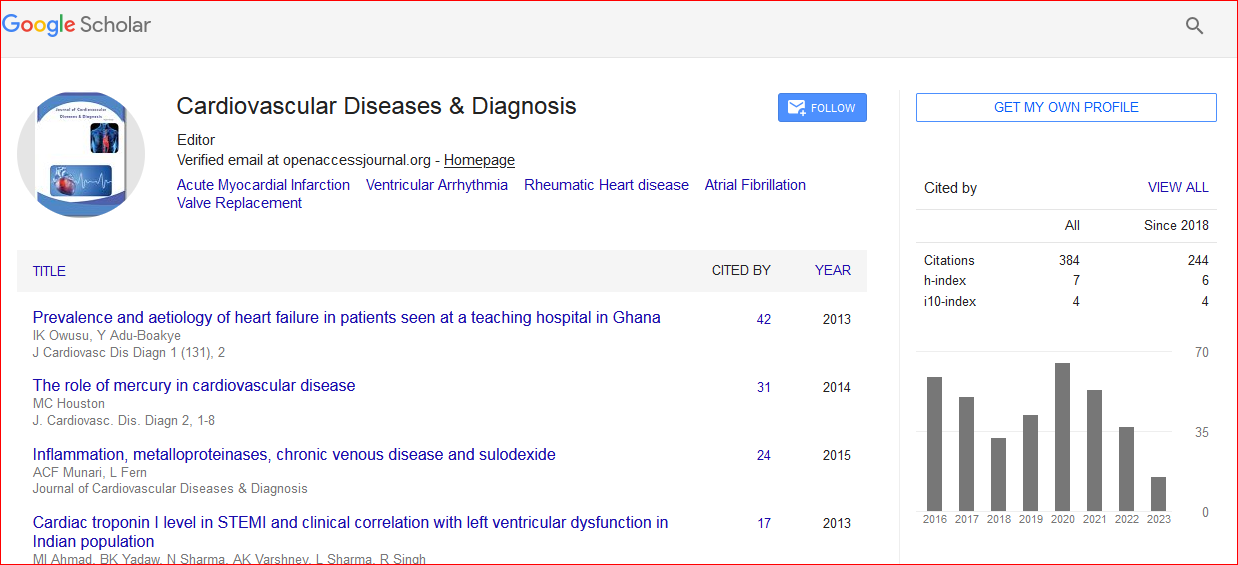
Cardiovascular Diseases & Diagnosis received 427 citations as per Google Scholar report