Commentary - (2025) Volume 13, Issue 1
Received: 03-Feb-2025, Manuscript No. jpgeb-25-741568;
Editor assigned: 05-Feb-2025, Pre QC No. P-741568;
Reviewed: 19-Feb-2025, QC No. Q-741568;
Revised: 24-Feb-2025, Manuscript No. R-741568;
Published:
28-Feb-2025
, DOI: 10.37421/2329-9002.2025.13.361
Citation: Johnson, Emily. ”Population Genomics: Mapping Life’s Evolutionary Journey.” J Phylogenetics Evol Biol 13 (2025):361.
Copyright: © 2025 Johnson E. This is an open-access article distributed under the terms of the Creative Commons Attribution License, which permits unrestricted use,
distribution and reproduction in any medium, provided the original author and source are credited.
The field of population genetics and genomics provides a robust framework for dissecting the intricate patterns of genetic diversity across various organisms, offering profound insights into evolutionary processes and historical demographics. Research highlights how human genomic diversity is profoundly shaped by population structure and ancient introgression events, with our genes carrying distinct signatures of past population movements and mixing that influence disease susceptibility and trait distribution [1].
A landmark study contributes a global genomic perspective on human population history, meticulously mapping major migrations and population splits across continents, thereby offering a clearer picture of how diverse human groups came to be distributed around the world [6].
Furthermore, investigations into indigenous Siberian populations have uncovered specific genetic adaptations, illustrating how natural selection has rapidly molded human genomes in response to harsh environmental pressures, allowing these communities to thrive over generations [2].
Beyond general human evolution, population genetics offers crucial insights into complex human diseases, particularly through the examination of rare genetic variants. Understanding these rare variants within populations is instrumental in pinpointing disease-causing genes and subsequently developing targeted treatments [4].
The scope extends to pathogen evolution, as population genomics has been instrumental in mapping the evolution of antimalarial drug resistance in Plasmodium falciparum across Africa. Deciphering these genetic patterns is key to monitoring and effectively combating the spread of drug-resistant malaria, a significant global health challenge [8].
Even the human gut microbiome is subject to population genetic analyses, where geographical location and dietary habits are shown to significantly influence its composition. Itâ??s clear that understanding these environmental factors is crucial for developing personalized medicine approaches, as the microbiome plays a vital role in health and disease [10].
The principles of population genomics are also critical for conservation biology, revealing important information about genetic diversity and past population changes in endangered species. By understanding these genetic patterns, researchers can develop more effective conservation strategies to protect vulnerable populations [3].
In the agricultural sector, population genetics is applied to analyze cultivated rice varieties, such as those in Bangladesh. This research identifies distinct genetic groups and adaptive traits adapted to local conditions, underscoring that understanding this diversity is crucial for developing resilient crops, especially in the face of ongoing climate change [7].
The advancement of computational methods has significantly bolstered the field, with new tools for reconstructing the complex demographic histories of populations using genomic data. These methods empower researchers to better understand ancient migrations, population bottlenecks, and expansions from vast genetic information [5].
This methodological power is exemplified by research utilizing ancient Deoxyribonucleic Acid (DNA) to provide compelling evidence for population continuity in Central Europe during the Neolithic period. This suggests that, contrary to some theories, certain ancient populations persisted in the region rather than being completely replaced, offering new perspectives on historical population dynamics [9].
The study of population genetics and genomics serves as a cornerstone for comprehending the vast evolutionary tapestry that has shaped life on Earth. A foundational understanding comes from studies examining human genomic diversity, revealing how elements like population structure and ancient introgression events leave indelible marks on our genetic makeup. These genetic signatures reflect past population movements and mixing, influencing present-day disease susceptibility and the distribution of various traits across different human groups [1]. Further contributing to this historical narrative, a broad genomic survey has successfully mapped the global history of human populations, outlining significant migrations and population splits that explain the present continental distribution of diverse human groups [6]. This historical genetic perspective is also enriched by targeted studies, such as those on indigenous Siberian populations, which have identified specific genetic adaptations. These adaptations vividly demonstrate the swift and powerful influence of natural selection, allowing human genomes to evolve and thrive in particularly harsh environmental conditions [2].
Population genetics provides invaluable tools for addressing critical challenges in human health, particularly concerning complex diseases. Research leveraging this field offers crucial insights by focusing on rare genetic variants. Let's break it down: understanding these rare variants within various populations helps in the precise identification of disease-causing genes, paving the way for the development of highly targeted and effective therapeutic strategies [4]. Moreover, the utility of population genomics extends to the ongoing battle against infectious diseases. For example, by mapping the evolution of antimalarial drug resistance in Plasmodium falciparum across Africa, scientists can better understand the genetic patterns driving this resistance. This understanding is absolutely key for effective surveillance and the development of new interventions to combat the spread of drug-resistant malaria [8]. The influence of environmental factors on health is also underscored by population genetic studies of the human gut microbiome, which clearly show that geographical location and dietary habits significantly impact its composition. Itâ??s clear that recognizing these intricate environmental-genetic interactions is crucial for the advancement of personalized medicine approaches, tailoring treatments to an individual's unique biological and environmental context [10].
Beyond human-centric applications, population genomics is a vital discipline in ecological and agricultural sciences. For threatened species, examining population genomics can reveal critical information about their genetic diversity and past demographic histories. What this really means is that by understanding these genetic patterns, conservation biologists can design and implement more robust and effective conservation strategies to prevent species extinction and maintain ecological balance [3]. Similarly, in agriculture, population genetics is instrumental for improving crop resilience and yield. A study on cultivated rice varieties in Bangladesh, for instance, has successfully identified distinct genetic groups and adaptive traits suited to local conditions. Understanding and leveraging this genetic diversity is paramount for developing crops that can withstand environmental stressors, a critical need given the challenges posed by climate change [7].
The power of population genetics is continually amplified by advancements in computational methodology. New computational methods are being introduced and discussed that specifically aim at reconstructing the complex demographic histories of populations using expansive genomic data. What this really means is these sophisticated tools enable researchers to unravel deep historical events such as ancient migrations, population bottlenecks, and periods of expansion, all inferred from the rich information embedded in genetic material [5]. The application of such methods, often combined with ancient Deoxyribonucleic Acid (DNA) analysis, can even revise our understanding of historical human settlement patterns. For example, research using ancient DNA has provided compelling evidence for population continuity in Central Europe during the Neolithic period. This groundbreaking finding suggests that, contrary to some prevailing theories, certain ancient populations persisted in the region over long periods rather than being entirely replaced by new migrating groups, offering a nuanced view of prehistoric demographic shifts [9]. The ongoing refinement of these analytical techniques promises even deeper insights into the forces that have shaped genetic diversity across all forms of life.
Population genetics and genomics are powerful fields that illuminate the evolutionary history, adaptation, and health implications of genetic diversity across various organisms. Research in this domain reveals how human genomic diversity is shaped by ancient population movements and mixing, influencing disease susceptibility and trait distribution. Studies also identify specific genetic adaptations in indigenous populations, showcasing the rapid impact of natural selection in response to environmental pressures. Globally, these fields map major human migrations and population splits, providing a clearer picture of human distribution worldwide. Beyond human evolution, population genomics is vital for conservation, identifying genetic diversity and historical demographic changes in endangered species to inform effective preservation strategies. It also offers crucial insights into complex human diseases by examining rare genetic variants to pinpoint disease-causing genes and develop targeted treatments. Furthermore, this research tracks the evolution of drug resistance in pathogens, like antimalarial resistance, which is essential for public health interventions. In agriculture, it aids in identifying adaptive traits in crops for developing resilient varieties, crucial for food security. Advanced computational methods continue to enhance our ability to reconstruct complex demographic histories, from ancient migrations to the subtle influences of diet and geography on the human gut microbiome, paving the way for personalized medicine.
None
None
1. Sharon RB, Brian LB, Brian MW. "The genomic landscape of population structure and introgression in modern humans".Science 383 (2023):eabm3843.
Indexed at, Google Scholar, Crossref
2. Hie LK, Taewoo L, A. JP. "Recent positive selection in the genomes of indigenous Siberians".Science Advances 6 (2020):eaba1817.
Indexed at, Google Scholar, Crossref
3. Hong-Bo S, Shu-Ye L, Hong-Liang L. "Genetic diversity and demographic history of threatened species: Insights from population genomics".Evol Biol 48 (2021):326–338.
Indexed at, Google Scholar, Crossref
4. Joshua DB, Andrea G, Tarunveer SA. "Leveraging population genetics to understand complex disease: A focus on rare variants".Mol Psychiatry 26 (2021):16–29.
Indexed at, Google Scholar, Crossref
5. Ryan NG, John KN, Laurent E. "New methods for inferring population history from genomic data".Mol Ecol Resour 21 (2021):2–16.
Indexed at, Google Scholar, Crossref
6. Anders B, Chris T, Qasim A. "A genomic history of the human population of the world".Nature 580 (2020):203–208.
Indexed at, Google Scholar, Crossref
7. Atiqur R, Md. SK, Md. EH. "Population genetics of cultivated rice (Oryza sativa L.) varieties from Bangladesh reveals distinct genetic groups and adaptive traits".Front Plant Sci 14 (2023):1109405.
Indexed at, Google Scholar, Crossref
8. Benjamin LM, Nicholas JC, Lucas A. "Population genomics of Plasmodium falciparum reveals patterns of antimalarial drug resistance evolution in Africa".Nat Commun 11 (2020):1198.
Indexed at, Google Scholar, Crossref
9. Anja F, Alistair WGP, Michael H. "Ancient DNA reveals population continuity in the Central European Neolithic".Nat Commun 11 (2020):1332.
Indexed at, Google Scholar, Crossref
10. Daphna R, Amir W, Elad S. "Population genetics of the human gut microbiome: The impact of geography and diet".Nat Med 25 (2019):253–260.
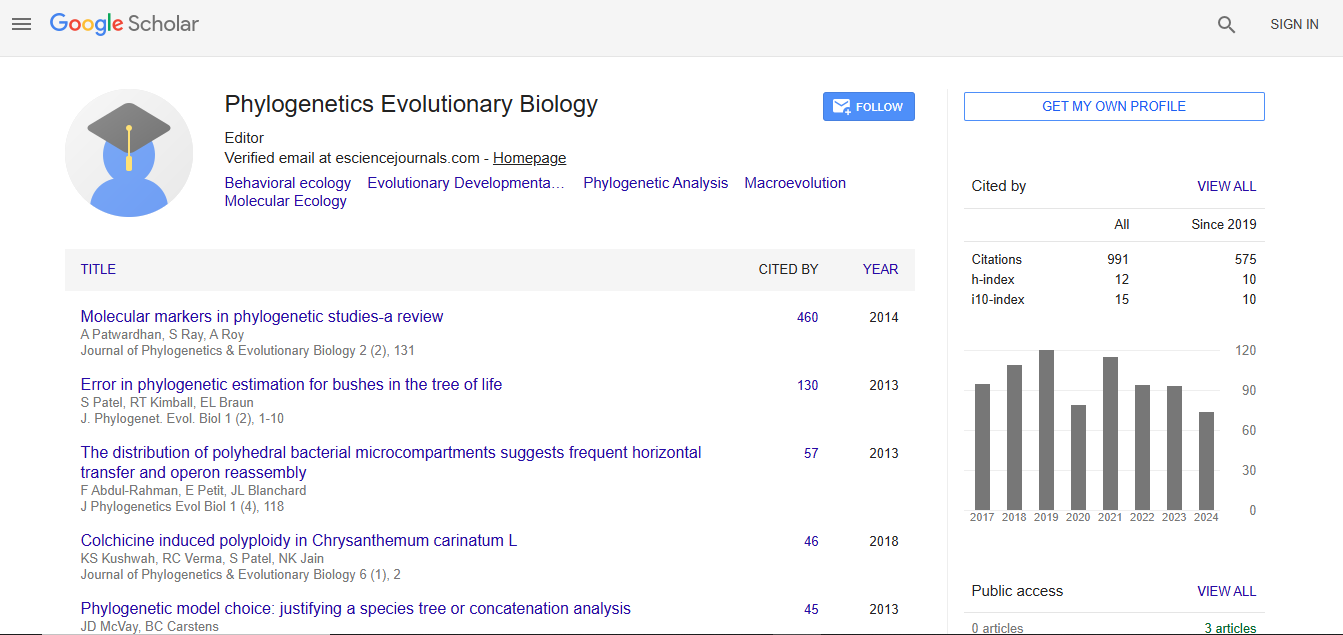
Journal of Phylogenetics & Evolutionary Biology received 911 citations as per Google Scholar report