Brief Report - (127) Volume 14, Issue 1
Received: 01-Jan-2025, Manuscript No. jtm-25-172809;
Editor assigned: 03-Jan-2025, Pre QC No. P-172809;
Reviewed: 17-Jan-2025, QC No. Q-172809;
Revised: 22-Jan-2025, Manuscript No. R-172809;
Published:
29-Jan-2025
, DOI: 10.37421/2167-1222.2025.14.659
Citation: Zhang, Ling. ”Polytrauma Management: Resuscitation, Challenges, Recovery.” J Trauma Treat 14 (2025):659.
Copyright: © 2025 Zhang L. This is an open-access article distributed under the terms of the Creative Commons Attribution License, which permits unrestricted use, distribution and reproduction in any medium, provided the original author and source are credited.
This article covers the crucial aspects of initial management in polytrauma, focusing on the golden hour principles and the evolution of trauma care. It highlights resuscitation strategies, early surgical interventions, and the importance of a multidisciplinary approach to improve patient outcomes. The discussion emphasizes balancing immediate life-saving procedures with stabilizing injuries [1].
This paper delves into the complex mechanisms of trauma-induced coagulopathy (TIC), a critical complication in severe trauma. It explains the pathophysiology, including hypoperfusion, inflammation, and hyperfibrinolysis, and discusses modern diagnostic tools and therapeutic strategies such as goal-directed coagulation management and viscoelastic testing to guide transfusions [2].
This review explores the role of damage control orthopedics (DCO) in managing severe extremity injuries in polytrauma patients. It discusses the 'fix and don't touch' principle and delayed definitive fixation, weighing the benefits of DCO in preventing a 'second hit' against the potential for complications. The article also addresses current controversies and patient selection criteria for this strategy [3].
This systematic review and meta-analysis identifies key prognostic factors influencing outcomes in severe polytrauma patients. It examines demographic, injury-specific, and physiological parameters that predict mortality and morbidity, providing insights into risk stratification and guiding clinical decision-making for intensive care and resource allocation [4].
This systematic review underscores the significant impact of early rehabilitation in improving functional recovery and reducing long-term disability for polytrauma patients. It evaluates different rehabilitation modalities and timing, advocating for initiation as soon as medically stable to prevent complications like muscle atrophy and enhance overall patient quality of life [5].
This article critically examines fluid resuscitation strategies in polytrauma, distinguishing between liberal and restrictive approaches. It discusses the controversies surrounding crystalloids versus colloids, the role of balanced solutions, and the avoidance of over-resuscitation, emphasizing the need for individualized, goal-directed fluid management to prevent adverse effects like coagulopathy and organ dysfunction [6].
This review addresses the challenges of managing traumatic brain injury (TBI) in the context of polytrauma, where systemic injuries can complicate TBI treatment. It highlights the importance of maintaining cerebral perfusion, managing intracranial pressure, and balancing TBI-specific interventions with the demands of concurrent injuries to optimize neurological and overall outcomes [7].
This study investigates the incidence, specific risk factors, and outcomes of sepsis in polytrauma patients, a significant contributor to mortality and prolonged hospital stays. It identifies early indicators and vulnerable patient populations, emphasizing prompt recognition and aggressive management strategies to improve survival rates in this complex patient group [8].
This systematic review and meta-analysis compares early total care (ETC) versus damage control orthopaedics (DCO) for polytrauma patients, particularly those with long bone fractures. It evaluates the impact of each strategy on patient outcomes, including mortality, complications, and length of hospital stay, providing evidence-based insights for surgical decision-making in complex trauma [9].
This article explores novel and evolving approaches to hemostatic resuscitation in severe polytrauma, moving beyond traditional methods. It discusses the integration of advanced coagulation assays, new hemostatic agents, and individualized transfusion protocols to rapidly correct coagulopathy and minimize blood product usage, aiming to improve survival in bleeding trauma patients [10].
Initial management of polytrauma patients is crucial, emphasizing golden hour principles and the evolution of trauma care. Resuscitation strategies, early surgical interventions, and a multidisciplinary approach are key to improving patient outcomes, requiring a careful balance between immediate life-saving procedures and stabilizing injuries [1]. This early phase is fundamental for setting the trajectory of recovery and mitigating severe complications. Effective trauma care depends on swift assessment and decisive action to address the most life-threatening conditions first, while simultaneously planning for comprehensive patient management.
Trauma-induced coagulopathy (TIC) presents a critical complication in severe trauma, stemming from hypoperfusion, inflammation, and hyperfibrinolysis. Modern diagnostic tools and therapeutic strategies, including goal-directed coagulation management and viscoelastic testing, are vital for guiding transfusions and addressing this complex pathophysiology [2]. Complementing this, fluid resuscitation strategies are extensively debated, with discussions comparing liberal versus restrictive approaches and the use of crystalloids versus colloids. Avoiding over-resuscitation and implementing individualized, goal-directed fluid management are crucial to prevent adverse effects such as exacerbating coagulopathy and organ dysfunction [6]. Furthermore, novel and evolving approaches to hemostatic resuscitation aim to move beyond traditional methods by integrating advanced coagulation assays and individualized transfusion protocols. These strategies are designed to rapidly correct coagulopathy and minimize blood product usage, significantly improving survival rates in bleeding trauma patients [10]. This integrated approach to managing bleeding and fluid balance is paramount for patient stability.
In orthopedic management of polytrauma, Damage Control Orthopedics (DCO) plays a significant role in severe extremity injuries. This strategy adheres to a 'fix and don't touch' principle, delaying definitive fixation to prevent a 'second hit' and potential complications, though patient selection criteria remain controversial [3]. A systematic review comparing Early Total Care (ETC) versus DCO, particularly for long bone fractures, evaluates their respective impacts on patient outcomes, including mortality, complications, and length of hospital stay, providing evidence-based insights for surgical decision-making [9]. Concurrently, managing Traumatic Brain Injury (TBI) in the context of polytrauma introduces unique challenges. Systemic injuries can complicate TBI treatment, requiring careful maintenance of cerebral perfusion, management of intracranial pressure, and a delicate balance between TBI-specific interventions and the demands of concurrent injuries to optimize neurological and overall outcomes [7].
Identifying key prognostic factors is essential for influencing outcomes in severe polytrauma patients. Systematic reviews and meta-analyses examine demographic, injury-specific, and physiological parameters to predict mortality and morbidity, which provides insights for risk stratification and guides clinical decision-making regarding intensive care and resource allocation [4]. A significant contributor to adverse outcomes is sepsis, which poses a considerable risk in polytrauma patients, leading to increased mortality and prolonged hospital stays. Research identifies early indicators and vulnerable patient populations, stressing the importance of prompt recognition and aggressive management strategies to improve survival rates in this complex patient group [8]. Vigilance against infection and organ dysfunction is a continuous challenge.
Finally, the impact of early rehabilitation in polytrauma patients cannot be overstated. A systematic review highlights its significant role in improving functional recovery and reducing long-term disability. Various rehabilitation modalities and their optimal timing are evaluated, advocating for initiation as soon as patients are medically stable. This proactive approach aims to prevent complications like muscle atrophy and significantly enhance the overall quality of life for polytrauma survivors [5]. Integrating rehabilitation early into the care pathway ensures a holistic recovery process.
Initial management in polytrauma prioritizes crucial golden hour principles, resuscitation strategies, and a multidisciplinary approach to optimize patient outcomes. Balancing immediate life-saving procedures with stabilizing injuries is fundamental. Trauma-induced coagulopathy presents a complex challenge, requiring modern diagnostic tools and goal-directed coagulation management. Fluid resuscitation strategies, distinguishing between liberal and restrictive approaches, crystalloids versus colloids, necessitate individualized management to prevent adverse effects like coagulopathy and organ dysfunction. Orthopedic care in polytrauma often employs Damage Control Orthopedics (DCO), a 'fix and don't touch' principle with delayed definitive fixation, which is debated against Early Total Care (ETC) for its impact on patient outcomes. Managing traumatic brain injury (TBI) concurrently with systemic injuries demands careful balancing of TBI-specific interventions and overall demands. Sepsis is a significant contributor to mortality and prolonged hospital stays, underscoring the need for prompt recognition and aggressive management. Early rehabilitation is vital for improving functional recovery and reducing long-term disability, ideally initiated when medically stable. Identifying key prognostic factors assists in risk stratification and clinical decision-making. Novel hemostatic resuscitation approaches, integrating advanced assays and individualized transfusion protocols, are evolving to correct coagulopathy and improve survival in bleeding trauma patients.
None
None
Indexed at, Google Scholar, Crossref
Indexed at, Google Scholar, Crossref
Indexed at, Google Scholar, Crossref
Indexed at, Google Scholar, Crossref
Indexed at, Google Scholar, Crossref
Indexed at, Google Scholar, Crossref
Indexed at, Google Scholar, Crossref
Indexed at, Google Scholar, Crossref
Indexed at, Google Scholar, Crossref
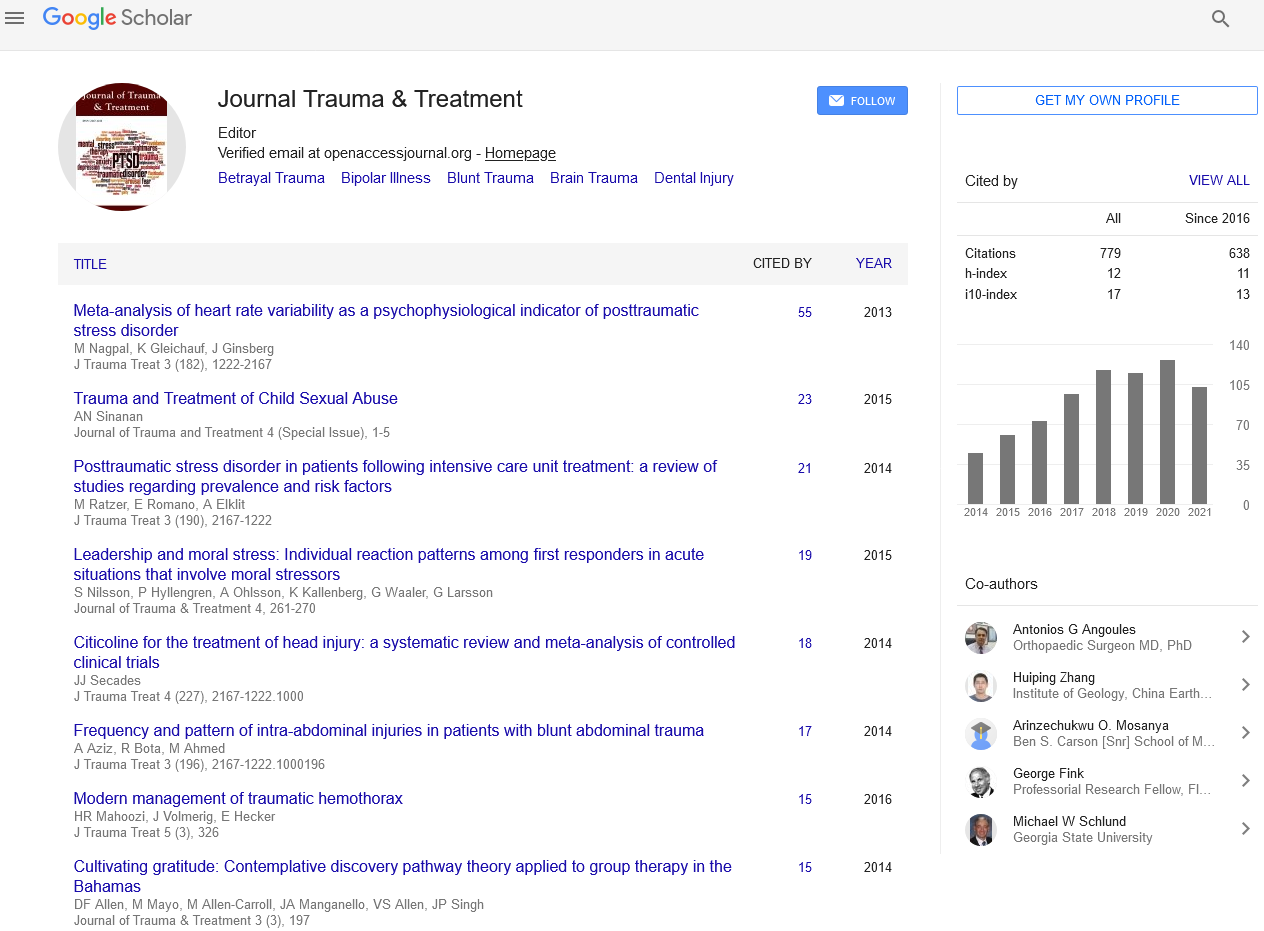
Journal of Trauma & Treatment received 1048 citations as per Google Scholar report