Perspective - (2025) Volume 13, Issue 3
Received: 02-Jun-2025, Manuscript No. jpgeb-26-184298;
Editor assigned: 04-Jun-2025, Pre QC No. P-184298;
Reviewed: 18-Jun-2025, QC No. Q-184298;
Revised: 23-Jun-2025, Manuscript No. R-184298;
Published:
30-Jun-2025
, DOI: 10.37421/2329-9002.2025.13.381
Citation: Morales, Sofia G.. ”Phylogenomics: Revolutionizing Deep Evolutionary Relationships and Life’s Tree.” J Phylogenetics Evol Biol 13 (2025):381.
Copyright: © 2025 Morales G. Sofia This is an open-access article distributed under the terms of the Creative Commons Attribution License, which permits unrestricted use, distribution and reproduction in any medium, provided the original author and source are credited.
Phylogenomics, the study of evolutionary history utilizing genomic data, is fundamentally transforming our comprehension of deep evolutionary relationships. By meticulously analyzing entire genomes or substantial genomic segments, researchers are empowered to resolve ambiguities and uncover previously obscured branches within the tree of life [1].
This advanced approach offers an unparalleled level of resolution when contrasted with traditional phylogenetic methods, proving especially effective for deciphering ancient divergences where complex events like gene and whole genome duplications can significantly complicate phylogenetic signals. The integration of diverse genomic datasets, encompassing gene order, copy number variations, and retroposon insertions, alongside traditional sequence data, profoundly strengthens the accuracy of phylogenetic inference [1].
Whole-genome duplication (WGD) events stand as critical milestones in understanding plant evolution, frequently serving as catalysts for the emergence of novel gene functions and significant evolutionary innovations. Phylogenomic analyses are particularly adept at the precise identification and dating of these ancient WGD events, thereby establishing a robust framework for tracing the diversification patterns of major plant lineages. Through the detailed comparison of gene trees with species trees, it becomes feasible to accurately infer the temporal sequencing of WGD events in relation to key speciation events [2].
The reconstruction of metazoan phylogeny has historically presented substantial challenges, primarily due to the rapid pace of early divergences and the intricate histories of gene gain and loss. Phylogenomics, leveraging its capacity to handle vast datasets, is now providing unprecedented resolution for the construction of the animal tree of life, significantly aiding in the clarification of relationships among major animal phyla. A key factor contributing to this progress is the ongoing development of robust phylogenetic methodologies specifically designed to effectively manage the inherent heterogeneity and evolutionary rate variations present in large genomic datasets [3].
Reconstructing the intricacies of deep evolutionary events necessitates a thorough accounting for horizontal gene transfer (HGT), a pervasive biological process that can obscure the clear delineation of vertical descent and consequently lead to misleading phylogenetic trees. Phylogenomic studies are increasingly incorporating sophisticated methods to detect and effectively integrate HGT signals, leading to more accurate evolutionary inferences, particularly within microbial lineages where the prevalence of HGT is notably high [4].
The accurate interpretation of phylogenomic data is profoundly influenced by the computational methodologies employed in their analysis. Addressing critical issues such as gene tree-species tree discordance, the phenomenon of long-branch attraction, and variations in site-specific evolutionary rates is paramount for robustly resolving deep divergences. The continuous development of sophisticated statistical models and advanced machine learning approaches is therefore essential for effectively overcoming these complex analytical challenges [5].
The study of macroevolutionary patterns, including the significant diversification of major clades across the tree of life, benefits immensely from the insights provided by phylogenomics. By furnishing a more accurate and comprehensive evolutionary backbone, phylogenomics enables a more precise correlation of evolutionary events with influential geological, climatic, and ecological changes, thereby shedding considerable light on the primary drivers of global biodiversity [6].
The resolution of deep phylogenetic relationships is frequently hampered by a phenomenon known as incomplete lineage sorting (ILS), wherein ancestral gene lineages persist and are sorted independently after speciation events. Phylogenomic methods that explicitly model ILS, such as coalescent-based approaches, are therefore indispensable for accurately inferring species trees from datasets characterized by discordant gene trees [7].
The advent and rapid evolution of high-throughput sequencing technologies have dramatically augmented both the quantity and quality of genomic data available for phylogenetic investigations. This exponential increase in data allows for the construction of significantly more robust phylogenies, particularly for taxa that have historically proven challenging to resolve and for deep divergences, by providing a substantially larger number of informative characters and effectively reducing the impact of stochastic errors [8].
Characterizing and quantifying phylogenomic uncertainty is an essential step for ensuring the reliability of evolutionary history interpretations. Probabilistic methods and rigorous statistical testing are consistently employed to assess the confidence associated with inferred branching patterns, especially in those regions of the phylogenetic tree that are characterized by rapid radiations or a paucity of adequate data coverage [9].
The evolutionary history of fungi, a diverse and ecologically vital kingdom, is characterized by significant diversification events and complex genome evolution. Phylogenomics has emerged as an instrumental tool in resolving deep fungal relationships, accurately identifying cryptic species, and elucidating the genomic underpinnings of their adaptive radiation and diverse ecological roles [10].
Phylogenomics, the discipline dedicated to understanding evolutionary history through the analysis of genomic data, is instrumental in revolutionizing our grasp of deep evolutionary connections. By undertaking the analysis of entire genomes or large genomic fragments, scientists are now capable of resolving previously intractable ambiguities and revealing evolutionary lineages that were once hidden within the grand tree of life [1].
This sophisticated methodology provides an unparalleled degree of resolution compared to conventional techniques, particularly when examining ancient divergences where phenomena such as gene and whole genome duplications can obscure phylogenetic signals. The incorporation of a wide array of genomic datasets, including information on gene order, copy number variations, and the distribution of retroposon insertions, alongside sequence data, significantly bolsters the reliability of phylogenetic inferences [1].
Whole-genome duplication (WGD) events represent pivotal moments in the evolutionary trajectory of plants, frequently leading to the acquisition of novel gene functions and driving significant evolutionary innovations. Phylogenomic analyses are exceptionally well-suited for the identification and precise dating of these ancient WGD events, thereby furnishing a crucial framework for reconstructing the diversification of major plant groups. By engaging in comparative analyses between gene trees and species trees, researchers can effectively infer the timing of WGDs in relation to significant speciation events [2].
The establishment of metazoan phylogeny has long been a source of considerable difficulty, largely attributable to the rapid rate of early divergences and the complex historical patterns of gene gain and loss. Phylogenomics, with its capacity to process extensive genomic datasets, is now offering unprecedented resolution for the construction of the animal tree of life, greatly facilitating the clarification of relationships among diverse animal phyla. A crucial element underpinning this advancement is the continuous development of robust phylogenetic methodologies adept at handling the inherent heterogeneity and varying evolutionary rates found within large genomic datasets [3].
Reconstructing the complex patterns of deep evolutionary events critically depends on the accurate consideration of horizontal gene transfer (HGT). This process can significantly obscure evidence of vertical descent and lead to the generation of misleading phylogenetic trees. Consequently, phylogenomic studies are increasingly adopting methods designed to detect and incorporate HGT signals, ultimately leading to more accurate evolutionary interpretations, especially in microbial lineages where HGT is a prevalent mode of genetic exchange [4].
The interpretation of phylogenomic data is highly contingent upon the computational approaches utilized for their analysis. Effectively addressing issues such as gene tree-species tree discordance, the problem of long-branch attraction, and variations in site-specific evolutionary rates is absolutely essential for the robust resolution of deep divergences. The ongoing development of advanced statistical models and sophisticated machine learning techniques is therefore vital for surmounting these complex analytical hurdles [5].
The investigation of macroevolutionary trends, such as the diversification processes shaping major clades, gains substantial advantages from the insights provided by phylogenomic studies. By establishing a more accurate and complete evolutionary framework, phylogenomics allows for a more precise correlation between evolutionary events and critical geological, climatic, and ecological shifts, thereby illuminating the key factors driving global biodiversity [6].
The resolution of deep phylogenetic relationships is often impeded by incomplete lineage sorting (ILS), a phenomenon where ancestral gene lineages persist and sort independently following speciation events. Phylogenomic methods that explicitly incorporate models of ILS, including coalescent-based approaches, are therefore vital for accurately inferring species trees from datasets exhibiting discordant gene tree topologies [7].
The proliferation of high-throughput sequencing technologies has led to a dramatic increase in the volume and quality of genomic data available for phylogenetic research. This surge in data enables the construction of more robust phylogenies, particularly for challenging taxa and deep evolutionary divergences, by providing a greater number of informative characters and mitigating the impact of random errors [8].
Accurate characterization of phylogenomic uncertainty is paramount for ensuring reliable interpretations of evolutionary history. Probabilistic methodologies and rigorous statistical evaluations are routinely employed to ascertain the level of confidence in inferred branching patterns, especially in phylogenetic regions marked by rapid diversification or limited data availability [9].
The evolutionary history of fungi is marked by extensive diversification and complex genome evolution. Phylogenomics serves as a powerful tool for resolving deep fungal relationships, identifying cryptic species, and understanding the genomic basis of their adaptive radiation and crucial ecological roles [10].
Phylogenomics, the study of evolutionary history using genomic data, is revolutionizing our understanding of deep evolutionary relationships by providing unparalleled resolution. This approach helps resolve ambiguities and uncover hidden branches in the tree of life, especially for ancient divergences. Whole-genome duplication events are crucial for plant evolution, and phylogenomics aids in dating these events and tracing lineage diversification. Metazoan phylogeny is also being clarified by phylogenomics, overcoming challenges of rapid early divergences and gene gain/loss. Detecting horizontal gene transfer is vital for accurate phylogenetic inference, particularly in microbial lineages. Computational methods play a critical role in interpreting phylogenomic data, addressing issues like gene tree discordance and long-branch attraction. Macroevolutionary patterns are better understood with phylogenomics, enabling correlation of evolutionary events with environmental changes. Incomplete lineage sorting is a key challenge addressed by specific phylogenomic models. High-throughput sequencing technologies provide vast data for robust phylogenies. Characterizing phylogenomic uncertainty through statistical methods ensures reliable interpretations. Fungal evolution is being illuminated by phylogenomics, aiding in relationship resolution and understanding adaptive radiation.
None
None
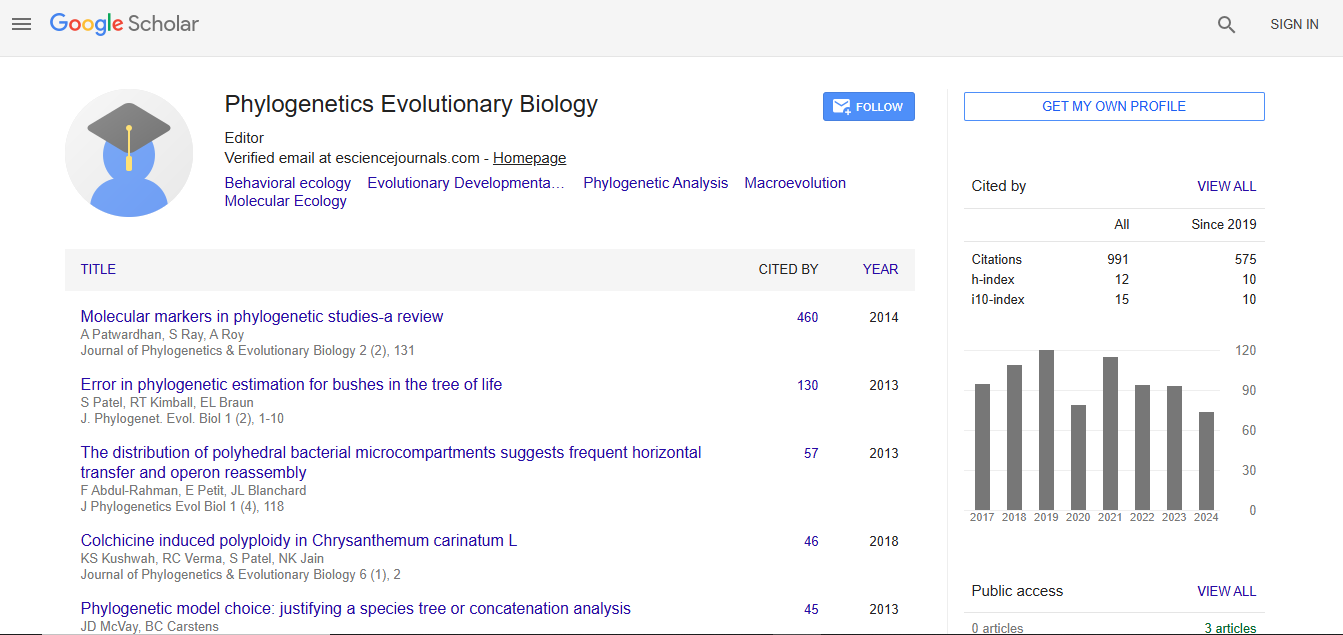
Journal of Phylogenetics & Evolutionary Biology received 911 citations as per Google Scholar report