Brief Report - (2025) Volume 15, Issue 6
Received: 03-Nov-2025, Manuscript No. jcde-25-177524;
Editor assigned: 05-Nov-2025, Pre QC No. P-177524;
Reviewed: 19-Nov-2025, QC No. Q-177524;
Revised: 24-Nov-2025, Manuscript No. R-177524;
Published:
01-Dec-2025
, DOI: 10.37421/2165-784X.2025.15.632
Citation: Papadopoulos, Maria. ”Optimizing Water Use: From
Plants to Policy.” J Civil Environ Eng 15 (2025):632.
Copyright: © 2025 Papadopoulos M. This is an open-access article distributed under the terms of the Creative Commons Attribution License, which permits unrestricted use,
distribution and reproduction in any medium, provided the original author and source are credited.
Understanding how plants use water efficiently is fundamental for global food security. This involves delving into the intricate biological mechanisms that govern water uptake and transport, as well as the physiological processes that minimize water loss. Scientists also rely on sophisticated models to predict water usage under varying conditions, and employ diverse field methods to accurately measure water-use efficiency in real-world agricultural settings. Such comprehensive reviews are vital for appreciating the inherent complexity of water management in farming, particularly when confronted with the pressing challenges posed by climate change[1].
Beyond fundamental understanding, there is a strong emphasis on actionable strategies and practical methods to elevate water-use efficiency in agriculture. This encompasses a broad spectrum of interventions, ranging from refined crop management techniques, like optimized irrigation schedules and drought-resistant crop choices, to advanced technological solutions such as precision farming tools. The overarching goal is to enable farmers to maximize yield per unit of water applied, a crucial step towards fostering truly sustainable agricultural practices in an era of increasing water scarcity[2].
Looking towards future innovations, genetic engineering presents a powerful avenue for enhancing water efficiency in crops. Significant progress has been made in modifying plant genes to improve their capacity for water uptake from the soil and to reduce transpiration losses. This field holds immense potential for developing novel crop varieties that are inherently more resilient to drought conditions, offering a biotechnological solution to water stress that complements traditional breeding efforts[3].
Accurate and large-scale monitoring of water use is essential. Here is how remote sensing technologies, including satellite imagery and unmanned aerial vehicles (drones), provide a scalable solution for measuring and estimating water-use efficiency across vast agricultural fields and forest ecosystems. These tools integrate diverse models and data inputs to offer a spatial perspective on water resource management. This allows for more effective planning and allocation of water resources over broad geographical areas, significantly improving decision-making processes for environmental and agricultural agencies[4].
Water-use efficiency is not solely an agricultural concern; it is a critical urban challenge too. This topic explores the multifaceted elements influencing water consumption and conservation in urban environments, along with the methodologies for assessing efficiency. The discussion spans infrastructural considerations, effective policy frameworks, and the pivotal role of public awareness and engagement. Ultimately, the aim is to provide a holistic view of how cities can proactively manage their water resources more judiciously and sustainably for their growing populations[5].
Specifically addressing water-stressed regions, strategies for simultaneously improving water-use efficiency and drought tolerance in crops are paramount, particularly in arid and semi-arid zones. This involves a blend of biological approaches, such as selecting naturally resilient plant species, and agricultural practices tailored to conserve moisture. The objective is clear: empower farmers to sustain agricultural productivity even under severe water limitations, thereby securing livelihoods and food supply in challenging climates[6].
Within the domain of irrigated agriculture, understanding water productivity and water-use efficiency is crucial for optimization. This involves a detailed examination of how these specific metrics are precisely defined, accurately measured, and effectively enhanced in practice. The focus is on identifying and promoting cultivation practices that lead to more sustainable and efficient water management within farming systems that heavily rely on irrigation, ensuring that every drop contributes maximally to crop yield[7].
Recent scientific breakthroughs have significantly deepened our understanding of the physiological and molecular underpinnings of plant water-use efficiency. Researchers are uncovering the complex internal mechanisms plants employ, ranging from the sophisticated regulation of stomatal openings to the nuanced development of root systems. This advanced knowledge is instrumental in understanding how plants naturally optimize water uptake and minimize wasteful loss, paving the way for the development of new, highly resilient crop varieties through targeted breeding programs[8].
Understanding the dynamic nature of water-use efficiency across ecosystems, especially in sensitive dryland regions, is another key area of study. This research investigates how efficiency fluctuates spatially and temporally, identifying the primary environmental and climatic drivers behind these variations. Such insights are invaluable for devising effective water resource management strategies in vulnerable ecosystems, helping conserve biodiversity and maintain ecological stability in arid environments[9].
Finally, a comprehensive overview of water-use efficiency in agriculture necessitates acknowledging both recent advancements and persistent challenges. This includes exploring a range of innovative techniques and emerging technologies that promise improved water management. However, it also critically examines ongoing hurdles such as the unpredictable impacts of climate change and inherent resource limitations. This forward-looking perspective is crucial for guiding future research and policy toward more sustainable agricultural systems worldwide[10].
Water-use efficiency (WUE) stands as a pivotal concept in environmental science and agriculture, especially as global water resources face unprecedented stress. A comprehensive understanding of WUE begins with exploring the fundamental biological mechanisms that dictate how plants acquire and utilize water, along with the sophisticated models scientists employ to predict its dynamics. Furthermore, robust field methods are essential for accurately measuring WUE, providing empirical data to validate theoretical frameworks. This holistic approach reveals the inherent complexity and immense importance of optimizing water use in agricultural systems, particularly given the escalating challenges presented by climate change [1]. Beyond the macroscopic view, recent breakthroughs have illuminated the physiological and molecular mechanisms underlying plant water-use efficiency. This includes delving into intricate internal processes, from precise stomatal regulation, which controls gas exchange, to the development of root systems that optimize water uptake, all crucial for cultivating more resilient crops capable of thriving in water-limited environments [8].
Improving water-use efficiency in agriculture is a multifaceted endeavor, encompassing a wide array of strategies and practical methods aimed at maximizing output from every drop of water. These approaches span from refined crop management techniques, such as precision irrigation and crop rotation, to innovative technological interventions that bolster sustainable agriculture [2]. Genetic engineering plays an increasingly significant role, with ongoing advancements in modifying plant genes to enhance water uptake capabilities and reduce water loss through transpiration. This area holds substantial potential for future breakthroughs in breeding drought-resilient crops, offering a powerful tool for adapting to changing climatic conditions [3]. Furthermore, specific strategies are tailored for arid and semi-arid regions, focusing on both biological and agricultural methods to enhance crop water-use efficiency and drought tolerance, thereby helping farmers sustain productivity in the most challenging water-scarce environments [6]. Within farming systems that rely on irrigation, a precise examination of water productivity and water-use efficiency is paramount, involving detailed definitions, measurement protocols, and effective improvement practices to foster truly sustainable water management [7].
Effective and large-scale assessment of water-use efficiency is crucial for informed resource management. Remote sensing technologies have emerged as a transformative tool in this regard, utilizing platforms like satellites and drones to measure and estimate WUE across vast agricultural and forest landscapes [4]. These advanced tools integrate diverse models and a multitude of data inputs, providing comprehensive spatial data that was previously unattainable. This capability allows for more effective planning and management of water resources over expansive areas, moving beyond localized observations to offer a regional and even global perspective on water dynamics. Such technological applications are vital for monitoring environmental changes and guiding large-scale conservation efforts, ensuring that water resources are allocated and managed with optimal efficiency [4].
Water-use efficiency is not confined to agricultural fields but extends critically into urban environments and natural ecosystems. In cities, a thorough review of urban water-use efficiency considers various influencing factors, including infrastructure design, policy frameworks, and the degree of public awareness, alongside different methods for assessing urban water consumption and conservation [5]. This comprehensive understanding is essential for guiding urban areas toward more effective and sustainable water management practices [5]. Moreover, research into ecosystem water-use efficiency, particularly in dryland regions, investigates spatiotemporal variations and identifies the key environmental and climatic factors driving these changes. Such insights are invaluable for managing water resources in vulnerable ecosystems, supporting their ecological stability and biodiversity [9]. Looking ahead, while significant advancements continue to improve water-use efficiency in agriculture through innovative techniques and emerging technologies, the field must confront persistent challenges. These include the increasingly unpredictable impacts of climate change and inherent resource limitations, necessitating a forward-looking perspective to ensure global water security and environmental sustainability [10].
The provided research thoroughly examines water-use efficiency (WUE) across various environments, from agriculture to urban settings and natural ecosystems. It explores the intricate biological and physiological mechanisms plants employ to efficiently manage water, alongside the scientific models used for prediction and practical methods for field measurement. The collection highlights the paramount importance of WUE in agriculture, especially as global climate change intensifies. Key strategies for improving agricultural WUE include innovative crop management techniques, advanced technological interventions, and genetic engineering aimed at developing drought-resilient crops. Remote sensing technologies, such as satellites and drones, are presented as indispensable tools for large-scale estimation and effective management of water resources in both cultivated lands and forests. Furthermore, the data reviews urban water-use efficiency, considering infrastructural, policy, and public awareness factors, and investigates spatiotemporal variations of WUE in vulnerable dryland ecosystems. The work consistently underscores both the significant advancements achieved in improving water efficiency and the ongoing challenges posed by environmental shifts and resource limitations, emphasizing the critical need for continued research and innovative solutions to ensure sustainable water management globally.
1. Feng L, Claudio OS, Zhaowei W. "Crop water use efficiency: A review of mechanisms, models, and measurements".Agric Water Manage 231 (2020):106024.
Indexed at, Google Scholar, Crossref
2. Debashish C, Nirmalendu B, Sangeeta L. "Enhancing water use efficiency in agriculture: A review of strategies and practices".J Crop Improve 35 (2021):755-778.
Indexed at, Google Scholar, Crossref
3. Chen N, Ying H, Xing Y. "Genetic engineering for improved water-use efficiency in crops: Current status and future prospects".Plant Biotechnol J 20 (2022):441-456.
Indexed at, Google Scholar, Crossref
4. Yuan Z, Yong Z, Shuai W. "Remote sensing for estimating crop water use efficiency: A review".Agric Forest Meteorol 329 (2023):109280.
Indexed at, Google Scholar, Crossref
5. Xiaojun G, Hong Z, Shujuan L. "Urban water use efficiency: A review of influencing factors and assessment methods".J Environ Manage 269 (2020):110757.
Indexed at, Google Scholar, Crossref
6. Bo G, Zhenyu W, Yongqiang L. "Improving crop water use efficiency and drought tolerance in arid and semi-arid regions: A review".Front Plant Sci 11 (2020):578648.
Indexed at, Google Scholar, Crossref
7. Manzoor Q, Dennis W, Jeroen H. "Water productivity and water use efficiency in irrigated agriculture".Irrig Drain 70 (2021):3-18.
Indexed at, Google Scholar, Crossref
8. Shuang S, Chunbo L, Wenjun Y. "Advances in understanding the physiological and molecular mechanisms of plant water use efficiency".Int J Mol Sci 23 (2022):9691.
Indexed at, Google Scholar, Crossref
9. Sheng M, Yujie L, Xiaoning W. "Spatiotemporal variations and driving factors of ecosystem water use efficiency in drylands".Sci Total Environ 856 (2023):159158.
Indexed at, Google Scholar, Crossref
10. LuÃs SP, Maria CR, Helena RN. "Water Use Efficiency in Agriculture: Recent Advances and Challenges".Agronomy 13 (2023):2977.
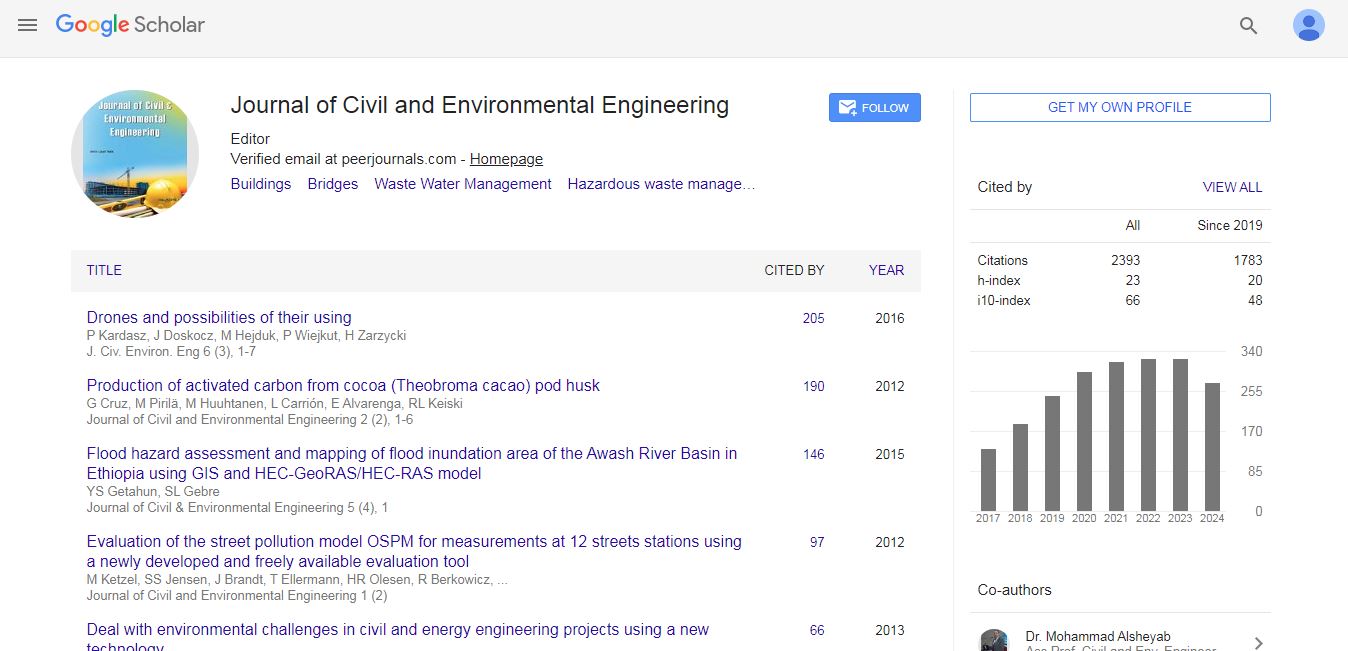
Journal of Civil and Environmental Engineering received 1798 citations as per Google Scholar report