Short Communication - (2025) Volume 12, Issue 4
Received: 01-Aug-2025, Manuscript No. ijn-26-183996;
Editor assigned: 04-Aug-2025, Pre QC No. P-183996;
Reviewed: 18-Aug-2025, QC No. Q-183996;
Revised: 22-Aug-2025, Manuscript No. R-183996;
Published:
29-Aug-2025
, DOI: 10.37421/2376-0281.2025.12.647
Citation: Rahman, Omar. ”Neurorehabilitation’s Interdisciplinary Future: Tech, Personalization, Engagement.” Int J Neurorehabilitation Eng 12 (2025):647.
Copyright: © 2025 Rahman O. This is an open-access article distributed under the terms of the Creative Commons Attribution License, which permits unrestricted use, distribution and reproduction in any medium, provided the original author and source are credited.
The field of neurorehabilitation is undergoing a significant transformation, driven by the integration of diverse scientific and therapeutic disciplines. This evolution is leading to more effective and personalized approaches for individuals with neurological disorders. The convergence of neuroscience, physiotherapy, occupational therapy, psychology, and technology is at the forefront of this paradigm shift, promising enhanced recovery outcomes and improved quality of life [1].
The technological landscape of neurorehabilitation is rapidly expanding, offering innovative tools to augment traditional therapies. Wearable sensors, robotic assistance systems, and immersive virtual reality environments are increasingly being employed to provide objective progress monitoring, facilitate repetitive and engaging training, and create stimulating environments that promote both motor and cognitive restoration [2].
A fundamental aspect of modern neurorehabilitation is the emphasis on personalized treatment plans. Recognizing that each patient's journey is unique, tailoring interventions to individual needs, capacities, and specific recovery goals is paramount. This personalized approach aims to maximize the effectiveness of rehabilitation by focusing on what is most relevant and achievable for each person [3].
Among the most promising technological advancements are virtual reality (VR) and augmented reality (AR). These immersive technologies offer novel ways to engage patients in rehabilitation exercises, improving motor control, balance, and cognitive functions through interactive and controlled training scenarios that enhance motivation and adherence [4].
Brain-computer interfaces (BCIs) represent another cutting-edge technology making inroads into neurorehabilitation. For conditions such as stroke, BCIs can directly link brain activity to assistive devices, facilitating motor relearning and promoting neuroplasticity by enabling individuals to control external tools with their thoughts, thereby accelerating the recovery process [5].
The psychological dimension of neurorehabilitation is equally critical, encompassing emotional well-being, motivation, and social reintegration. Addressing these aspects through dedicated psychological support and therapeutic interventions is vital for improving patient adherence to treatment plans and fostering a more holistic recovery [6].
Furthermore, the importance of early intervention in neurorehabilitation cannot be overstated. Initiating rehabilitation services as soon as medically feasible following neurological events like traumatic brain injury (TBI) has been shown to significantly improve functional recovery and mitigate long-term disability, making timely access to care a crucial factor [7].
Robotics has emerged as a valuable tool, particularly in stroke rehabilitation focusing on upper-limb motor recovery. Robotic devices offer consistent, task-specific training and precise feedback, enabling patients to engage in high-repetition practice that can lead to significant improvements in dexterity and range of motion [8].
Innovative strategies are also being employed to enhance patient engagement and motivation within rehabilitation programs. The incorporation of gamification principles, such as integrating game-like elements like points, rewards, and challenges, can transform routine exercises into more enjoyable and motivating experiences, potentially improving adherence and overall outcomes [9].
Finally, the expansion of neurorehabilitation beyond clinical settings is being facilitated by technologies like wearable sensors and tele-rehabilitation. These tools enable continuous monitoring of patient activity at home and provide remote support, thereby increasing access to care, promoting independence, and allowing for a more integrated approach to recovery [10].
The advancement of neurorehabilitation is characterized by a multidisciplinary approach that integrates various specialized fields. The synergy between neuroscience, physiotherapy, occupational therapy, psychology, and technology is fundamentally reshaping how recovery is approached for individuals with neurological disorders. This collaborative effort aims to optimize treatment plans, emphasizing early intervention and the sophisticated use of technologies like virtual reality and brain-computer interfaces to enhance functional restoration [1].
Technological innovations are playing an increasingly pivotal role in augmenting neurorehabilitation practices. The deployment of wearable sensors provides objective data for tracking patient progress, while robotic assistance systems facilitate repetitive and task-specific training. Virtual reality platforms offer immersive environments that are highly effective in promoting both motor and cognitive recovery, making therapy more engaging and data-driven [2].
A cornerstone of effective neurorehabilitation is the development and implementation of personalized rehabilitation plans. This strategy involves carefully tailoring interventions to align with each patient's unique needs, existing capacities, and specific long-term recovery goals. The integration of detailed assessment tools and patient-reported outcomes is crucial for guiding and refining these individualized strategies [3].
Virtual reality (VR) and augmented reality (AR) technologies are proving to be transformative in neurorehabilitation. Their application in improving motor control, balance, and cognitive functions is well-documented. These immersive technologies create engaging and motivating training experiences with precisely controllable parameters, allowing for standardized yet personalized therapeutic challenges [4].
Brain-computer interfaces (BCIs) are opening new avenues in neurorehabilitation, particularly for patients recovering from conditions like stroke. By directly linking brain activity to prosthetic or exoskeletal devices, BCIs facilitate motor relearning and actively promote neuroplasticity, offering a direct pathway for restoring lost function through thought control [5].
Addressing the psychological well-being of patients is an integral part of successful neurorehabilitation. This includes focusing on emotional state, motivation levels, and the process of social reintegration. The active involvement of psychologists is essential for providing crucial support and implementing therapeutic interventions that enhance patient adherence and foster a positive outlook on recovery [6].
The benefits of early intervention in neurorehabilitation are substantial, especially following traumatic brain injury (TBI). Initiating rehabilitation as soon as medically feasible can significantly promote optimal functional recovery and reduce the likelihood of long-term disability. This underscores the critical need for prompt access to comprehensive rehabilitation services [7].
Robotics is demonstrating significant efficacy in neurorehabilitation, particularly for upper-limb motor recovery post-stroke. Robotic devices provide consistent, high-repetition, task-specific training, coupled with objective feedback mechanisms. This consistent and targeted approach is instrumental in improving patient dexterity and restoring a wider range of motion [8].
Enhancing patient engagement and motivation is a key objective in neurorehabilitation, and gamification principles offer an innovative solution. By incorporating game-like elements into rehabilitation exercises, such as scoring systems, rewards, and competitive challenges, therapy can become more enjoyable and intrinsically motivating, potentially leading to improved adherence and better overall outcomes [9].
Wearable sensors and tele-rehabilitation are extending the reach of neurorehabilitation services, particularly for home-based care. These technologies facilitate continuous monitoring of patient activity and provide remote access to professional support. This not only enhances convenience but also expands access to care and promotes greater patient independence in managing their recovery [10].
Neurorehabilitation is advancing through the integration of diverse disciplines, including neuroscience, physiotherapy, occupational therapy, psychology, and technology. Key trends include personalized treatment plans, early intervention, and the use of advanced technologies such as virtual reality, brain-computer interfaces, and robotics to optimize recovery for individuals with neurological disorders. Wearable sensors and tele-rehabilitation are also expanding access to care and promoting home-based recovery. Gamification is being employed to enhance patient engagement and motivation. Psychological support is recognized as crucial for emotional well-being and social reintegration.
None
None
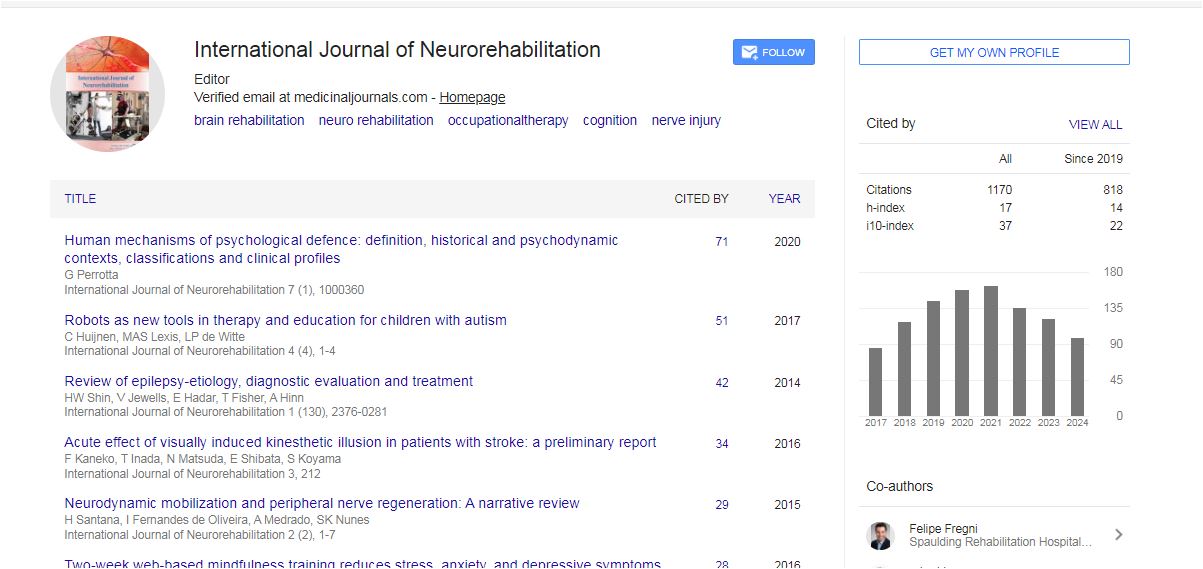
International Journal of Neurorehabilitation received 1078 citations as per Google Scholar report