Perspective - (2025) Volume 12, Issue 6
Received: 01-Dec-2025, Manuscript No. ijn-26-184028;
Editor assigned: 03-Dec-2025, Pre QC No. P-184028;
Reviewed: 17-Dec-2025, QC No. Q-184028;
Revised: 22-Dec-2025, Manuscript No. R-184028;
Published:
29-Dec-2025
, DOI: 10.37421/2376-0281.2025.12.665
Citation: Zayed, Hassan. ”Neurorehabilitation For Post-COVID Neurological Complications.” Int J Neurorehabilitation Eng 12 (2025):665.
Copyright: © 2025 Zayed H. This is an open-access article distributed under the terms of the Creative Commons Attribution License, which permits unrestricted use, distribution and reproduction in any medium, provided the original author and source are credited.
The global health crisis precipitated by COVID-19 has brought to the forefront a spectrum of lingering health issues, with neurological complications emerging as a significant and growing concern among survivors. These post-infectious sequelae present a complex challenge, necessitating a deep understanding of their underlying mechanisms and the development of effective management strategies. Neurorehabilitation has thus become an indispensable component of recovery, aiming to restore function and enhance the quality of life for individuals affected by these neurological deficits [1].
The persistence of neurological symptoms following COVID-19 infection is often attributed to neuroinflammatory processes that can affect the central nervous system. The virus's ability to trigger enduring inflammation poses a considerable threat to neuronal health and function, leading to a range of debilitating conditions. Neurorehabilitation plays a pivotal role in mitigating these effects by fostering neuroplasticity and alleviating symptoms linked to inflammation [2].
Among the most frequently reported neurological consequences is cognitive impairment, colloquially termed 'brain fog.' This condition manifests as difficulties with memory, attention, and executive functions, significantly impacting daily life. Cognitive rehabilitation strategies, encompassing targeted exercises and techniques, have shown promise in ameliorating these deficits, offering a structured approach to cognitive recovery [3].
The physical repercussions of COVID-19 on motor function are also a substantial area of concern, with many patients experiencing impaired mobility, balance issues, and muscle weakness. Neurorehabilitation, particularly through physiotherapy, offers evidence-based interventions aimed at restoring strength, coordination, and balance, thereby improving motor outcomes and functional independence [4].
Beyond the direct neurological and physical impacts, the psychological burden of COVID-19 cannot be overlooked. Anxiety, depression, and post-traumatic stress disorder are common comorbidities that can exacerbate neurological symptoms and hinder recovery. Integrating mental health support into neurorehabilitation programs is crucial for addressing the holistic well-being of post-COVID patients [5].
As the number of individuals experiencing post-COVID neurological sequelae continues to rise, the delivery of neurorehabilitation services faces logistical and accessibility challenges. Telemedicine and digital health technologies are emerging as vital tools, enabling remote monitoring and virtual therapy sessions, thereby extending the reach of rehabilitation to a broader patient population, including those in remote areas or with mobility limitations [6].
Speech and swallowing difficulties, such as dysphagia, represent another set of debilitating symptoms that affect a significant number of post-COVID patients. Specialized interventions provided by speech-language pathologists are essential for evaluating and treating these issues, ensuring that patients can regain safe and effective communication and nutritional intake [7].
Recognizing that the effects of COVID-19 on the nervous system can be long-lasting, the field of neurorehabilitation is continually evolving. A focus on standardized assessment tools and evidence-based protocols is paramount for effectively managing persistent neurological symptoms. Ongoing research and the development of clinical guidelines are critical for advancing long-term patient care [8].
Functional limitations following COVID-19 extend to daily living activities, work, and leisure, impacting a patient's overall independence and participation in society. Occupational therapy plays a crucial role by employing adaptive strategies, assistive devices, and environmental modifications to help patients regain their ability to perform these essential tasks [9].
A thorough understanding of the pathophysiology of post-COVID neurological complications, including conditions like Guillain-Barré syndrome, encephalitis, and cerebrovascular events, is fundamental to designing targeted neurorehabilitation interventions. This knowledge base directly informs the development of strategies aimed at improving patient outcomes and facilitating recovery [10].
The emergent challenge of neurological complications following COVID-19 infection underscores the critical need for comprehensive neurorehabilitation strategies tailored to the unique needs of affected individuals. These complications can range from subtle cognitive deficits to severe motor impairments and psychological distress, creating a complex landscape for recovery. Effective neurorehabilitation aims to address these multifaceted issues through a combination of therapeutic modalities designed to restore function and improve the overall quality of life for post-COVID patients [1].
Neuroinflammation is increasingly recognized as a primary driver of many post-COVID neurological sequelae. The virus's ability to provoke persistent inflammatory responses within the central nervous system can lead to neuronal damage and dysfunction. Neurorehabilitation interventions are designed to counteract these effects by promoting neuroplasticity, which is the brain's capacity to reorganize itself, and by reducing inflammation-related symptoms. A multidisciplinary approach integrating pharmacological and rehabilitative therapies is often advocated to optimize outcomes [2].
Cognitive dysfunction, commonly referred to as 'brain fog,' is a pervasive symptom experienced by many post-COVID patients. This can manifest as problems with concentration, memory, and information processing, significantly hindering daily functioning. Cognitive rehabilitation programs employ specific exercises and techniques, such as memory training and attention-building activities, to target these deficits and promote cognitive recovery. Patient education and coping strategies are also integral components of these programs [3].
Motor deficits represent another significant challenge for post-COVID patients, with common issues including gait disturbances, impaired balance, and weakness in the limbs. Neurorehabilitation, particularly through physiotherapy, provides targeted interventions aimed at improving motor control and mobility. Evidence supports the efficacy of exercises designed to enhance strength, coordination, and balance, ultimately contributing to improved functional outcomes and a greater degree of independence [4].
The psychological impact of COVID-19, including anxiety, depression, and PTSD, often coexists with neurological symptoms and can complicate the recovery process. Comprehensive neurorehabilitation necessitates the integration of mental health support and psychological interventions to address the emotional and mental well-being of patients. This holistic approach ensures that all aspects of a patient's health are considered during the rehabilitation journey [5].
The widespread nature of post-COVID neurological sequelae has highlighted the importance of accessible and adaptable rehabilitation services. Telemedicine and digital health technologies are playing an increasingly vital role in delivering neurorehabilitation, offering remote monitoring, virtual therapy, and digital platforms. These innovations are particularly beneficial for patients with limited mobility or those residing in geographically isolated areas, expanding the reach of care [6].
Speech and swallowing disorders are common and distressing consequences of COVID-19, affecting communication and nutrition. Speech-language pathologists utilize specialized evaluation methods and therapeutic interventions, such as dysphagia management techniques and targeted speech exercises, to address these issues. These interventions are crucial for restoring functional communication and safe swallowing abilities [7].
Understanding the long-term neurological outcomes of COVID-19 is an evolving area of research, and consequently, neurorehabilitation strategies are also developing. The development and implementation of standardized assessment tools and evidence-based protocols are essential for managing persistent neurological symptoms effectively. Continued research and the refinement of clinical guidelines are vital for improving long-term patient care and outcomes [8].
Occupational therapy focuses on helping post-COVID patients regain their ability to perform daily living activities, return to work, and engage in leisure pursuits. This involves addressing functional limitations through adaptive strategies, the use of assistive devices, and modifications to the patient's environment. The goal is to enhance independence and promote greater participation in meaningful activities [9].
The pathophysiology of post-COVID neurological manifestations, including conditions such as Guillain-Barré syndrome, encephalitis, and cerebrovascular events, provides a critical foundation for developing effective neurorehabilitation interventions. By understanding the underlying disease mechanisms, clinicians can design more targeted and efficient therapeutic approaches to optimize patient recovery and improve functional outcomes [10].
COVID-19 has led to a significant increase in neurological complications, necessitating comprehensive neurorehabilitation. These complications include fatigue, cognitive impairment, motor dysfunction, and psychological issues. Neurorehabilitation strategies, such as physical, occupational, and speech therapy, are crucial for recovery. Early intervention and individualized treatment plans are emphasized. Neuroinflammation is a key factor, and therapies aim to promote neuroplasticity. Cognitive rehabilitation targets 'brain fog' with specific exercises. Motor rehabilitation focuses on improving strength, coordination, and balance. Psychological support is integrated into care. Telemedicine is expanding access to rehabilitation services. Speech and swallowing disorders require specialized attention. Long-term outcomes are being studied, driving the evolution of rehabilitation protocols. Occupational therapy addresses functional limitations in daily life. Understanding the pathophysiology of neurological manifestations guides the development of targeted interventions. Overall, a multidisciplinary and individualized approach is essential for optimizing recovery in post-COVID patients.
None
None
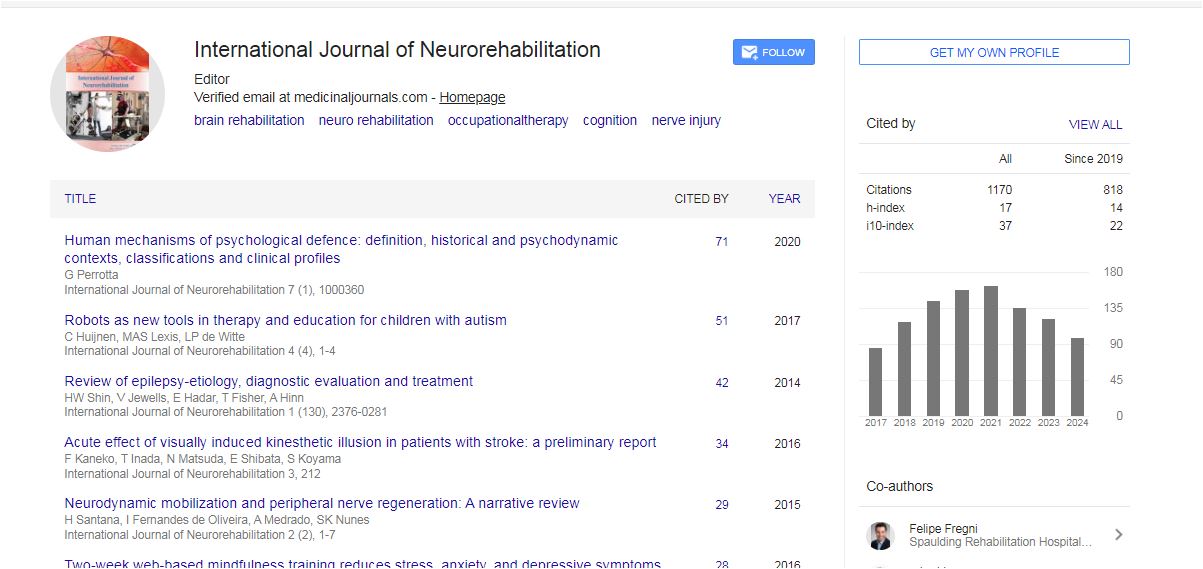
International Journal of Neurorehabilitation received 1078 citations as per Google Scholar report