Opinion - (2025) Volume 12, Issue 5
Received: 01-Oct-2025, Manuscript No. ijn-26-184009;
Editor assigned: 03-Oct-2025, Pre QC No. P-184009;
Reviewed: 17-Oct-2025, QC No. Q-184009;
Revised: 22-Oct-2025, Manuscript No. R-184009;
Published:
29-Oct-2025
, DOI: 10.37421/2376-0281.2025.12.652
Citation: Noor, Fatima. ”Neurorehabilitation: Enhancing Brain Injury Recovery with Technology.” Int J Neurorehabilitation Eng 12 (2025):652.
Copyright: © 2025 Noor F. This is an open-access article distributed under the terms of the Creative Commons Attribution License, which permits unrestricted use, distribution and reproduction in any medium, provided the original author and source are credited.
Post-surgical brain injury represents a significant clinical challenge, necessitating comprehensive neurorehabilitation strategies to optimize patient recovery and functional outcomes. The complexity of such injuries demands a multifaceted approach that addresses a wide spectrum of deficits, ranging from motor and cognitive impairments to emotional dysregulation. Early and intensive therapeutic interventions, meticulously tailored to the unique needs of each individual, have demonstrated the greatest potential for enhancing recovery trajectories. The integration of advanced technological tools, including virtual reality and robotics, is actively transforming the landscape of neurorehabilitation, offering novel avenues for more effective and engaging therapeutic experiences. This review aims to consolidate current evidence and explore future directions in the field of neurorehabilitation following traumatic brain injury, highlighting key areas of intervention such as motor control, cognitive functions, and emotional regulation, with a focus on the importance of personalized and early therapeutic engagement. The critical role of early intervention in neurorehabilitation post-neurosurgery cannot be overstated, as immediate initiation of therapy can actively prevent secondary complications, significantly reduce prolonged hospital stays, and ultimately improve the long-term prognosis for patients. The establishment and utilization of multidisciplinary teams are paramount for delivering comprehensive care, effectively addressing the intricate physical, cognitive, and psychological aspects inherent in the recovery process, emphasizing the fundamental need for personalized treatment plans that adapt dynamically to the evolving needs of each patient. Technological advancements are profoundly impacting neurorehabilitation strategies, particularly for patients recovering from post-surgical brain injury, with robotic-assisted therapy offering precise and repetitive movements that are instrumental in motor skill recovery and virtual reality providing immersive environments for engaging functional task practice, thereby enhancing both patient motivation and adherence to therapy protocols. These cutting-edge tools are also enabling objective measurement of patient progress and facilitating personalized adjustments to ongoing treatment regimens, leading to more efficient and effective rehabilitation outcomes. Cognitive rehabilitation plays a pivotal role in the recovery process following post-surgical brain injury, as deficits in crucial domains such as attention, memory, executive functions, and processing speed are commonly observed in affected individuals. Therapies in this area are specifically designed to improve these cognitive domains through the implementation of compensatory strategies and retraining techniques, effectively harnessing the inherent capacity of neuroplasticity to facilitate the brain's remarkable ability to reorganize and adapt, ultimately leading to significant functional improvements. Motor rehabilitation following brain surgery is meticulously designed to restore voluntary movement capabilities and substantially improve functional mobility in patients. This rehabilitation employs a variety of specialized techniques, including task-oriented training, constraint-induced movement therapy, and functional electrical stimulation, all underpinned by the core principles of motor learning, such as the critical importance of repetition, consistent feedback, and strategic practice variability, which are central to achieving effective motor recovery. The psychosocial aspects of recovery are critically important for individuals experiencing post-surgical brain injury, as many patients encounter challenges related to emotional dysregulation, depression, anxiety, and social isolation. To address these complex issues, psychological interventions, encompassing vital components such as professional counseling, structured support groups, and cognitive behavioral therapy, are considered essential elements of a truly comprehensive neurorehabilitation program. Neuroplasticity serves as the fundamental biological basis for all neurorehabilitation efforts. Following a brain injury, the brain possesses an extraordinary capacity to reorganize its structure and function to effectively compensate for the damage incurred, and rehabilitation strategies are strategically developed to actively promote and guide these inherent plastic changes, thereby significantly facilitating the recovery of lost or impaired functions. The long-term management of individuals who have sustained post-surgical brain injury necessitates continuous assessment and the dynamic adaptation of rehabilitation plans to meet evolving patient needs. Key goals in this prolonged phase of care include maximizing functional independence and significantly enhancing overall quality of life, with community reintegration and vocational rehabilitation emerging as crucial considerations for ensuring successful transitions back into the patient's daily life and societal roles. A deeper understanding of the intricate biological mechanisms that underpin the recovery process from brain injury is absolutely essential for the development of more potent and effective neurorehabilitation strategies. Ongoing research efforts focused on critical areas such as neuroinflammation, the complex functions of glial cells, and the nuanced processes of synaptic plasticity are providing invaluable insights into novel approaches that can effectively promote neural repair and accelerate functional recovery. The integration of advanced imaging techniques into neurorehabilitation practices enables a more precise and comprehensive assessment of brain structure and function, both prior to and throughout the course of interventions. Techniques such as functional magnetic resonance imaging (fMRI) and electroencephalography (EEG) are capable of providing objective measures of brain activity and connectivity patterns, which are invaluable for guiding highly personalized rehabilitation approaches and accurately tracking patient progress over time.
Neurorehabilitation following post-surgical brain injury is a critical process aimed at optimizing functional outcomes by addressing a wide array of deficits. This involves restoring lost abilities and compensating for cognitive, motor, and emotional impairments. Key interventions focus on areas like motor control, cognitive functions, and emotional regulation, emphasizing the importance of early and intensive therapy tailored to individual patient needs. Technological advancements, including virtual reality and robotics, are significantly enhancing these therapeutic approaches, offering new possibilities for recovery. The profound impact of early intervention in neurorehabilitation post-neurosurgery cannot be underestimated; initiating therapy promptly can prevent secondary complications, shorten hospital stays, and improve long-term prognosis. Multidisciplinary teams are vital for comprehensive care, addressing physical, cognitive, and psychological recovery aspects, with personalized treatment plans that adapt to evolving patient needs being fundamental to success. Technological advancements are revolutionizing neurorehabilitation strategies for post-surgical brain injury. Robotic-assisted therapy enables precise, repetitive movements crucial for motor skill recovery, while virtual reality offers immersive environments that enhance motivation and adherence through engaging functional task practice. These tools also allow for objective progress measurement and individualized treatment adjustments. Cognitive rehabilitation is a cornerstone in the recovery from post-surgical brain injury, addressing common deficits in attention, memory, executive functions, and processing speed. Therapies focus on improving these domains through compensatory strategies and retraining, leveraging neuroplasticity to foster the brain's reorganization and adaptation, leading to functional gains. Motor rehabilitation after brain surgery is designed to restore voluntary movement and enhance functional mobility. It employs techniques such as task-oriented training, constraint-induced movement therapy, and functional electrical stimulation, all grounded in motor learning principles like repetition, feedback, and practice variability, which are essential for effective recovery. Psychosocial aspects are paramount in the recovery journey of individuals with post-surgical brain injury, as many experience emotional dysregulation, depression, anxiety, and social isolation. Psychological interventions, including counseling, support groups, and cognitive behavioral therapy, are indispensable components of a holistic neurorehabilitation program. Neuroplasticity serves as the biological bedrock of neurorehabilitation. Post-brain injury, the brain exhibits an inherent ability to reorganize its structure and function to compensate for damage. Rehabilitation strategies are specifically designed to promote and guide these plastic changes, thereby facilitating the restoration of lost functions. Long-term management for individuals with post-surgical brain injury necessitates ongoing assessment and adaptive planning. The primary goals are achieving functional independence and improving quality of life, with community reintegration and vocational rehabilitation playing crucial roles in successful transitions back to daily living. Investigating the biological mechanisms underlying brain injury recovery is fundamental to developing more effective neurorehabilitation strategies. Current research into neuroinflammation, glial cell function, and synaptic plasticity is providing critical insights into promoting neural repair and functional recovery. Integrating advanced neuroimaging techniques with neurorehabilitation offers enhanced assessment of brain structure and function. Modalities like fMRI and EEG provide objective data on brain activity and connectivity, guiding personalized rehabilitation and progress tracking.
Post-surgical brain injury recovery is significantly enhanced by neurorehabilitation, focusing on motor, cognitive, and emotional aspects. Early and intensive therapy, personalized to individual needs, yields the best results. Technological advancements like virtual reality and robotics are transforming therapeutic approaches. Multidisciplinary teams and adaptable treatment plans are crucial for comprehensive care. Cognitive and motor rehabilitation strategies leverage neuroplasticity and motor learning principles. Psychosocial support is vital for emotional well-being and social reintegration. Long-term management emphasizes functional independence and quality of life. Understanding underlying biological mechanisms and utilizing advanced neuroimaging aid in developing more effective strategies.
None
None
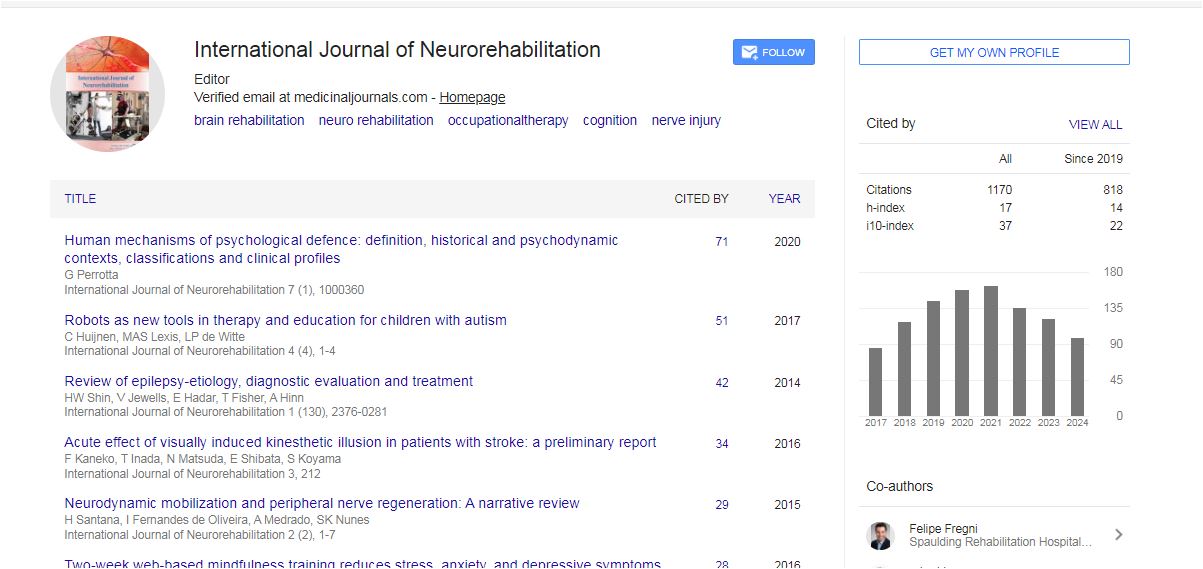
International Journal of Neurorehabilitation received 1078 citations as per Google Scholar report