Brief Report - (2025) Volume 12, Issue 2
Received: 01-Apr-2025, Manuscript No. ijn-26-183965;
Editor assigned: 03-Apr-2025, Pre QC No. P-183965;
Reviewed: 17-Apr-2025, QC No. Q-183965;
Revised: 22-Apr-2025, Manuscript No. R-183965;
Published:
29-Apr-2025
, DOI: 10.37421/2376-0281.2025.12.620
Citation: Hughes, Daniel R.. ”Neuroplasticity: Brain’s Power for Recovery and Repair.” Int J Neurorehabilitation Eng 12 (2025):620.
Copyright: © 2025 Hughes R. Daniel This is an open-access article distributed under the terms of the Creative Commons Attribution License, which permits unrestricted use, distribution and reproduction in any medium, provided the original author and source are credited.
Neuroplasticity, the brain's remarkable ability to reorganize itself by forming new neural connections, is fundamental to recovery from neurological injuries and disorders. This inherent capacity of the brain allows it to adapt, compensate for damage, and regain lost functions, forming the cornerstone of modern neurological rehabilitation strategies. Understanding the intricate molecular and cellular underpinnings of neuroplasticity is therefore crucial for guiding the development of more effective and targeted rehabilitation approaches for individuals with neurological impairments [1].
Repetitive functional training, specifically guided by the principles of neuroplasticity, has demonstrated significant efficacy in enhancing both motor and cognitive recovery following stroke. This therapeutic paradigm involves the repeated practice of meaningful and functional tasks, thereby actively promoting adaptive changes within the brain's neural circuitry. The increasing integration of advanced technologies such as virtual reality and robotics further enables the delivery of high-intensity, task-specific training, amplifying neuroplastic responses and optimizing recovery outcomes [2].
The role of enriched environments and robust social interaction in fostering neuroplasticity and facilitating recovery after brain injury cannot be overstated. These external factors possess the profound ability to stimulate neural circuits, enhance overall cognitive function, and improve emotional well-being, all of which collectively contribute to superior rehabilitation outcomes. Consequently, the deliberate implementation of these elements within clinical rehabilitation settings is considered vital for maximizing patient potential [3].
Pharmacological interventions designed to modulate neuroplasticity, including certain classes of antidepressants and administered growth factors, offer a promising avenue for augmenting the effects of conventional rehabilitation therapies. However, the judicious integration of these agents into rehabilitation programs necessitates careful consideration of potential drug interactions and individual patient-specific responses to ensure optimal efficacy and safety [4].
Beyond synaptic plasticity, the process of neurogenesis, characterized by the birth of new neurons, also contributes to neuroplasticity and the brain's capacity for repair. While generally less adaptable than changes in synaptic connections, strategies that actively promote neurogenesis can prove beneficial in managing specific neurological conditions and supporting recovery processes [5].
Non-invasive brain stimulation techniques, notably transcranial magnetic stimulation (TMS) and transcranial direct current stimulation (tDCS), are emerging as powerful and versatile tools for modulating cortical excitability and consequently enhancing neuroplasticity. These innovative methods can effectively prime the brain for subsequent learning processes and significantly facilitate functional recovery following neurological insult [6].
Cognitive rehabilitation strategies are meticulously designed to leverage the principles of neuroplasticity for the specific purpose of improving executive functions, memory, and attention deficits that frequently arise after acquired brain injury. The efficacy of these strategies is significantly enhanced through the application of personalized and goal-directed cognitive exercises, which are key to achieving meaningful and lasting functional gains [7].
The plasticity observed within the somatosensory and motor cortices following peripheral nerve injury is critically important for the restoration of functional capabilities. Rehabilitation efforts in these cases are strategically aimed at re-establishing appropriate sensory-motor mappings and optimizing the cortical representations of the affected body parts, thereby promoting recovery [8].
The significant role of sleep in the consolidation of newly learned motor skills and the broader facilitation of neuroplasticity is gaining increasing recognition within the scientific community. Consequently, it is imperative that rehabilitation programs thoughtfully consider and actively work to optimize sleep hygiene as a means of robustly supporting the complex recovery processes individuals undergo [9].
A deeper understanding of the intricate molecular mechanisms that underpin neuroplasticity, particularly the involvement of neurotrophic factors such as brain-derived neurotrophic factor (BDNF), provides critical targets for the development of enhanced recovery strategies. Future research endeavors are predominantly focused on devising and refining therapies that can specifically and effectively activate these vital pathways within the brain [10].
Neuroplasticity, the brain's inherent capability to reorganize its structure and function by establishing new neural connections, stands as a fundamental mechanism enabling recovery from a spectrum of neurological injuries and disorders. This remarkable adaptability allows the brain to compensate for damage and facilitate the regain of lost functions, underpinning the efficacy of contemporary neurological rehabilitation [1].
Repetitive functional training, when deliberately guided by neuroplastic principles, has been shown to significantly improve both motor and cognitive recovery in patients who have experienced a stroke. This approach centers on the consistent practice of tasks that are meaningful to the individual, thereby stimulating adaptive changes in the brain. Emerging technologies like virtual reality and robotics are increasingly utilized to deliver training that is both high-intensity and task-specific, amplifying the brain's neuroplastic responses [2].
The profound influence of enriched environments and active social engagement on promoting neuroplasticity and fostering recovery after brain injury is well-documented. These factors serve to stimulate neural circuits, enhance cognitive capabilities, and improve emotional well-being, all of which are crucial components contributing to successful rehabilitation outcomes. Therefore, incorporating these elements into rehabilitation settings is considered essential [3].
Pharmacological interventions aimed at modulating neuroplasticity, such as the administration of certain antidepressants and growth factors, can enhance the benefits derived from standard rehabilitation therapies. However, the successful integration of these pharmacological agents into comprehensive rehabilitation programs requires meticulous attention to potential drug interactions and individual patient responses [4].
While synaptic plasticity is a primary driver of adaptation, the process of neurogenesis, the creation of new neurons, also contributes to neuroplasticity and brain repair. Although less adaptable than synaptic changes, interventions that promote neurogenesis can offer therapeutic advantages for specific neurological conditions, aiding in recovery processes [5].
Non-invasive brain stimulation techniques, including transcranial magnetic stimulation (TMS) and transcranial direct current stimulation (tDCS), are rapidly advancing as potent methods for modulating cortical excitability and thereby boosting neuroplasticity. These techniques can effectively prepare the brain for new learning and expedite functional recovery following neurological damage [6].
Cognitive rehabilitation strategies are designed to harness the power of neuroplasticity to address deficits in executive functions, memory, and attention that commonly occur after acquired brain injuries. The effectiveness of these strategies is maximized through the use of personalized and goal-oriented cognitive exercises, which are instrumental in achieving significant functional improvements [7].
Following peripheral nerve injury, the plasticity of the somatosensory and motor cortices plays a critical role in the recovery of function. Rehabilitation interventions are specifically designed to help re-establish proper sensory-motor mappings and optimize the brain's representation of the affected body parts, thereby promoting functional restoration [8].
The consolidation of motor skills and the broader process of neuroplasticity are significantly influenced by sleep, a role that is increasingly acknowledged. Consequently, rehabilitation programs should actively address and optimize sleep hygiene to provide optimal support for an individual's recovery journey [9].
Investigating the molecular underpinnings of neuroplasticity, including the function of neurotrophic factors like BDNF, is paramount for identifying novel targets to enhance brain repair. Ongoing research is heavily focused on developing therapeutic approaches that can specifically activate these crucial molecular pathways to promote recovery [10].
Neuroplasticity is the brain's ability to reorganize by forming new neural connections, essential for recovery from neurological injuries. Therapeutic interventions like physical therapy, cognitive training, and enriched environments leverage these mechanisms. Repetitive functional training, particularly after stroke, enhances recovery through task-specific practice, often augmented by technology. Pharmacological and non-invasive brain stimulation techniques offer additional ways to modulate neuroplasticity. While neurogenesis also contributes to brain repair, sleep plays a vital role in consolidating learned skills and facilitating plasticity. Understanding molecular pathways, such as those involving BDNF, is key to developing future therapies.
None
None
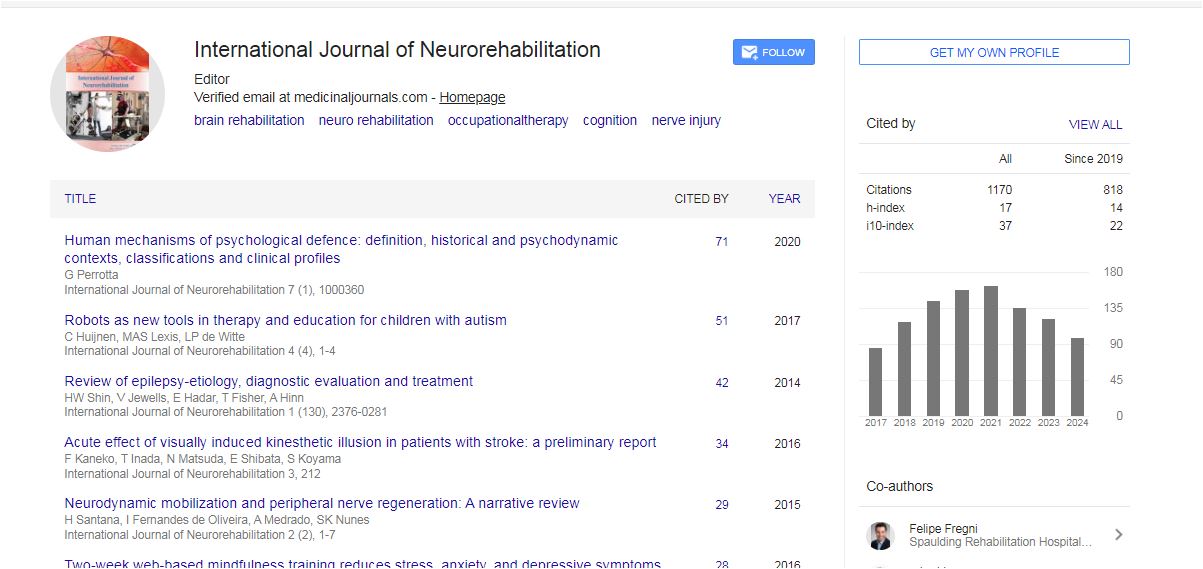
International Journal of Neurorehabilitation received 1078 citations as per Google Scholar report