Brief Report - (2025) Volume 13, Issue 4
Received: 01-Aug-2025, Manuscript No. JCMG-26-185553;
Editor assigned: 03-Aug-2025, Pre QC No. P-185553;
Reviewed: 18-Aug-2025, QC No. Q-185553;
Revised: 22-Aug-2025, Manuscript No. R-185553;
Published:
29-Aug-2025
, DOI: 10.37421/2472-128X.2025.13.356
Citation: Mensah, Isaac. ”Neurogenomics: Revolutionizing Brain Disorder Understanding and Treatment.” J Clin Med Genomics 13 (2025):356.
Copyright: © 2025 Mensah I. This is an open-access article distributed under the terms of the Creative Commons Attribution License, which permits unrestricted use, distribution and reproduction in any medium, provided the original author and source are credited.
Neurogenomics is profoundly revolutionizing our comprehension of brain disorders by identifying the genetic factors underlying conditions such as Alzheimer's, Parkinson's, schizophrenia, and autism. This scientific domain investigates how an individual's genomic variations impact brain structure, function, and susceptibility to neurological and psychiatric diseases, utilizing advanced sequencing technologies and sophisticated bioinformatic analyses to uncover novel genes, regulatory elements, and pathways implicated in these complex conditions. The insights gleaned from this genetic exploration are paving the way for more precise diagnostics, personalized therapeutic strategies, and the development of targeted interventions aimed at mitigating disease progression or preventing onset. Genome-wide association studies (GWAS) serve as a critical tool for identifying genetic variants associated with complex brain disorders. Recent GWAS have successfully pinpointed numerous loci linked to Alzheimer's disease, uncovering genes involved in amyloid processing, tau pathology, and neuroinflammation. Similarly, substantial advancements have been made in understanding the genetic architecture of Parkinson's disease, with identified variants influencing dopamine metabolism and protein aggregation. The application of polygenic risk scores, derived from GWAS data, presents a promising avenue for predicting an individual's predisposition to these conditions. The significance of rare genetic variants in brain disorders is increasingly appreciated, particularly in conditions characterized by high heritability and early onset. Whole-exome and whole-genome sequencing have proven instrumental in identifying causative mutations within genes associated with intellectual disability, epilepsy, and autism spectrum disorder. Subsequent functional studies are now focused on elucidating how these rare variants disrupt neuronal development, synaptic function, and neural circuitries, thereby providing critical insights into disease mechanisms. Epigenetic modifications, including DNA methylation and histone modifications, play a substantial role in regulating gene expression within the brain and are implicated in a variety of neurological and psychiatric disorders. Neurogenomic studies are actively exploring how environmental factors interact with an individual's genetic predisposition through epigenetic mechanisms, thereby influencing brain development and disease risk. A deeper understanding of these dynamic changes holds the potential for therapeutic interventions targeting epigenetic pathways. The advancement of precision medicine for brain disorders is intrinsically linked to neurogenomic insights. By categorizing patients based on their genetic profiles, clinicians can personalize treatments to individuals most likely to respond, consequently enhancing efficacy and minimizing adverse effects. This approach encompasses pharmacogenomics, which guides drug selection and dosage according to an individual's genetic makeup, a particularly relevant aspect for psychiatric medications. Neuroinflammation is a prevalent pathological characteristic across a wide array of brain disorders, and genetic factors significantly modulate the inflammatory response. Neurogenomic studies are identifying genes that play a role in immune pathways within the central nervous system and contribute to disease pathogenesis. This knowledge is indispensable for the development of immunomodulatory therapies for conditions such as Alzheimer's and multiple sclerosis. The gut-brain axis, a sophisticated bidirectional communication system, is influenced by genetic factors. Neurogenomic approaches are investigating how microbial metabolites and host genetics interact to affect brain function and behavior, with implications for mood disorders, anxiety, and neurodevelopmental conditions. The identification of genetic predispositions that alter the gut microbiome's influence on the brain offers novel therapeutic targets. Computational and bioinformatics tools are essential for analyzing the extensive datasets generated by neurogenomic research. Machine learning and artificial intelligence are being employed to discern complex genetic patterns, predict disease risk, and discover novel therapeutic targets. These technological advancements are accelerating the translation of genetic discoveries into practical clinical applications. Navigating the complexities of neurogenomic research for brain disorders presents several challenges, including the inherent complexity of these conditions, the heterogeneity observed within patient populations, and the critical need for large-scale, well-phenotyped cohorts. Furthermore, ethical considerations surrounding genetic data privacy and the potential for discrimination are of paramount importance. Addressing these multifaceted challenges necessitates interdisciplinary collaboration and the adoption of innovative research strategies. The trajectory of neurogenomics holds immense promise for further elucidating the genetic underpinnings of brain disorders, leading to enhanced diagnostic accuracy, the development of personalized treatment plans, and potentially novel preventative strategies. Progress in multi-omics integration, single-cell genomics, and functional genomics will undoubtedly deepen our understanding of how genetic variations translate into cellular and organismal phenotypes associated with neurological and psychiatric conditions.
Neurogenomics is fundamentally transforming our understanding of brain disorders by pinpointing the genetic underpinnings of conditions like Alzheimer's, Parkinson's, schizophrenia, and autism. This field investigates how variations in an individual's genome influence brain structure, function, and susceptibility to neurological and psychiatric diseases. By employing advanced sequencing technologies and sophisticated bioinformatic analyses, researchers are identifying novel genes, regulatory elements, and pathways implicated in these complex conditions. This genetic insight is paving the way for more precise diagnostics, personalized therapeutic strategies, and the development of targeted interventions aimed at mitigating disease progression or preventing onset. Genome-wide association studies (GWAS) are crucial for identifying genetic variants associated with complex brain disorders. Recent GWAS have uncovered numerous loci linked to Alzheimer's disease, revealing genes involved in amyloid processing, tau pathology, and neuroinflammation. Similarly, significant progress has been made in understanding the genetic architecture of Parkinson's disease, with identified variants influencing dopamine metabolism and protein aggregation. The application of polygenic risk scores, derived from GWAS data, offers a promising avenue for predicting an individual's predisposition to these conditions. The role of rare genetic variants in brain disorders is increasingly recognized, particularly in conditions with high heritability and early onset. Whole-exome and whole-genome sequencing have been instrumental in identifying causative mutations in genes associated with intellectual disability, epilepsy, and autism spectrum disorder. Functional studies are now focused on elucidating how these rare variants disrupt neuronal development, synaptic function, and neural circuitries, providing critical insights into disease mechanisms. Epigenetic modifications, such as DNA methylation and histone modifications, play a significant role in regulating gene expression in the brain and are implicated in various neurological and psychiatric disorders. Neurogenomic studies are exploring how environmental factors interact with an individual's genetic predisposition through epigenetic mechanisms to influence brain development and disease risk. Understanding these dynamic changes opens up possibilities for therapeutic interventions that target epigenetic pathways. The development of precision medicine for brain disorders hinges on neurogenomic insights. By stratifying patients based on their genetic profiles, clinicians can tailor treatments to individuals most likely to respond, thereby improving efficacy and minimizing adverse effects. This includes pharmacogenomics, which guides drug selection and dosage based on an individual's genetic makeup, particularly relevant for psychiatric medications. Neuroinflammation is a common pathological feature across a spectrum of brain disorders, and genetic factors significantly influence the inflammatory response. Neurogenomic studies are identifying genes involved in immune pathways within the central nervous system that contribute to disease pathogenesis. This understanding is crucial for developing immunomodulatory therapies for conditions like Alzheimer's and multiple sclerosis. The gut-brain axis is a complex bidirectional communication system influenced by genetic factors. Neurogenomic approaches are exploring how microbial metabolites and host genetics interact to affect brain function and behavior, with implications for mood disorders, anxiety, and neurodevelopmental conditions. Identifying genetic predispositions that alter the gut microbiome's influence on the brain offers novel therapeutic targets. Computational and bioinformatics tools are indispensable for analyzing the vast datasets generated by neurogenomic research. Machine learning and artificial intelligence are being employed to identify complex genetic patterns, predict disease risk, and discover novel therapeutic targets. These advancements are accelerating the translation of genetic discoveries into clinical applications. Challenges in neurogenomic research include the high complexity of brain disorders, heterogeneity within patient populations, and the need for large-scale, well-phenotyped cohorts. Ethical considerations regarding genetic data privacy and potential discrimination are also paramount. Addressing these challenges requires interdisciplinary collaboration and innovative research strategies. The future of neurogenomics promises further elucidation of the genetic basis of brain disorders, leading to improved diagnostic accuracy, personalized treatment plans, and potentially novel preventative strategies. Advances in multi-omics integration, single-cell genomics, and functional genomics will deepen our understanding of how genetic variations translate into cellular and organismal phenotypes associated with neurological and psychiatric conditions.
Neurogenomics is revolutionizing brain disorder understanding by identifying genetic underpinnings of conditions like Alzheimer's, Parkinson's, schizophrenia, and autism. Advanced technologies and bioinformatics reveal genes, regulatory elements, and pathways, leading to precise diagnostics and personalized therapies. Genome-wide association studies (GWAS) are vital for identifying disease-associated variants, with progress in Alzheimer's and Parkinson's research. Rare genetic variants are also crucial, with whole-exome and whole-genome sequencing identifying causative mutations. Epigenetic modifications and environmental interactions are explored for their role in brain disorders. Precision medicine leverages neurogenomic insights for tailored treatments, including pharmacogenomics. Neuroinflammation's genetic determinants are being identified, paving the way for immunomodulatory therapies. The gut-brain axis's genetic influences on brain function are under investigation. Computational tools like AI and machine learning accelerate discovery. Challenges include research complexity, data heterogeneity, and ethical considerations. The future promises enhanced diagnostics, personalized treatments, and novel prevention strategies through multi-omics and advanced genomic techniques.
None
None
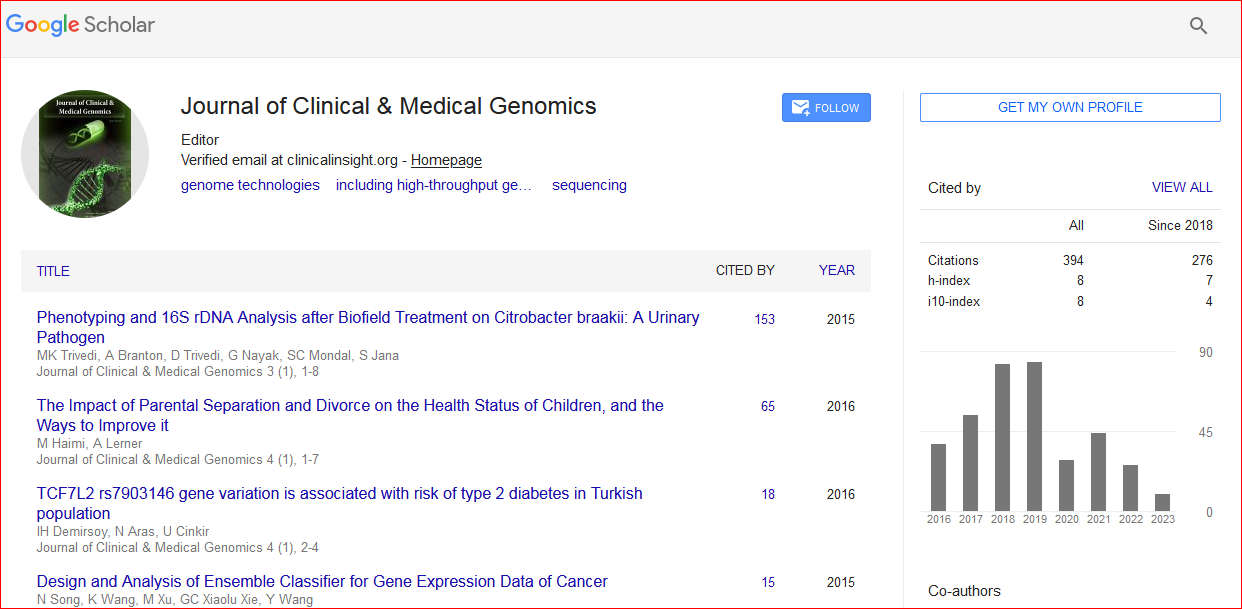
Journal of Clinical & Medical Genomics received 391 citations as per Google Scholar report