Commentary - (2025) Volume 13, Issue 2
Received: 01-Apr-2025, Manuscript No. jcdd-25-175423;
Editor assigned: 03-Apr-2025, Pre QC No. P-175423;
Reviewed: 17-Apr-2025, QC No. Q-175423;
Revised: 22-Apr-2025, Manuscript No. R-175423;
Published:
29-Apr-2025
, DOI: 10.37421/2329-9517.2025.13.656
Citation: Mehta, Rajesh. ”Myocardial Infarction: Evolving Diagnosis,
Treatment, Care.” J Cardiovasc Dis Diagn 13 (2025):656.
Copyright: © 2025 Mehta R. This is an open-access article distributed under the terms of the Creative Commons Attribution License, which permits unrestricted use, distribution
and reproduction in any medium, provided the original author and source are credited.
This meta-analysis investigated the effectiveness of early invasive versus selective invasive strategies for non-ST-segment elevation myocardial infarction (NSTEMI) patients. The findings suggest that an early invasive approach significantly reduces the risk of major adverse cardiovascular events compared to a selective invasive strategy, supporting its use in NSTEMI management[1].
Spontaneous coronary artery dissection (SCAD) is an increasingly recognized cause of acute myocardial infarction, particularly in younger women. This review article synthesizes current understanding of SCAD's causes, diagnostic approaches, and therapeutic strategies, highlighting the importance of conservative management in most cases and specific revascularization techniques when necessary[2].
This review explores the emerging role of Artificial Intelligence (AI) in improving the diagnosis and prognostic assessment of acute myocardial infarction (AMI). It discusses how AI algorithms, using various clinical data, can enhance early detection, risk stratification, and potentially guide personalized treatment strategies, paving the way for more efficient and accurate patient care[3].
This paper delves into the critical role of inflammation in the pathophysiology of acute myocardial infarction (AMI), exploring the various cellular and molecular mechanisms involved. It also discusses potential anti-inflammatory therapeutic strategies that could mitigate cardiac damage and improve patient outcomes post-AMI by targeting specific inflammatory pathways[4].
This review examines significant sex differences observed in the presentation, diagnosis, treatment, and outcomes of acute myocardial infarction (AMI). It highlights how women often experience atypical symptoms, face diagnostic delays, and may receive less aggressive treatment, emphasizing the need for sex-specific approaches to improve care and reduce disparities[5].
This review explores several novel biomarkers that show promise for the early and accurate diagnosis of acute myocardial infarction (AMI), beyond traditional troponins. It discusses their potential to improve diagnostic sensitivity and specificity, particularly in the critical early hours, which could lead to faster intervention and better patient outcomes[6].
This article reviews the emerging role of microRNAs (miRNAs) as diagnostic biomarkers and potential therapeutic targets in acute myocardial infarction (AMI). It highlights specific miRNA profiles associated with AMI and their involvement in cardiac injury and repair, suggesting new avenues for early detection and novel treatment strategies[7].
This article discusses the long-term prognosis for patients after acute myocardial infarction (AMI) and explores effective management strategies aimed at improving survival and reducing recurrent events. It emphasizes the importance of risk factor modification, adherence to medication, and cardiac rehabilitation for optimizing long-term outcomes and quality of life[8].
This systematic review and meta-analysis investigates the prevalence and impact of psychological distress, such as anxiety and depression, following an acute myocardial infarction (AMI). The findings highlight that a significant proportion of AMI survivors experience psychological issues, underscoring the need for routine screening and integrated psychological support in post-AMI care to improve recovery and quality of life[9].
This meta-analysis evaluates the impact of various lifestyle interventions (e.g., diet, exercise, smoking cessation) on cardiovascular outcomes in patients who have experienced a myocardial infarction (MI). The findings underscore the critical role of comprehensive lifestyle changes in significantly reducing the risk of recurrent cardiovascular events and improving overall prognosis post-MI[10].
Early invasive strategies for Non-ST-segment Elevation Myocardial Infarction (NSTEMI) patients have been shown to significantly reduce the risk of major adverse cardiovascular events when compared to a selective invasive strategy, supporting their widespread use in NSTEMI management [1]. In a distinct cardiac emergency, Spontaneous Coronary Artery Dissection (SCAD) is an increasingly recognized cause of acute myocardial infarction, particularly noted in younger women. Current understanding of SCAD encompasses its causes, diagnostic approaches, and therapeutic strategies, with a strong emphasis on conservative management in most cases, while specific revascularization techniques are employed only when truly necessary [2].
The evolving landscape of acute myocardial infarction (AMI) care is significantly shaped by technological advancements. Artificial Intelligence (AI) is emerging with a pivotal role in enhancing the diagnosis and prognostic assessment of AMI. AI algorithms, leveraging diverse clinical data, can significantly improve early detection, refine risk stratification, and potentially guide personalized treatment strategies, thereby paving the way for more efficient and accurate patient care [3].
Beyond AI, the search for advanced diagnostic tools continues with promising results. Several novel biomarkers are showing significant potential for the early and accurate diagnosis of AMI, extending beyond the capabilities of traditional troponins. These biomarkers promise to improve diagnostic sensitivity and specificity, especially during the critical early hours following an event, which could lead to faster interventions and ultimately, better patient outcomes [6]. Furthermore, microRNAs (miRNAs) are increasingly recognized for their dual role as diagnostic biomarkers and potential therapeutic targets in AMI. Research highlights specific miRNA profiles linked to cardiac injury and repair, suggesting new avenues for both early detection and innovative treatments [7].
A deeper understanding of AMI pathophysiology also reveals critical insights. Inflammation plays a central role in the development and progression of acute myocardial infarction, involving various intricate cellular and molecular mechanisms. Exploring these pathways allows for the identification of potential anti-inflammatory therapeutic strategies that could effectively mitigate cardiac damage and improve patient outcomes post-AMI [4].
Addressing population-specific considerations is also paramount in AMI care. Significant sex differences are consistently observed across the presentation, diagnosis, treatment, and subsequent outcomes of acute myocardial infarction. Studies indicate that women often experience atypical symptoms, may face delays in diagnosis, and might receive less aggressive treatment compared to men, highlighting an urgent need for sex-specific approaches to enhance care and reduce these existing disparities [5].
Finally, long-term patient well-being and recovery after AMI are critical focuses. Effective management strategies aimed at improving survival and reducing recurrent events are essential for patients post-AMI. This involves emphasizing the importance of risk factor modification, diligent adherence to medication regimens, and comprehensive cardiac rehabilitation programs designed to optimize long-term outcomes and enhance overall quality of life [8]. The psychological toll of AMI is also substantial; a systematic review and meta-analysis confirmed a high prevalence and significant impact of psychological distress, including anxiety and depression, among AMI survivors. This underscores the need for routine screening and integrated psychological support as part of post-AMI care to foster better recovery and improve the quality of life [9]. Moreover, comprehensive lifestyle interventions, such as tailored diet plans, regular exercise, and smoking cessation, are shown to have a critical impact on cardiovascular outcomes in patients who have experienced a myocardial infarction. These lifestyle changes are crucial for significantly reducing the risk of recurrent cardiovascular events and improving overall prognosis post-MI [10].
The aggregated research provides a comprehensive view of myocardial infarction, touching on various clinical and scientific facets. One key area focuses on treatment strategies, advocating for an early invasive approach in Non-ST-segment Elevation Myocardial Infarction (NSTEMI) to reduce adverse events. Another highlights conservative management for Spontaneous Coronary Artery Dissection (SCAD), especially in younger women, with revascularization reserved for specific cases. Diagnostic advancements are prominent, with studies exploring the role of Artificial Intelligence (AI) in improving early detection and risk stratification for Acute Myocardial Infarction (AMI), alongside the investigation of novel biomarkers, including microRNAs, to enhance diagnostic accuracy beyond traditional methods. Pathophysiological understandings are also advanced, particularly regarding the critical role of inflammation in AMI and the exploration of potential anti-inflammatory therapies. An important social and clinical consideration is the documented sex differences in AMI presentation, diagnosis, and treatment, calling for tailored approaches to bridge existing disparities. Finally, the research underscores the long-term aspects of post-AMI care, emphasizing effective management strategies for prognosis, the significant impact of psychological distress on survivors, and the crucial role of comprehensive lifestyle interventions in preventing recurrent cardiovascular events and enhancing overall quality of life. Together, these studies paint a picture of ongoing efforts to refine understanding, diagnosis, and patient care for myocardial infarction.
Indexed at, Google Scholar, Crossref
Indexed at, Google Scholar, Crossref
Indexed at, Google Scholar, Crossref
Indexed at, Google Scholar, Crossref
Indexed at, Google Scholar, Crossref
Indexed at, Google Scholar, Crossref
Indexed at, Google Scholar, Crossref
Indexed at, Google Scholar, Crossref
Indexed at, Google Scholar, Crossref
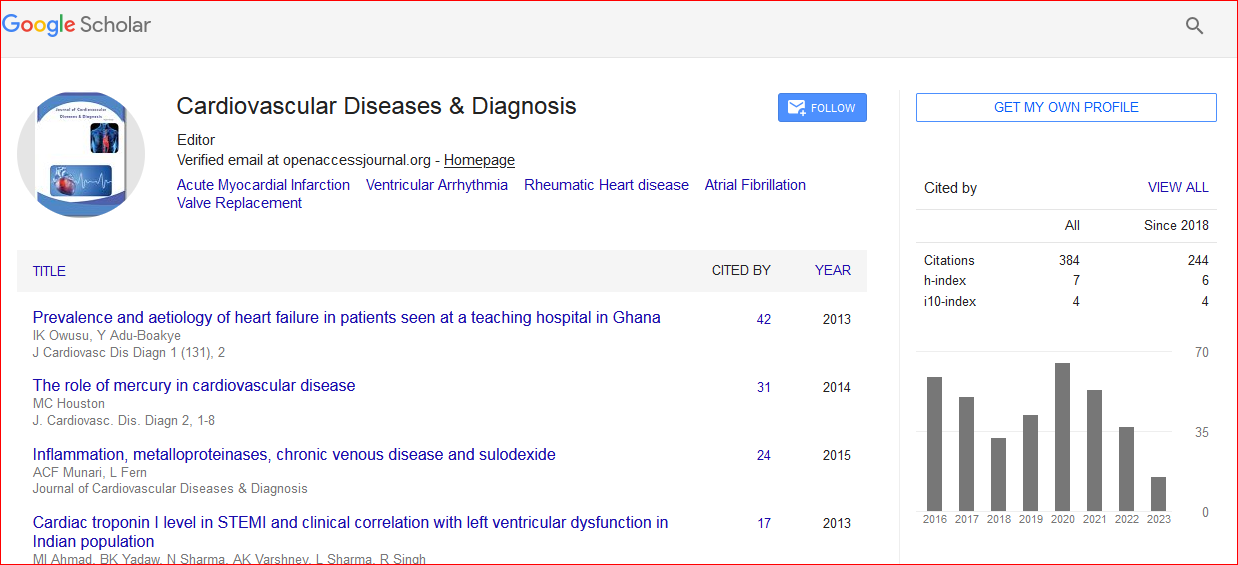
Cardiovascular Diseases & Diagnosis received 427 citations as per Google Scholar report