Opinion - (2025) Volume 15, Issue 6
Received: 31-Oct-2025, Manuscript No. jccr-26-181166;
Editor assigned: 03-Nov-2025, Pre QC No. P-181166;
Reviewed: 17-Nov-2025, QC No. Q-181166;
Revised: 21-Nov-2025, Manuscript No. R-181166;
Published:
28-Nov-2025
, DOI: 10.37421-2165-7920.2025.15.1693
Citation: Liu, Benjamin. ”MRI Hallmarks: Advancing Rare Neurological Disorder Diagnosis.” J Clin Case Rep 15 (2025):1693.
Copyright: © 2025 Liu B. This is an open-access article distributed under the terms of the Creative Commons Attribution License, which permits unrestricted use, distribution and reproduction in any medium, provided the original author and source are credited.
Advanced neuroimaging techniques have revolutionized the diagnosis and understanding of rare neurological disorders. This report delves into the critical role of pathognomonic MRI findings in identifying specific conditions that may otherwise be challenging to diagnose [1].
Diffusion tensor imaging (DTI), a sophisticated MRI sequence, has emerged as a powerful tool, revealing subtle white matter tract abnormalities that serve as pathognomonic indicators for certain neurodegenerative diseases previously undetectable with conventional methods [2].
The characteristic pattern of leptomeningeal enhancement on contrast-enhanced MRI is a pathognomonic sign for specific rare inflammatory encephalopathies, aiding in differentiation from other inflammatory conditions and guiding timely therapeutic interventions [3].
In the realm of inherited neurometabolic disorders, a unique pattern of basal ganglia calcification observed on CT and MRI can exhibit a pathognomonic appearance, enabling definitive diagnosis even in the absence of biochemical confirmation in specific clinical scenarios [4].
Specific cystic lesions within the cerebellum, characterized by pathognomonic T2 hyperintensity and peripheral enhancement on MRI, strongly suggest rare congenital brain malformations, thus improving radiologists' recognition of these key imaging features [5].
A distinct pattern of thickened and nodular cerebral arteries, visible on angiography and MRI, presents as a pathognomonic appearance in rare vasculopathies, making prompt diagnosis and management of these potentially devastating conditions essential [6].
The presence of specific pituitary stalk abnormalities on MRI, manifesting as T1 hypointensity and T2 hyperintensity, is a pathognomonic finding for rare syndromes affecting hypothalamic-pituitary function, facilitating early identification and classification of the disorder [7].
A crucial pathognomonic finding for a rare genetic disorder characterized by iron accumulation is the T2 hypointense signal within the dentate nucleus on MRI, a hallmark that critically differentiates it from other cerebellar conditions [8].
The intricate pattern of contrast enhancement within the spinal cord, exhibiting pathognomonic features, is key to diagnosing rare forms of myelitis, with detailed MRI analysis aiding in confident diagnosis and guiding appropriate treatment strategies [9].
Finally, a specific pattern of cortical thinning and subcortical T2 signal abnormalities on MRI is identified as pathognomonic for rare genetic leukoencephalopathies, underscoring the importance of recognizing these distinctive imaging features for accurate diagnosis and genetic counseling [10].
The field of neurology is continuously advanced by the identification of specific imaging biomarkers that enable precise diagnosis of complex conditions. This report highlights the discovery of pathognomonic MRI findings that significantly contribute to the diagnostic process for various rare neurological disorders [1].
Advanced diffusion tensor imaging (DTI) has been instrumental in uncovering subtle yet critical white matter tract abnormalities. These findings are now recognized as pathognomonic indicators for a rare neurodegenerative disease, offering a new avenue for early and accurate diagnosis [2].
Contrast-enhanced MRI has revealed a characteristic pattern of leptomeningeal enhancement, a pathognomonic sign that is crucial for diagnosing a specific rare inflammatory encephalopathy and distinguishing it from other inflammatory conditions [3].
In inherited neurometabolic disorders, the observation of basal ganglia calcification on neuroimaging, specifically CT and MRI, presents a pathognomonic appearance that is vital for definitive diagnosis, particularly when biochemical confirmation is challenging [4].
The detailed analysis of cerebellar lesions on MRI, characterized by pathognomonic T2 hyperintensity and peripheral enhancement, has become essential for diagnosing rare congenital brain malformations and improving diagnostic accuracy [5].
Rare cerebral vasculopathies are now more readily identified due to the pathognomonic appearance of thickened and nodular cerebral arteries on angiography and MRI, emphasizing the importance of recognizing these imaging hallmarks for effective management [6].
Pituitary stalk abnormalities on MRI, specifically T1 hypointensity and T2 hyperintensity, have been identified as pathognomonic for rare syndromes affecting hypothalamic-pituitary function, thereby aiding in early detection and classification [7].
A distinct T2 hypointense signal within the dentate nucleus on MRI serves as a pathognomonic hallmark for a rare genetic disorder involving iron accumulation, proving critical in its differentiation from other cerebellar pathologies [8].
Rare forms of myelitis can now be diagnosed with greater confidence due to the identification of pathognomonic features in the pattern of contrast enhancement within the spinal cord on MRI, facilitating targeted treatment [9].
Lastly, the recognition of pathognomonic cortical thinning and subcortical T2 signal abnormalities on MRI is crucial for diagnosing rare genetic leukoencephalopathies, enabling more accurate diagnoses and informed genetic counseling [10].
This collection of case reports highlights the significant advancements in diagnosing rare neurological disorders through specific and pathognomonic MRI findings. The studies demonstrate how advanced imaging techniques, including diffusion tensor imaging and contrast-enhanced MRI, reveal characteristic patterns in various conditions such as neurodegenerative diseases, inflammatory encephalopathies, inherited neurometabolic disorders, congenital brain malformations, cerebral vasculopathies, hypothalamic-pituitary syndromes, genetic iron accumulation disorders, myelitis, and genetic leukoencephalopathies. These distinctive imaging hallmarks are crucial for achieving early and accurate diagnoses, differentiating between conditions, and guiding timely and appropriate therapeutic interventions. The consistent identification of these pathognomonic features underscores the indispensable role of detailed radiological assessment in modern neurology.
None
None
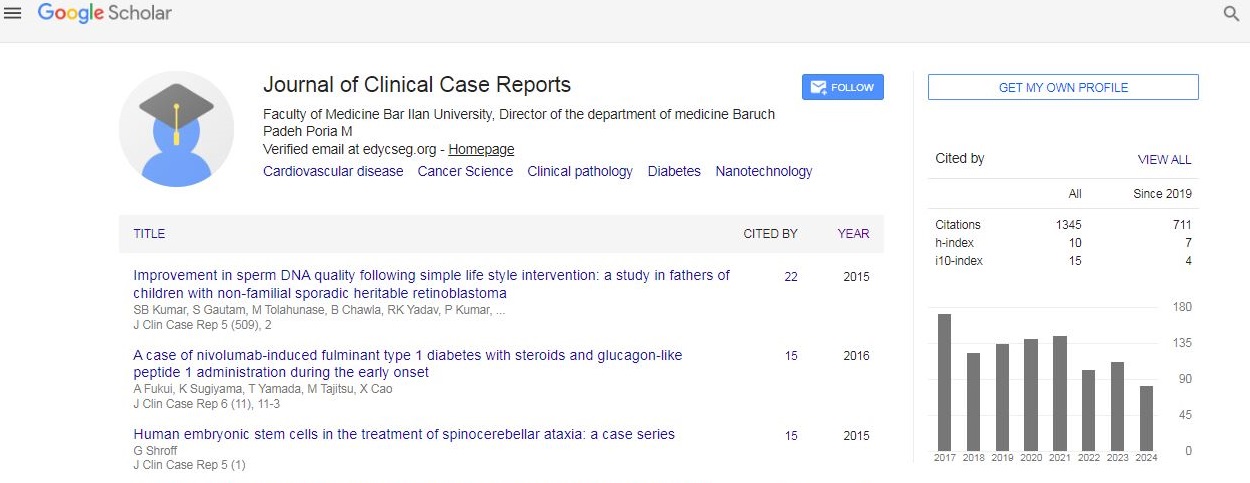
Journal of Clinical Case Reports received 1345 citations as per Google Scholar report