Short Communication - (2025) Volume 14, Issue 3
Received: 02-Jun-2025, Manuscript No. jsp-26-182259;
Editor assigned: 04-Jun-2025, Pre QC No. P-182259;
Reviewed: 18-Jun-2025, QC No. Q-182259;
Revised: 23-Jun-2025, Manuscript No. R-182259;
Published:
30-Jun-2025
, DOI: 10.37421/2165-7939.2025.14.728
Citation: Williams, Hannah C.. ”Motion Preservation: Spine Surgery’s Promising Future.” J Spine 14 (2025):728.
Copyright: © 2025 Williams C. Hannah This is an open-access article distributed under the terms of the Creative Commons Attribution License, which permits unrestricted use, distribution and reproduction in any medium, provided the original author and source are credited.
Motion preservation technologies in spine surgery represent a significant advancement aimed at maintaining spinal segment mobility, thereby reducing the incidence of adjacent segment degeneration compared to traditional fusion techniques [1].
These innovative approaches encompass a range of surgical options, including dynamic stabilization systems, interspinous process devices, and total disc replacements, each offering potential benefits in terms of enhanced patient function and a decrease in long-term complications [1].
Despite these promising advancements, the long-term efficacy of these technologies and their specific indications remain areas of active research and ongoing clinical debate [1].
Total disc replacement (TDR) has emerged as a prominent motion preservation option specifically for degenerative disc disease, particularly in the lumbar spine, with studies indicating its capacity to provide pain relief and functional improvement while preserving motion at the treated level [2].
However, critical considerations such as appropriate patient selection, implant survivorship, and the potential for reoperation are paramount for achieving successful surgical outcomes [2].
Dynamic stabilization systems present an alternative to rigid spinal fusion by permitting controlled motion across the operated spinal segment. The biomechanical principles underpinning these systems are designed to offload the compromised disc while retaining a degree of segmental mobility [3].
Emerging evidence suggests that these systems may contribute to a reduction in adjacent segment disease, though further investigation is warranted for definitive comparisons with standard fusion and other motion preservation techniques [3].
Interspinous process devices (IPDs) are characterized as minimally invasive implants engineered to restrict extension and decrease intradiscal pressure. These devices are frequently considered for patients experiencing symptomatic spinal stenosis and low-grade spondylolisthesis [4].
While IPDs have demonstrated the ability to alleviate pain and improve functional capacity, their long-term durability and effectiveness when contrasted with conservative management or alternative surgical interventions necessitate careful consideration [4].
Adjacent segment degeneration (ASD) is a recognized complication that can arise following spinal fusion procedures. Motion preservation technologies are specifically designed to mitigate this issue by preserving the natural biomechanics of the spinal segments adjacent to the fused area [5].
This review critically examines the existing evidence that compares spinal fusion with various motion-preserving devices, focusing on their impact on ASD rates and overall clinical outcomes [5].
The biomechanics governing motion preservation devices are inherently complex, exhibiting considerable variation across different implant designs. A thorough understanding of how these devices interact with the spinal column and influence load distribution is essential for accurately predicting their efficacy and identifying potential complications [6].
To this end, sophisticated methodologies such as finite element analysis and in vitro studies play an indispensable role in their comprehensive assessment [6].
The judicious selection of patients is of paramount importance for ensuring successful outcomes when employing motion preservation technologies. Several factors, including the patient's age, activity level, bone quality, and the specific pathology requiring treatment, significantly influence the choice of device and the overall probability of success [7].
This article delves into the currently established criteria for patient selection for a variety of motion-preserving surgical procedures [7].
While motion preservation technologies may offer certain advantages over fusion in terms of complication rates, they are not entirely devoid of potential adverse events. These complications can encompass issues such as implant migration, subsidence, persistent pain, and a failure to achieve the desired functional improvement [8].
A comprehensive understanding and effective management of these potential complications are crucial for optimizing patient care and maximizing the benefits of these interventions [8].
The economic implications of motion preservation technologies are a dynamic and evolving area of study. Although the initial cost of these devices may be higher, the potential for reduced long-term healthcare utilization, including fewer revision surgeries or treatments for adjacent segment disease, could ultimately render them cost-effective [9].
This analysis endeavors to explore the cost-benefit profiles associated with the adoption of these advanced spinal technologies [9].
Looking ahead, the future trajectory of motion preservation in spine surgery is anticipated to involve continuous refinement of existing technologies alongside the development of novel therapeutic approaches. Advancements in personalized medicine, the creation of innovative biomaterials, and improvements in diagnostic imaging techniques are all poised to play pivotal roles in optimizing patient outcomes and expanding the clinical applicability of these sophisticated procedures [10].
Motion preservation technologies in spine surgery are designed to maintain the natural mobility of spinal segments, aiming to prevent or reduce adjacent segment degeneration that can occur after traditional spinal fusion [1].
These technologies include a spectrum of devices such as dynamic stabilization systems, interspinous process devices, and total disc replacements, which hold the potential for improving patient function and mitigating long-term complications [1].
However, the comprehensive evaluation of their long-term effectiveness and precise indications continues to be a subject of ongoing scientific inquiry and clinical discussion [1].
Total disc replacement (TDR) has emerged as a significant advancement in motion preservation for managing degenerative disc disease, particularly in the lumbar region. Clinical studies suggest that TDR can effectively alleviate pain and enhance functional capacity by preserving motion at the treated spinal level [2].
Nonetheless, careful patient selection, consideration of implant longevity, and the possibility of subsequent reoperation remain critical factors for successful TDR outcomes [2].
Dynamic stabilization systems offer an alternative surgical strategy to rigid fusion, allowing for controlled movement across the operated segment. The underlying biomechanical principles aim to relieve stress on the affected disc while maintaining some degree of segmental mobility [3].
Evidence indicates that these systems may reduce the incidence of adjacent segment disease, although further research is needed to definitively compare their outcomes with standard fusion and other motion preservation techniques [3].
Interspinous process devices (IPDs) are characterized as minimally invasive implants designed to limit spinal extension and reduce intradiscal pressure. They are often indicated for patients suffering from symptomatic spinal stenosis and low-grade spondylolisthesis [4].
While IPDs can provide symptomatic relief and functional improvement, their durability and long-term efficacy in comparison to conservative treatments or other surgical options warrant careful consideration [4].
Adjacent segment degeneration (ASD) is a recognized sequela following spinal fusion. Motion preservation technologies are specifically engineered to address this complication by preserving the biomechanics of the adjacent spinal segments [5].
This article provides a comprehensive review of studies that compare spinal fusion with various motion-preserving devices, specifically examining their effects on ASD rates and clinical outcomes [5].
The biomechanical principles governing motion preservation devices are intricate and vary significantly depending on the specific implant design. Understanding how these devices interact with the spinal column and influence the distribution of forces is crucial for predicting their therapeutic benefits and potential adverse effects [6].
Methodologies such as finite element analysis and in vitro biomechanical testing are vital for thoroughly assessing these devices [6].
Effective patient selection is a cornerstone for achieving successful outcomes with motion preservation technologies. Factors such as the patient's age, activity level, bone density, and the specific nature of the spinal pathology play a critical role in determining the most appropriate device and the likelihood of a favorable result [7].
This article outlines the current guidelines and criteria used for selecting patients for various motion-preserving surgical interventions [7].
While motion preservation technologies may present fewer complications than fusion in certain aspects, they are associated with their own set of potential adverse events. These can include implant-related issues such as migration or subsidence, persistent pain, and an inability to achieve the desired functional recovery [8].
A thorough understanding and proactive management of these potential complications are essential for optimizing patient care and maximizing the benefits of these procedures [8].
The economic impact of motion preservation technologies is an area of ongoing investigation. Although the initial acquisition cost of these devices may be higher than traditional fusion, the potential for reduced long-term healthcare expenditures, such as fewer revision surgeries or treatments for adjacent segment disease, suggests that they may prove to be cost-effective over time [9].
This analysis explores the comparative cost-benefit profiles of various motion preservation technologies [9].
The future landscape of motion preservation in spine surgery is expected to witness the continued refinement of existing technologies and the emergence of novel approaches. Advancements in personalized medicine, the development of advanced biomaterials, and improvements in diagnostic imaging will be instrumental in enhancing patient outcomes and broadening the clinical applications of these surgical techniques [10].
Motion preservation technologies in spine surgery aim to maintain spinal mobility and reduce adjacent segment degeneration, offering alternatives to traditional fusion. These include dynamic stabilization systems, interspinous process devices, and total disc replacements. While they show promise for improved function and fewer long-term complications, their efficacy and indications are still under research. Key considerations for these technologies involve patient selection, implant survivorship, and managing potential complications. Future developments are expected to enhance personalization and broaden applications.
None
None
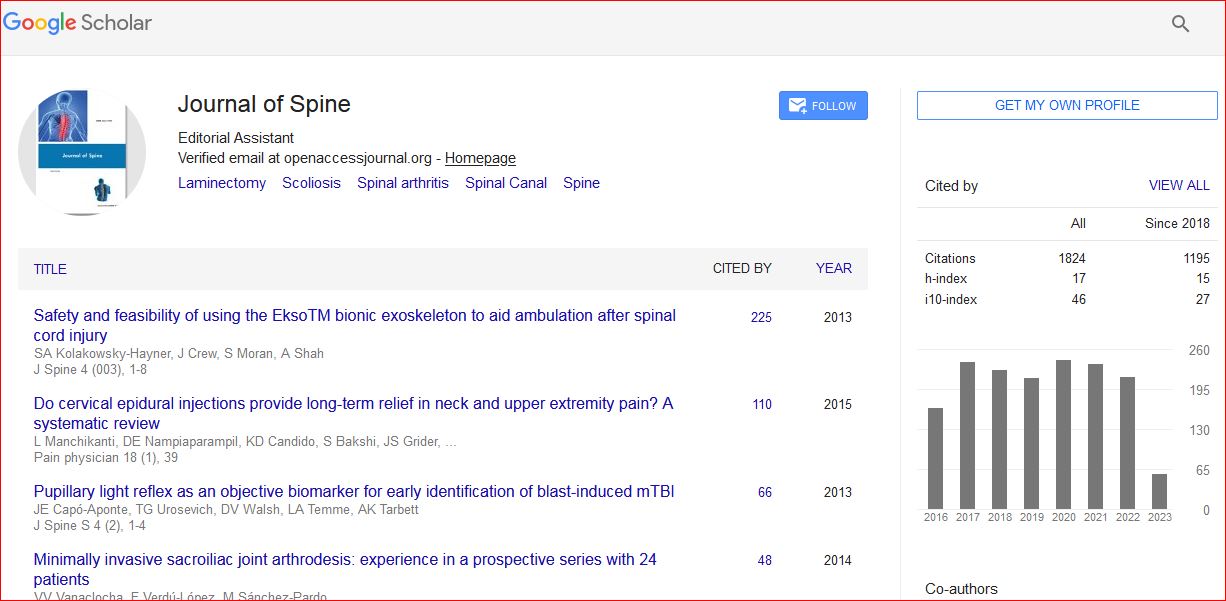
Journal of Spine received 2022 citations as per Google Scholar report