Brief Report - (2025) Volume 11, Issue 3
Received: 02-Jun-2025, Manuscript No. icoa-25-173585;
Editor assigned: 04-Jun-2025, Pre QC No. P-173585;
Reviewed: 18-Jun-2025, QC No. Q-173585;
Revised: 23-Jun-2025, Manuscript No. R-173585;
Published:
30-Jun-2025
, DOI: 10.37421/2469-9756.2025.11.300
Citation: Browning, Ethan J.. ”Monoclonal Antibody Innovations Across Diseases.” Immunochem Immunopathol 11 (2025):300.
Copyright: © 2025 Browning J. Ethan This is an open-access article distributed under the terms of the Creative Commons Attribution License, which permits unrestricted use,
distribution and reproduction in any medium, provided the original author and source are credited.
This study evaluated the combination of durvalumab and tremelimumab, two monoclonal antibodies, in treating metastatic non-small cell lung cancer. It demonstrated improved overall survival and progression-free survival compared to chemotherapy alone or durvalumab monotherapy, offering a new treatment option for this patient population.[1] This review explores sarilumab, a monoclonal antibody targeting interleukin-6 (IL-6), for treating rheumatoid arthritis. It highlights sarilumab's efficacy in improving disease activity and reducing structural joint damage, positioning it as a valuable option for patients who haven't responded adequately to other therapies.[2] This clinical trial investigated the effectiveness and safety of bamlanivimab and etesevimab, a combination of neutralizing monoclonal antibodies, in patients with mild to moderate COVID-19. The findings showed a significant reduction in COVID-19-related hospitalizations and deaths, demonstrating their potential as early intervention therapies.[3] This article delves into the rise of bispecific antibodies as a novel class of immunotherapeutics in cancer treatment. It discusses their unique mechanism of action, simultaneously binding to two different targets, and highlights their potential to overcome resistance mechanisms and enhance anti-tumor responses.[4] This article provides an update on lecanemab, a monoclonal antibody targeting amyloid-beta protofibrils, for early Alzheimer's disease. It outlines its clinical efficacy in slowing cognitive decline and discusses its safety profile, marking a significant advancement in treating this neurodegenerative condition.[5] This review examines the evolution of antibody-drug conjugates (ADCs), highlighting advancements that improve their therapeutic efficacy and safety. It discusses innovations in linker technology, payload selection, and antibody design, which are crucial for developing more potent and less toxic cancer treatments.[6] This review discusses the significant role of monoclonal antibodies in managing inflammatory bowel disease (IBD), including Crohn's disease and ulcerative colitis. It outlines the mechanisms of action for various biological agents, such as anti-TNF and anti-integrin antibodies, and their impact on achieving remission and improving patient quality of life.[7] This paper reviews the current landscape of anti-calcitonin gene-related peptide (CGRP) monoclonal antibodies used for migraine prevention. It highlights their efficacy in reducing migraine frequency and severity for both episodic and chronic migraineurs, offering a targeted therapeutic approach with improved tolerability compared to traditional treatments.[8] This article provides an update on emerging monoclonal antibodies for treating psoriasis, a chronic inflammatory skin condition. It explores novel biologics targeting various cytokine pathways, such as IL-17, IL-23, and TNF-alpha, emphasizing their effectiveness in achieving clear or nearly clear skin and improving patients' quality of life.[9] This review covers the recent advancements in monoclonal antibody-based therapeutics, spanning from their discovery to diverse clinical applications. It highlights innovative engineering strategies, such as humanization, affinity maturation, and the development of multispecific antibodies, which are driving the next generation of highly effective and safe therapeutic agents.[10]
Significant advancements are emerging in cancer immunotherapy. The combination of durvalumab and tremelimumab, both monoclonal antibodies, has demonstrated improved overall survival and progression-free survival in treating metastatic non-small cell lung cancer, presenting a new and promising treatment option for patients [1]. Concurrently, bispecific antibodies are revolutionizing cancer treatment as a novel class of immunotherapeutics. Their unique mechanism involves simultaneously binding to two different targets, which helps overcome resistance mechanisms and enhances anti-tumor responses, signifying a major breakthrough in the field [4].
The evolution of antibody-drug conjugates (ADCs) continues to push the boundaries of cancer treatment, with next-generation ADCs enhancing therapeutic efficacy and safety. Innovations in linker technology, payload selection, and antibody design are crucial for developing more potent yet less toxic cancer therapies [6]. Beyond oncology, monoclonal antibodies are providing valuable solutions for autoimmune diseases. Sarilumab, for instance, targets interleukin-6 (IL-6) for rheumatoid arthritis, effectively improving disease activity and reducing structural joint damage, positioning it as a key option for patients who do not respond adequately to other treatments [2].
Monoclonal antibodies have proven effective in combating infectious diseases, exemplified by bamlanivimab and etesevimab. This combination of neutralizing antibodies significantly reduced COVID-19-related hospitalizations and deaths in patients with mild to moderate symptoms, showcasing their potential as early intervention therapies [3]. Furthermore, these agents are vital in managing chronic inflammatory conditions such as inflammatory bowel disease (IBD), including Crohn's disease and ulcerative colitis. Various biological agents, such as anti-TNF and anti-integrin antibodies, outline mechanisms of action that significantly impact achieving remission and improving patient quality of life [7].
Advances in monoclonal antibody therapies are also extending to neurological disorders. Lecanemab, a monoclonal antibody specifically targeting amyloid-beta protofibrils, offers an important update for early Alzheimer's disease. Clinical efficacy in slowing cognitive decline coupled with a manageable safety profile marks a significant advancement in treating this neurodegenerative condition [5]. Parallel progress is seen in migraine prevention with anti-calcitonin gene-related peptide (CGRP) monoclonal antibodies, which effectively reduce migraine frequency and severity for both episodic and chronic sufferers, providing a targeted therapeutic approach with improved tolerability compared to older treatments [8].
For chronic inflammatory skin conditions like psoriasis, emerging monoclonal antibodies targeting various cytokine pathways, including IL-17, IL-23, and TNF-alpha, are proving highly effective in achieving clear or nearly clear skin and significantly improving patients' quality of life [9]. These specific applications are part of broader recent advancements in monoclonal antibody-based therapeutics. The field has evolved from initial discovery through diverse clinical applications, emphasizing innovative engineering strategies like humanization, affinity maturation, and the development of multispecific antibodies, which are driving the next generation of highly effective and safe therapeutic agents across a wide spectrum of diseases [10].
Monoclonal antibodies represent a dynamic and expanding area in therapeutic medicine, addressing a wide range of diseases. In oncology, the combination of durvalumab and tremelimumab has demonstrated improved survival rates for metastatic non-small cell lung cancer, marking a new treatment path [1]. Complementing this, bispecific antibodies are emerging as a significant breakthrough, employing unique dual-targeting mechanisms to enhance anti-tumor responses and overcome resistance [4]. The evolution of antibody-drug conjugates (ADCs) is also critical, with ongoing innovations in linker technology and payload design leading to more potent and safer cancer treatments [6]. Beyond cancer, these targeted therapies are transforming treatment for autoimmune and inflammatory conditions. Sarilumab effectively manages rheumatoid arthritis by targeting IL-6, improving disease activity and reducing joint damage [2]. Monoclonal antibodies are also indispensable in inflammatory bowel disease, where various biological agents help achieve remission and improve patient quality of life [7]. Similarly, emerging monoclonal antibodies for psoriasis show great promise, effectively clearing skin and enhancing patient well-being by targeting key cytokine pathways [9]. Neurological and infectious diseases are also seeing significant impact. Lecanemab offers a vital update for early Alzheimer's disease, showing efficacy in slowing cognitive decline [5]. For migraine prevention, anti-CGRP monoclonal antibodies provide a targeted approach that reduces frequency and severity with improved tolerability [8]. In infectious disease, bamlanivimab and etesevimab demonstrated effectiveness in reducing hospitalizations and deaths in mild to moderate COVID-19 patients [3]. Overall, recent advancements highlight innovative engineering strategies, from humanization to multispecific antibody development, driving the creation of highly effective and safe therapeutic agents across numerous clinical applications [10].
None
None
1. Melissa LJ, Marina CG, Luis GP. "Durvalumab Plus Tremelimumab in Metastatic NSCLC: A Randomized, Open-Label, Phase 3 Study (POSEIDON)".J Thorac Oncol 18 (2023):715-728.
Indexed at, Google Scholar, Crossref
2. Ruchi J, Pooja G, Shilpa B. "Targeting IL-6 with Sarilumab in Rheumatoid Arthritis: A Comprehensive Review.".Indian J Rheumatol 17 (2022):60-66.
Indexed at, Google Scholar, Crossref
3. Myron SC, William GP, Eric SD. "Efficacy and safety of bamlanivimab and etesevimab in mild to moderate COVID-19".N Engl J Med 385 (2021):1393-1402.
Indexed at, Google Scholar, Crossref
4. Laura AC, Richard WvdM, Mark DB. "Bispecific Antibodies: A Breakthrough in Cancer Immunotherapy".Trends Pharmacol Sci 41 (2020):852-863.
Indexed at, Google Scholar, Crossref
5. Shanshan L, Wenjia Z, Bo L. "Lecanemab in Early Alzheimer's Disease â?? An Update on Clinical Efficacy and Safety".Brain Disord 13 (2023):100234.
Indexed at, Google Scholar, Crossref
6. Chengyu Z, Yan G, Mingjuan L. "Next-generation antibody-drug conjugates: enhancing therapeutic efficacy and safety".Signal Transduct Target Ther 9 (2024):23.
Indexed at, Google Scholar, Crossref
7. Nivedita B, Abhipsa D, Arka JR. "The role of monoclonal antibodies in inflammatory bowel disease".World J Clin Cases 9 (2021):2841-2858.
Indexed at, Google Scholar, Crossref
8. Xin L, Xiangxiang X, Yingting L. "Current status of anti-calcitonin gene-related peptide monoclonal antibodies for migraine prevention".Brain Behav 12 (2022):e2534.
Indexed at, Google Scholar, Crossref
9. Hanyu Z, Siqi L, Zhiqing H. "Emerging Monoclonal Antibodies for Psoriasis: An Update".Front Immunol 14 (2023):1205367.
Indexed at, Google Scholar, Crossref
10. Guozhong S, Shuo W, Yu C. "Recent advances in monoclonal antibody-based therapeutics: from discovery to application".Front Pharmacol 15 (2024):1353164.
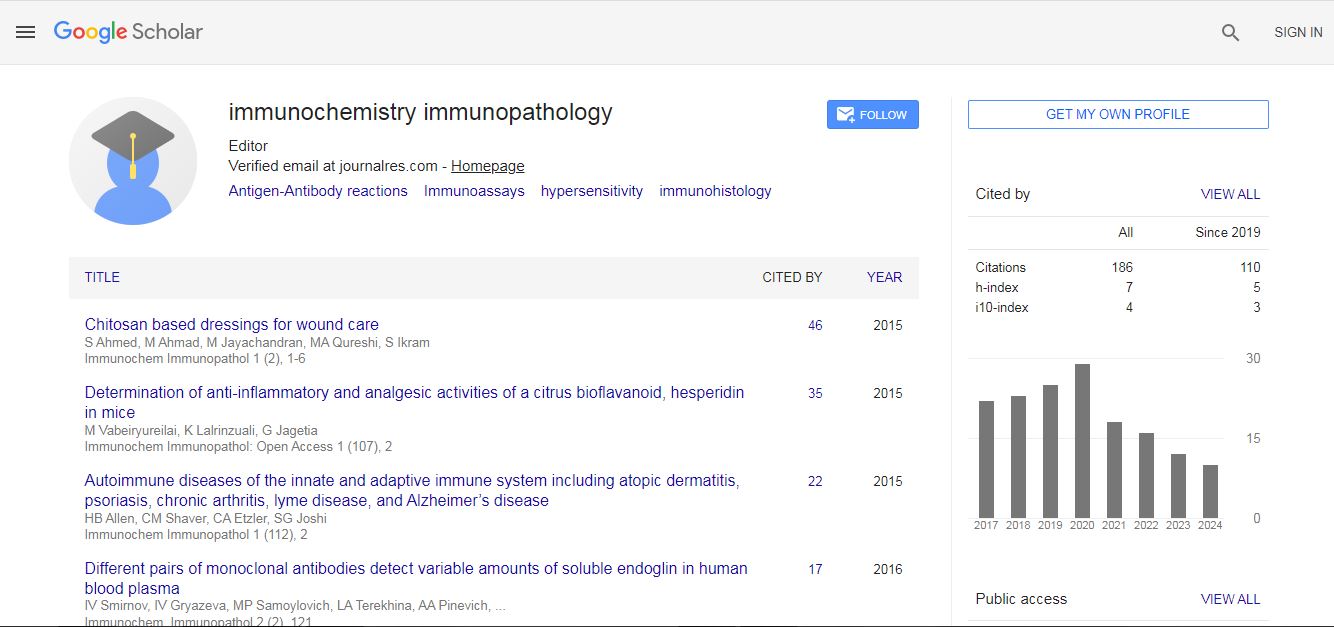
Immunochemistry & Immunopathology received 174 citations as per Google Scholar report