Brief Report - (2025) Volume 13, Issue 2
Received: 01-Apr-2025, Manuscript No. jpgeb-25-741568;
Editor assigned: 03-Apr-2025, Pre QC No. P-741568;
Reviewed: 17-Apr-2025, QC No. Q-741568;
Revised: 22-Apr-2025, Manuscript No. R-741568;
Published:
29-Apr-2025
, DOI: 10.37421/2329-9002.2025.13.366
Citation: García, Elena. ”Molecular Clocks: Challenges, Methods, Accuracy.” J Phylogenetics Evol Biol 13 (2025):366.
Copyright: © 2025 García E. This is an open-access article distributed under the terms of the Creative Commons Attribution License, which permits unrestricted use, distribution
and reproduction in any medium, provided the original author and source are credited.
Molecular clocks are fundamental tools in evolutionary biology, providing a framework for estimating the timing of evolutionary events and species divergences. This approach, however, is not without its intricacies and ongoing refinements, as highlighted by a range of contemporary research. Understanding the nuances of phylogenomic dating, particularly in the context of molecular clock analyses, involves navigating challenges like model selection, accommodating diverse evolutionary rates, and implementing robust calibration strategies to ensure accurate estimations of evolutionary timescales [1] The dependability of molecular clock dating is under continuous assessment, especially when applied to rapidly evolving organisms such as SARS-CoV-2. Researchers are actively scrutinizing various factors that influence the precision and consistency of these estimates within dynamic viral populations [2] Mapping the deep evolutionary history of life forms, like fungi, presents significant challenges for molecular clock applications. It underscores the critical need for selecting appropriate calibration points and models to effectively resolve ancient fungal divergences and reconstruct their evolutionary tree [3] To enhance the accuracy of phylogenetic timescale estimations, novel approaches integrate molecular clock data with geological events, providing a more robust method for determining the absolute divergence times of species [4] In plant evolutionary studies, the application of molecular clocks encounters unique hurdles, including the effects of ancient polyploidy and the wide array of generation times across different plant lineages. Addressing these specific challenges requires developing and employing effective strategies to achieve reliable phylogenetic dating [5] Advancements in molecular clock models, particularly those developed within a Bayesian statistical framework, are continuously enhancing the accuracy of phylogenetic inference. These newer models are especially beneficial for estimating divergence times when working with extensive genomic datasets, offering more sophisticated ways to analyze evolutionary relationships [6] Further refining our understanding of primate evolutionary timescales involves a powerful combination of ancient DNA data with molecular clock analyses. This integrated approach emphasizes the essential role of combining both genetic and fossil evidence to achieve more precise divergence time estimates for deep evolutionary history [7] The study of evolutionary dynamics extends to understanding how molecular clock rates and patterns of speciation vary across different ecological zones, such as tropical and temperate regions. This research offers valuable insights into the underlying mechanisms that drive global biodiversity gradients and the broader patterns of evolutionary diversification [8] Calibration strategies profoundly impact the results of molecular clock dating. A case study involving angiosperms reveals how the careful choice and quality of fossil calibration points directly influence the accuracy of divergence time inferences, stressing the importance of data quality in these analyses [9] Finally, disentangling the complex causes of evolutionary rate variations across different genomic regions and taxa is a major focus. Advanced genomic molecular clock models are specifically designed to account for these inherent complexities, thereby improving our fundamental understanding of evolutionary dynamics and the mechanisms shaping biological diversity [10]
The field of molecular clock dating is a cornerstone of evolutionary biology, offering invaluable insights into the timing of evolutionary events. However, its application is frequently accompanied by significant methodological challenges and ongoing refinements. For instance, the accuracy of phylogenomic dating relies heavily on critical factors such as appropriate model selection, accounting for variations in evolutionary rates across lineages, and employing robust calibration strategies [1]. These aspects are particularly crucial for achieving dependable estimations of evolutionary timescales, as highlighted by comprehensive reviews in the field. The reliability of these techniques is consistently evaluated, especially in contexts of rapid evolution, such as with the SARS-CoV-2 virus, where maintaining precision and consistency in dating estimates within highly dynamic viral populations remains a complex endeavor [2]. The choice of models and calibration points directly influences the confidence in these estimates, requiring careful consideration and empirical validation.
Delving into the deep evolutionary history of diverse taxa presents its own set of unique challenges for molecular clock applications. When calibrating the fungal tree of life, researchers emphasize the paramount importance of selecting appropriate calibration points and models to accurately resolve ancient divergences that shaped fungal biodiversity [3]. Similarly, plant evolutionary studies grapple with complexities like ancient polyploidy events and highly variable generation times among different plant lineages. These factors can significantly impact phylogenetic dating, underscoring the need for tailored strategies to ensure reliable reconstructions of plant evolutionary history [5].
The precision of dating can be substantially improved through integrated approaches. For example, combining molecular clock data with geological events offers a more robust framework for the absolute dating of species divergence, leading to more accurate and dependable phylogenetic timescale estimations [4]. Another powerful integration involves combining ancient DNA data with molecular clock analyses, a strategy used to refine primate evolutionary timescales by harmonizing both genetic and fossil evidence, thereby strengthening divergence time estimates in deep evolutionary contexts [7].
Recent technological and methodological advancements have significantly bolstered the capabilities of molecular clock analyses. A notable area of progress lies in the development of sophisticated molecular clock models, particularly those operating within a Bayesian framework. These new models are designed to enhance the accuracy of phylogenetic inference and divergence time estimation, proving especially effective when dealing with the vast and complex data generated by modern phylogenomic studies [6]. Such advancements allow researchers to analyze large genomic datasets with greater confidence, leading to more nuanced understandings of evolutionary relationships. Beyond methodological improvements, the application of molecular clocks has also shed light on fundamental ecological and evolutionary patterns. Studies investigating molecular clock and speciation rates have revealed interesting differences between tropical and temperate regions, offering valuable insights into the mechanisms driving global biodiversity gradients and patterns of evolutionary diversification across different biomes [8].
The impact of calibration strategies on the outcomes of molecular clock dating cannot be overstated. Research demonstrates that the careful selection and quality of fossil calibration points directly and profoundly influence the accuracy of divergence time inferences. This is particularly evident in studies focusing on angiosperms, where varying calibration approaches can lead to significantly different evolutionary timelines [9]. Therefore, robust and well-justified calibration protocols are essential for minimizing uncertainty in dating results. Furthermore, a key challenge involves understanding the diverse factors that contribute to variations in evolutionary rates across different genomic regions and taxa. Advanced genomic molecular clock models are specifically developed to disentangle these complexities, providing clearer insights into the underlying causes of rate heterogeneity and ultimately improving our comprehensive understanding of evolutionary dynamics [10]. These ongoing efforts collectively refine the molecular clock as a tool, making it increasingly precise and versatile for exploring the tree of life.
Molecular clock analyses are essential for estimating evolutionary timescales, though they face various challenges. Researchers delve into the complexities of phylogenomic dating, emphasizing the importance of model selection, accounting for varying evolutionary rates, and employing effective calibration strategies to achieve accurate estimates [1]. The reliability of these dating methods is critically assessed in rapidly evolving systems, like SARS-CoV-2, where factors influencing precision and consistency are under scrutiny [2]. Applying molecular clocks to deep evolutionary histories, such as those of fungi, demands careful consideration of appropriate calibration points and models to resolve ancient divergences [3]. The integration of molecular clock data with geological events offers enhanced precision for determining absolute divergence times [4]. Similarly, plant evolutionary studies encounter unique hurdles, including ancient polyploidy and diverse generation times, necessitating tailored strategies for reliable phylogenetic dating [5]. Recent advancements in molecular clock models, particularly within a Bayesian framework, improve the accuracy of phylogenetic inference and divergence time estimation, especially with large genomic datasets [6]. Further refining evolutionary timescales involves combining ancient DNA data with molecular clock analyses, crucial for groups like primates where genetic and fossil evidence are integrated [7]. Studies also explore differences in molecular clock and speciation rates between tropical and temperate regions, providing insights into global biodiversity patterns [8]. The impact of calibration strategies on dating results is significant, with the choice and quality of fossil calibration points directly affecting the accuracy of divergence time inferences, as highlighted in angiosperm studies [9]. Ultimately, understanding the diverse factors contributing to variations in evolutionary rates across genomic regions and taxa is key; advanced molecular clock models are designed to unravel these complexities and improve our grasp of evolutionary dynamics [10].
None
None
Indexed at, Google Scholar, Crossref
Indexed at, Google Scholar, Crossref
Indexed at, Google Scholar, Crossref
Indexed at, Google Scholar, Crossref
Indexed at, Google Scholar, Crossref
Indexed at, Google Scholar, Crossref
Indexed at, Google Scholar, Crossref
Indexed at, Google Scholar, Crossref
Indexed at, Google Scholar, Crossref
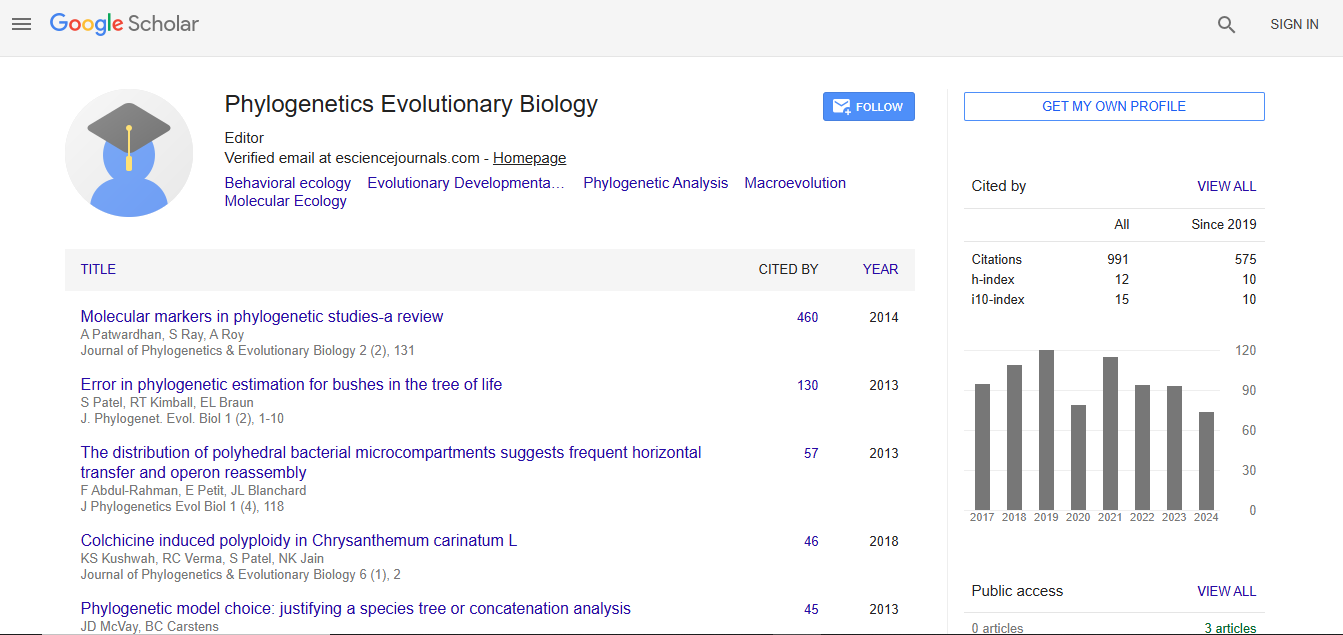
Journal of Phylogenetics & Evolutionary Biology received 911 citations as per Google Scholar report