Short Communication - (2025) Volume 9, Issue 3
Received: 01-Sep-2025, Manuscript No. rrms-25-175072;
Editor assigned: 03-Sep-2025, Pre QC No. P-175072;
Reviewed: 17-Sep-2025, QC No. Q-175072;
Revised: 22-Sep-2025, Manuscript No. R-175072;
Published:
29-Sep-2025
, DOI: 10.37421/2952-8127.2025.9.234
Citation: Al-Sabah, Fatima. ”Modern Patient Care: Integrated Strategies for Outcomes.” Res Rep Med Sci 09 (2025):234.
Copyright: © 2025 Al-Sabah F. This is an open-access article distributed under the terms of the Creative Commons Attribution License, which permits unrestricted use, distribution and reproduction in any medium, provided the original author and source are credited.
The modern healthcare landscape is deeply committed to enhancing patient care, improving outcomes, and centering services around individual needs. A fundamental strategy here involves integrated care models. These models are crucial for managing patients with complex health needs, particularly those with multiple chronic conditions. The goal is to coordinate services across different healthcare settings and providers, enhancing patient satisfaction and improving health outcomes. Effective integration requires robust communication, shared information systems, and a patient-centered approach to care planning [1].
Digital transformation is another driving force in this evolution. Telemedicine and digital health tools are fundamentally transforming patient care by expanding access to medical services, especially in remote areas or during public health crises. These technologies enable remote consultations, monitoring, and health education, requiring careful integration into existing healthcare systems to ensure equity and effectiveness [2].
Complementing this, shared decision-making marks a significant step towards patient-centered care. This approach involves clinicians and patients collaboratively making healthcare decisions, taking into account the best available evidence, the clinician's expertise, and the patient's values and preferences. It fosters patient engagement and improves adherence to treatment plans [3].
Furthermore, managing chronic diseases effectively often hinges on integrating patient-reported outcomes (PROs) into clinical practice. PROMIS, for example, offers standardized, validated tools to assess symptoms, functional status, and quality of life from the patient's perspective. This information helps tailor care plans, monitor treatment effectiveness, and identify areas for intervention, ultimately improving the patient's lived experience [4].
While these digital advancements offer many benefits, patient safety remains a core pillar of quality healthcare. Digital health tools also introduce new safety challenges. Effective patient management requires vigilance in identifying and mitigating risks associated with electronic health records, Artificial Intelligence (AI), and telemedicine. Proactive strategies and continuous monitoring are essential to prevent harm in increasingly digitized healthcare environments [5].
Remote patient monitoring (RPM) is proving valuable, especially after hospital discharge, to improve outcomes and reduce readmissions. RPM technologies track vital signs and other health data, allowing healthcare providers to intervene proactively. The evidence suggests RPM can lead to better management of chronic conditions, but successful implementation requires thoughtful integration into care pathways and patient education [6].
Beyond technology, patient engagement and involvement are critical components of a safe and effective healthcare system. When patients are actively involved in their care decisions and processes, it enhances safety by utilizing their unique perspective on their condition and treatment. Strategies for effective engagement often include clear communication, shared decision-making, and empowering patients to speak up about their concerns [7].
Health literacy significantly influences a patient's ability to understand health information, make informed decisions, and navigate the healthcare system. It's a key determinant of patient-centered care. Providers need to assess and address health literacy levels, using clear communication strategies and accessible materials to ensure all patients can participate effectively in their own management [8].
Expanding the scope of care, palliative care aims to improve the quality of life for patients and their families facing life-limiting illnesses. It's not just for end-of-life but should be integrated early into the patient's management journey alongside curative treatments. This holistic approach addresses physical symptoms, psychological distress, and spiritual needs, providing comprehensive support [9].
Finally, in acute care settings, efficient patient flow in the emergency department is critical for managing overcrowding, reducing wait times, and improving patient outcomes. Implementing strategic management approaches, such as rapid assessment zones, dedicated fast-track units, and real-time bed management systems, can significantly streamline operations. The key is to optimize resource allocation and minimize bottlenecks, ensuring timely care for all patients [10].
This comprehensive approach to patient management highlights a multifaceted commitment to optimizing care delivery, empowering patients, and ensuring safety across all healthcare domains.
Modern patient management operates on principles that prioritize individualized care, enhanced safety, and improved health outcomes through a variety of integrated strategies. A core aspect of this approach is the implementation of integrated care models, which are fundamental for effectively managing patients with complex health needs, particularly those with multiple chronic conditions [1]. The objective is to coordinate services across diverse healthcare settings and providers, thereby boosting patient satisfaction and improving health outcomes. Successful integration relies on robust communication, shared information systems, and a consistently patient-centered approach to care planning. This strategy helps create a cohesive and supportive care environment.
Digital health solutions are profoundly reshaping patient care delivery. Telemedicine and a suite of digital health tools are expanding access to medical services, especially in remote areas or during public health crises [2]. These technologies facilitate remote consultations, monitoring, and health education, although their effective deployment requires careful integration into existing systems to ensure equity and efficacy. Further amplifying the benefits of technology, remote patient monitoring (RPM) proves particularly valuable after hospital discharge, aiming to improve outcomes and reduce readmissions [6]. RPM systems track vital signs and other health data, enabling healthcare providers to intervene proactively. Evidence suggests RPM leads to better management of chronic conditions, but successful implementation hinges on thoughtful integration into care pathways and comprehensive patient education.
A cornerstone of patient-centered care is shared decision-making, an approach where clinicians and patients collaborate in making healthcare decisions [3]. This involves carefully considering the best available evidence, the clinician's expertise, and, most importantly, the patient's individual values and preferences. This collaborative process not only fosters greater patient engagement but also significantly improves adherence to treatment plans. Furthermore, the effective management of chronic diseases often integrates patient-reported outcomes (PROs) into clinical practice [4]. Tools such as PROMIS offer standardized, validated methods to assess symptoms, functional status, and overall quality of life directly from the patientâ??s perspective. This valuable information helps tailor care plans, monitor treatment effectiveness, and identify specific areas for intervention, ultimately enhancing the patient's lived experience.
Patient safety remains an unwavering core pillar of quality healthcare. While digital health tools offer numerous advantages, they also introduce novel safety challenges [5]. Effective patient management demands continuous vigilance in identifying and mitigating risks associated with electronic health records, Artificial Intelligence (AI), and telemedicine. Proactive strategies and continuous monitoring are essential to prevent harm in increasingly digitized healthcare environments. Parallel to this, patient engagement and active involvement are critical components of a safe and effective healthcare system [7]. When patients participate proactively in their care decisions and processes, it inherently enhances safety by leveraging their unique perspective on their condition and treatment. Strategies for achieving effective engagement commonly include clear communication, embracing shared decision-making, and empowering patients to confidently voice their concerns.
Health literacy is another significant factor influencing a patient's capacity to comprehend health information, make well-informed decisions, and effectively navigate the complex healthcare system [8]. It serves as a key determinant of truly patient-centered care. Providers need to systematically assess and address varying health literacy levels, employing straightforward communication strategies and readily accessible materials to ensure that all patients can participate meaningfully in their own management. Extending the reach of holistic support, palliative care aims to improve the quality of life for patients and their families confronting life-limiting illnesses [9]. This specialized care is not exclusively reserved for end-of-life stages; rather, it should be seamlessly integrated early into the patientâ??s management journey, running concurrently with curative treatments. This holistic strategy meticulously addresses physical symptoms, psychological distress, and spiritual needs, providing a comprehensive spectrum of support.
Finally, within acute care settings, efficient patient flow in the emergency department is critical for managing overcrowding, significantly reducing wait times, and ultimately improving patient outcomes [10]. Implementing strategic management approaches, such as rapid assessment zones, dedicated fast-track units, and real-time bed management systems, can dramatically streamline operations. The key objective here is to optimize resource allocation and minimize bottlenecks, thereby ensuring timely and effective care for every patient.
Modern patient management emphasizes comprehensive, patient-centered care, integrating diverse strategies to improve health outcomes and safety. Integrated care models are crucial for complex patients with multiple chronic conditions, coordinating services across settings to enhance satisfaction and outcomes [1]. Digital health tools, including telemedicine and remote patient monitoring, transform care by expanding access, enabling remote consultations, and improving post-discharge management, though requiring careful integration and patient education [2, 6]. Shared decision-making empowers patients, involving them collaboratively in healthcare choices, which boosts engagement and treatment adherence [3]. Incorporating patient-reported outcomes, like PROMIS, offers vital insights from the patient's perspective, guiding personalized care and monitoring effectiveness in chronic disease management [4]. Patient safety remains a core pillar, particularly in digitized healthcare. Vigilance is essential to mitigate risks associated with electronic health records, Artificial Intelligence (AI), and telemedicine [5]. Active patient engagement, clear communication, and empowering patients to voice concerns are critical for a safe and effective system [7]. Health literacy significantly influences a patient's ability to understand health information and make informed decisions, necessitating clear communication strategies from providers [8]. Palliative care, integrated early, addresses the holistic needs of patients and families facing life-limiting illnesses, improving quality of life [9]. Lastly, efficient patient flow in the emergency department is critical for reducing wait times and improving outcomes, requiring strategic management approaches like rapid assessment zones and real-time bed management [10]. These interconnected efforts aim to optimize care delivery and ensure patient well-being.
None
None
Fabrizio G, Silvia DV, Alice D. "Integrated care for complex patients: a systematic review of the literature".BMC Health Serv Res 20 (2020):1032.
Indexed at, Google Scholar, Crossref
Eric RD, Ryan WD, Nicholas BT. "Telemedicine and digital health in patient care".Lancet 396 (2020):1706-1707.
Indexed at, Google Scholar, Crossref
Michael JB, Kathleen HD, Patricia AG. "Shared decision making: A new frontier in patient-centered care".J Clin Oncol 38 (2020):1501-1502.
Indexed at, Google Scholar, Crossref
Theodore P, Caroline AM, Joel S. "The Patient-Reported Outcomes Measurement Information System (PROMIS®) in Clinical Care: An Overview".Arthritis Care Res (Hoboken) 73 (2021):1-5.
Indexed at, Google Scholar, Crossref
Peter JP, Elizabeth AS, Allen K. "Enhancing Patient Safety in an Era of Digital Health".JAMA 330 (2023):401-402.
Indexed at, Google Scholar, Crossref
Melody SO, Chae-Yeon K, Grace EL. "Effectiveness of remote patient monitoring after hospital discharge: a systematic review and meta-analysis".Ann Intern Med 174 (2021):603-611.
Indexed at, Google Scholar, Crossref
Rumbidzai S, Maryam E, Jennifer AW. "Patient engagement and involvement in health care safety: a scoping review".J Patient Saf 17 (2021):e265-e274.
Indexed at, Google Scholar, Crossref
Leena P, Elina S, Pirjo R. "Health literacy as a determinant of patient-centered care".Scand J Public Health 49 (2021):781-789.
Indexed at, Google Scholar, Crossref
Katherine ES, Miriam JJ, Liliana DL. "Palliative care for all: it's time to act".Lancet 397 (2021):2217-2218.
Indexed at, Google Scholar, Crossref
Geert-Jan G, Koen PH, Petra vdB. "Management strategies to improve patient flow in the emergency department: a systematic review".J Hosp Med 15 (2020):60-66.
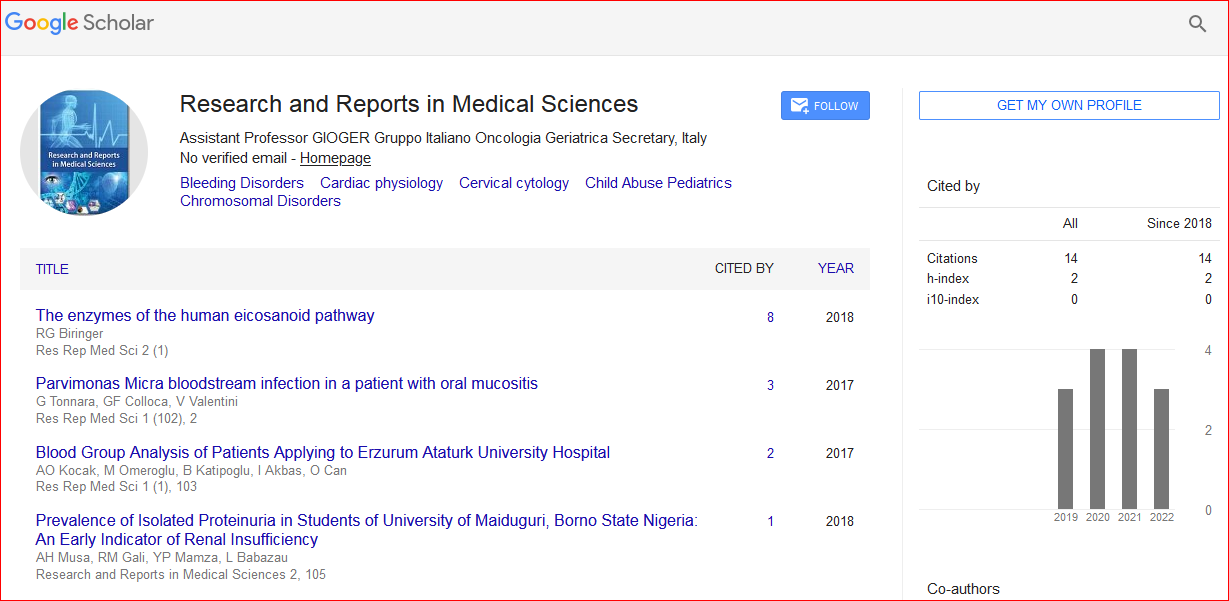
Research and Reports in Medical Sciences received 13 citations as per Google Scholar report