Short Communication - (2025) Volume 12, Issue 2
Received: 01-Apr-2025, Manuscript No. ijn-26-183972;
Editor assigned: 03-Apr-2025, Pre QC No. P-183972;
Reviewed: 17-Apr-2025, QC No. Q-183972;
Revised: 22-Apr-2025, Manuscript No. R-183972;
Published:
29-Apr-2025
, DOI: 10.37421/2376-0281.2025.12.627
Citation: Kobayashi, Hanae. ”Mirror Therapy: Enhancing Neurorehabilitation Through Visual Feedback.” Int J Neurorehabilitation Eng 12 (2025):627.
Copyright: © 2025 Kobayashi H. This is an open-access article distributed under the terms of the Creative Commons Attribution License, which permits unrestricted use, distribution and reproduction in any medium, provided the original author and source are credited.
Mirror therapy has emerged as a promising intervention in the field of neurorehabilitation, particularly for individuals experiencing hemiplegia, a condition often resulting from stroke. This technique leverages visual feedback to stimulate motor recovery and alleviate associated symptoms. Its application is increasingly being explored for its potential to enhance the quality of life for affected individuals. One significant area of focus for mirror therapy is its role in improving motor function following a stroke. By providing a visual representation of a moving limb, it is believed to activate neural pathways that can facilitate motor relearning and recovery in the affected side of the body. This novel approach offers a different modality for therapists to employ in their rehabilitation strategies. Furthermore, mirror therapy has demonstrated effectiveness in managing phantom limb pain, a challenging and often debilitating condition experienced by amputees and individuals with neurological impairments. The visual illusion created by the mirror can help to recalibrate the brain's sensory processing, leading to a reduction in perceived pain. This offers a non-pharmacological option for pain management. The underlying mechanisms of mirror therapy are thought to involve the principles of neuroplasticity. The brain's ability to reorganize itself by forming new neural connections is crucial for recovery after neurological injury. Mirror therapy appears to harness this inherent capacity, encouraging the brain to adapt and compensate for damaged areas. Studies investigating the neural correlates of mirror therapy have utilized neuroimaging techniques to understand its impact on brain activity. These investigations suggest that the therapy engages motor-related cortical areas bilaterally, promoting interhemispheric communication and visual-motor integration. This provides a deeper understanding of how the therapy exerts its effects. The clinical utility of mirror therapy is being substantiated through various research designs, including randomized controlled trials. These studies compare the outcomes of mirror therapy against conventional rehabilitation approaches, aiming to quantify its added benefits in terms of motor recovery and functional independence in patients. The versatility of mirror therapy allows for its application across a spectrum of neurological conditions beyond stroke-induced hemiplegia. Its principles and adaptations are being reviewed to cater to diverse patient populations and their specific rehabilitation needs, highlighting its broad therapeutic potential. Research is also delving into the optimal parameters for mirror therapy, such as the dose-response relationship. Understanding how the frequency and duration of therapy influence functional gains can help in tailoring treatment plans for maximum efficacy. This optimization is key to advancing its implementation. The integration of mirror therapy with other rehabilitation modalities, such as virtual reality, is another avenue being explored. This combined approach aims to leverage the strengths of different techniques to achieve synergistic effects and accelerate motor improvements, offering innovative solutions. Finally, the long-term efficacy of mirror therapy is crucial for assessing its sustained impact on patients' recovery and overall quality of life. Longitudinal studies are providing valuable insights into how continued engagement with mirror therapy can lead to lasting functional benefits and improved well-being.
Mirror therapy is a rehabilitative technique that utilizes a mirror to create a visual illusion of the affected limb moving normally, thereby engaging the intact hemisphere of the brain to promote recovery in the paretic limb [1].
This approach has shown significant promise in enhancing motor recovery for individuals with hemiplegia, particularly in the context of stroke rehabilitation [1].
The visual feedback provided by the mirror stimulates the affected side of the brain, fostering neuroplasticity and potentially leading to improved functional outcomes [1].
Its non-invasive nature allows for its seamless integration into existing rehabilitation programs, making it a practical addition for clinicians [1].
The neural mechanisms underpinning mirror therapy are complex, involving the intricate interplay of visual-motor integration and interhemispheric communication [2].
Functional magnetic resonance imaging (fMRI) studies suggest that the visual illusion generated by the mirror can activate motor-related cortical areas bilaterally. This dual activation is believed to be instrumental in facilitating motor relearning processes in individuals with upper limb hemiparesis resulting from stroke [2].
Clinical trials have been instrumental in validating the efficacy of mirror therapy. A randomized controlled trial, for instance, compared mirror therapy with conventional therapy in patients with subacute stroke. The findings indicated statistically significant improvements in motor function and daily living activities for the group receiving mirror therapy, underscoring its clinical utility in this population [3].
The application of mirror therapy extends to various neurological conditions, with hemiplegia being a primary focus. Reviews on its use discuss the fundamental principles, modifications for different patient groups, and essential recommendations for clinical practice. A key takeaway is the importance of individualized treatment plans to maximize therapeutic benefits [4].
Further research has explored the dose-response relationship of mirror therapy in stroke survivors. This pilot study suggests that increased frequency and duration of mirror therapy sessions may result in greater functional gains. Additionally, it hints at potential synergistic effects when mirror therapy is combined with other neurorehabilitation techniques, opening doors for integrated treatment protocols [5].
Beyond motor recovery, mirror therapy has been investigated for its role in managing spasticity and contractures in chronic hemiplegia. Case studies presented in this research demonstrate how the visual feedback can aid in reducing muscle tone and improving range of motion, thereby enhancing limb function and patient comfort in chronic cases [6].
Systematic reviews and meta-analyses have consistently supported the efficacy of mirror therapy as an adjunct to conventional rehabilitation for upper limb motor function in stroke survivors. These comprehensive evaluations conclude that mirror therapy leads to statistically significant improvements in motor scores, reinforcing its value in stroke recovery protocols [7].
Investigating the practicality of mirror therapy, a study examined its feasibility and patient acceptance in a home-based rehabilitation setting for individuals with hemiplegia. The results indicated that the intervention is well-tolerated and can be effectively administered by patients with appropriate guidance, thereby expanding its accessibility and potential reach [8].
The synergistic potential of mirror therapy is further explored when combined with virtual reality (VR) for upper limb rehabilitation in stroke patients. Preliminary findings suggest that this combined approach may lead to enhanced motor improvements compared to utilizing either modality independently, pointing towards future directions in therapeutic innovation [9].
Finally, longitudinal studies are crucial for understanding the sustained benefits of mirror therapy. A 1-year follow-up study on chronic hemiplegia suggests that consistent application of mirror therapy can lead to continued functional improvements and a better quality of life for individuals over the long term, highlighting the importance of ongoing therapeutic engagement [10].
Mirror therapy is a promising non-invasive technique for neurorehabilitation, particularly for hemiplegia post-stroke. It utilizes visual feedback to enhance motor recovery, reduce phantom limb pain, and improve functional independence. Research indicates that mirror therapy engages motor-related cortical areas, promoting neuroplasticity and interhemispheric communication. Clinical trials and systematic reviews support its efficacy as an adjunct to conventional therapy, leading to significant improvements in motor function and daily living activities. The therapy's principles are being adapted for various neurological conditions, and its potential is being explored in conjunction with virtual reality. Optimizing the dose-response relationship and exploring home-based applications are advancing its accessibility and effectiveness. Long-term studies suggest sustained functional benefits and improved quality of life with continued engagement.
None
None
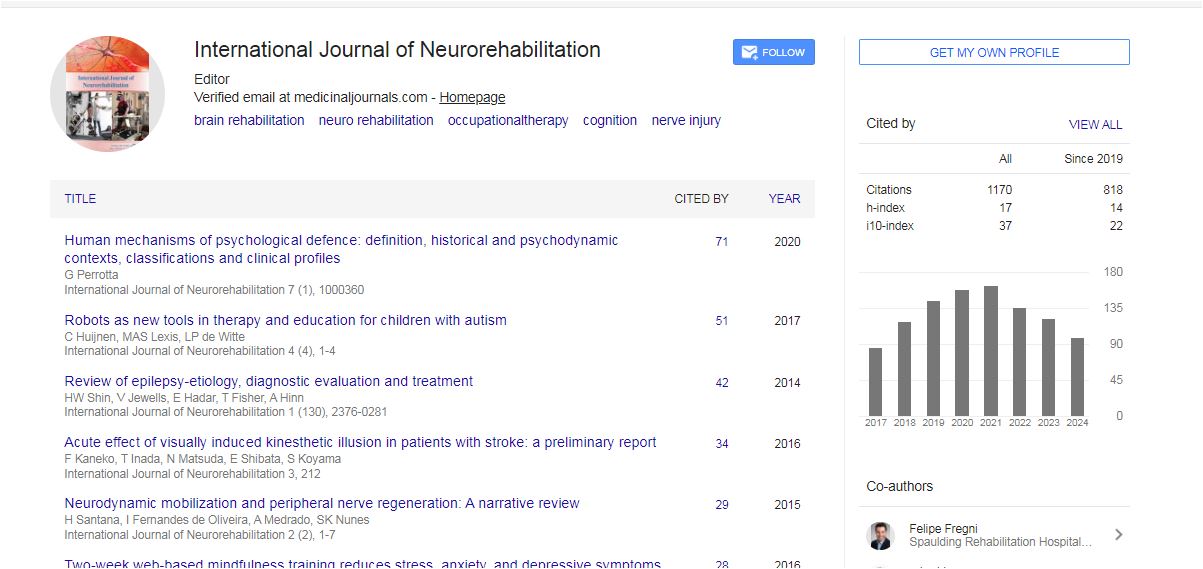
International Journal of Neurorehabilitation received 1078 citations as per Google Scholar report