Brief Report - (2025) Volume 8, Issue 3
Received: 01-Sep-2025, Manuscript No. pollution-25-176601;
Editor assigned: 03-Sep-2025, Pre QC No. P-176601;
Reviewed: 17-Sep-2025, QC No. Q-176601;
Revised: 22-Sep-2025, Manuscript No. R-176601;
Published:
29-Sep-2025
, DOI: 10.37421/2684-4958.2025.8.380
Citation: Roy M. Harrison. ”Mining Waste: Sustainability, Circularity, Valorization.” Pollution 08 (2025):380.
Copyright: © 2025 H. M. Roy This is an open-access article distributed under the terms of the Creative Commons Attribution License, which permits unrestricted use,
distribution and reproduction in any medium, provided the original author and source are credited.
This review explores the valorization of mine tailings, often considered waste, into valuable resources. It delves into technologies for extracting critical raw materials, producing construction materials, and aiding environmental remediation. The paper highlights the significant potential for sustainable resource management, aiming to lessen mining's environmental footprint and promote circular economy principles within the extractive industries.[1].
In related discussions, comprehensive reviews analyze the extensive environmental impacts stemming from mining waste. These analyses cover pollution, widespread ecosystem disruption, and significant human health risks. They often propose integrated approaches focused on waste minimization, advanced treatment methods, and sustainable disposal. There is a strong emphasis on proactive environmental planning and establishing robust regulatory frameworks to effectively mitigate adverse effects.[2].
A closer look reveals specific efforts to sustainably valorize bauxite residue, also known as red mud. This problematic waste is transformed through innovative methods into useful products such as construction materials, catalysts, and, importantly, allows for rare earth element recovery. These efforts underscore its potential contribution to a circular economy and significant reductions in environmental burdens.[3].
More broadly, the revalorization of various mine wastes is emerging as a critical pathway toward achieving a circular economy and supporting the broader Sustainable Development Goals. Examining strategies for converting mining by-products into valuable materials, experts emphasize their crucial role in enhancing resource efficiency, reducing waste, and fostering responsible production and consumption patterns within the mining sector.[4].
Addressing another significant environmental challenge, recent progress in treating Acid Mine Drainage (AMD) has been thoroughly reviewed. This area covers both passive and active treatment technologies, with evaluations focusing on their effectiveness, economic viability, and long-term sustainability. Key advancements in bioremediation, chemical precipitation, and membrane technologies are highlighted, all aiming for more efficient and environmentally sound AMD management strategies.[5].
The discourse also extends to the sustainable management of mining waste, where a notable shift towards a circular economy model is being advocated. Discussions often center on strategies such as waste-to-product conversion, eco-design principles, and industrial symbiosis. The goal is to minimize waste generation while maximizing resource recovery. This approach integrates environmental, social, and economic considerations to ensure long-term sustainability in mining operations.[6].
Investigating the fundamental aspects, reviews explore the geochemical stability of mine tailings and waste rocks, assessing their profound long-term environmental implications. These studies tackle issues like metal leaching, acid generation, and contaminant transport. They underscore the importance of understanding complex geochemical processes for effective waste management and site remediation. Recommendations often include strategies for improving the stability of mine waste through advanced geological and engineering solutions.[7].
Furthermore, the recovery of critical raw materials from mining waste is a burgeoning field, with particular attention paid to hydrometallurgical routes. Detailed analyses of various extraction and separation techniques are presented, highlighting the immense potential for valorizing secondary resources. This not only reduces reliance on primary mining but also significantly contributes to the security of supply for essential metals. Challenges and future directions in process optimization and industrial application are also key topics.[8].
An environmentally friendly and cost-effective approach to reclaiming degraded mining areas is phytoremediation. Critical reviews in this area explore its crucial role in the ecological restoration of mine waste sites. This involves examining how specific plant species can stabilize contaminated lands, effectively extract pollutants, and improve overall soil health. Discussions cover various phytoremediation techniques and their applicability across diverse mine waste contexts.[9].
Finally, current approaches and challenges in modeling and predicting Acid Mine Drainage (AMD) generation are a significant focus. This involves evaluating various geochemical and hydrological models used to forecast AMD formation, contaminant release, and transport. The papers consistently emphasize the critical need for accurate prediction tools to design effective prevention and mitigation strategies, which are essential for minimizing the long-term environmental impacts of mining operations.[10].
The contemporary mining industry is actively pivoting towards more sustainable practices, fundamentally shifting its approach to waste management by embracing valorization and revalorization strategies. This transformation is central to moving away from a traditional linear economy towards a robust circular economy model. Here, materials historically discarded as mine tailings are now being reimagined as valuable resources, capable of yielding critical raw materials and even construction components [1]. Such innovative endeavors are not merely economic pursuits; they are directly aligned with the United Nations Sustainable Development Goals. They aim to boost resource efficiency, drastically reduce waste output, and cultivate more responsible production and consumption patterns across the entire mining sector [4]. The overarching objective is to significantly reduce the environmental footprint of mining operations by systematically recovering valuable elements from mining by-products, thereby addressing both waste generation and the pressing issue of resource depletion [6].
Specific attention is being directed towards some of the most challenging waste streams, notably bauxite residue, colloquially known as red mud. Advanced research and development are enabling its sustainable valorization, transforming this problematic waste into highly useful products such as specialized catalysts and, critically, facilitating the recovery of rare earth elements [3]. Beyond the general treatment of mine tailings, the focus also extends to the complex task of recovering essential critical raw materials from diverse mining waste through sophisticated hydrometallurgical routes. These processes involve intricate extraction and separation techniques, which hold immense potential for valorizing secondary resources. This strategic shift is vital not only for reducing reliance on virgin primary mining but also for significantly bolstering the security of supply for essential metals on a global scale [8].
Despite these advancements, mining activities inherently present substantial environmental challenges that demand rigorous management. Comprehensive reviews meticulously analyze the extensive environmental impacts associated with mining waste, detailing serious concerns such as pervasive pollution, widespread ecosystem disruption, and acute risks to human health. This reality underscores the urgent need for integrated management strategies that incorporate waste minimization at the source, employ effective treatment technologies, and ensure truly sustainable disposal practices [2]. A critical and often overlooked aspect involves understanding the inherent geochemical stability of mine tailings and waste rocks. This understanding is paramount for accurately assessing their long-term environmental implications, particularly concerning issues like metal leaching, acid generation, and the transport of contaminants. Effective waste management and thorough site remediation efforts are heavily reliant on this geochemical insight, frequently leading to the implementation of targeted geological and engineering solutions designed to enhance stability and safety [7].
Acid Mine Drainage (AMD) remains one of the most significant and persistent environmental challenges stemming from mining operations. There has been considerable progress in AMD treatment, involving both passive and active technologies, with continuous evaluations focusing on their overall effectiveness, economic viability, and long-term sustainability. Key advancements have been made in innovative areas like bioremediation, chemical precipitation, and sophisticated membrane technologies. These developments are pivotal for achieving more efficient and environmentally sound AMD management systems [5]. Furthermore, the ability to accurately model and predict AMD generation is absolutely vital for proactive environmental protection. This involves the evaluation and application of various geochemical and hydrological models that are used to forecast AMD formation, predict contaminant release, and track their transport pathways. These predictive tools are indispensable for designing robust prevention and mitigation strategies, which are essential for minimizing the profound and long-term environmental impacts of mining operations [10].
Looking towards comprehensive site restoration, the ecological restoration of degraded mine waste sites significantly benefits from approaches like phytoremediation. This is recognized as an environmentally friendly and remarkably cost-effective technique. It leverages the power of specific plant species to stabilize contaminated lands, effectively extract pollutants from the soil, and generally improve overall soil health, thereby facilitating the successful reclamation of mining areas that have been negatively impacted [9]. Ultimately, integrating environmental, social, and economic considerations into all stages of mining is paramount for achieving long-term sustainability. This drives continuous innovation towards concepts like waste-to-product conversion, eco-design principles, and industrial symbiosis, all aimed at maximizing resource recovery while simultaneously minimizing environmental harm across the entire lifecycle of mining projects [6].
The reviewed literature highlights a critical shift in mining waste management towards sustainability and circular economy principles. Papers explore the valorization of mine tailings and bauxite residue into valuable resources like critical raw materials and construction materials, aiming to reduce environmental footprints and promote responsible production [1, 3, 4]. Environmental impacts of mining waste, including pollution and ecosystem disruption, are extensively analyzed, emphasizing the need for robust management strategies, waste minimization, and effective disposal [2, 6]. A significant focus is on Acid Mine Drainage (AMD) treatment, with advancements in passive, active, bioremediation, and membrane technologies, alongside the importance of accurate modeling and prediction for prevention and mitigation [5, 10]. The geochemical stability of mine tailings and waste rocks is also examined to address long-term environmental implications like metal leaching and acid generation, advocating for engineering solutions [7]. Furthermore, hydrometallurgical routes for recovering critical raw materials from waste are explored to enhance resource security [8]. Ecological restoration through phytoremediation is presented as a crucial, environmentally friendly method for reclaiming contaminated sites, utilizing plant species to stabilize land and extract pollutants [9]. Collectively, these studies advocate for integrated approaches that consider environmental, social, and economic aspects for long-term sustainability in the mining sector.
None
None
Indexed at, Google Scholar, Crossref
Indexed at, Google Scholar, Crossref
Indexed at, Google Scholar, Crossref
Indexed at, Google Scholar, Crossref
Indexed at, Google Scholar, Crossref
Indexed at, Google Scholar, Crossref
Indexed at, Google Scholar, Crossref
Indexed at, Google Scholar, Crossref
Indexed at, Google Scholar, Crossref
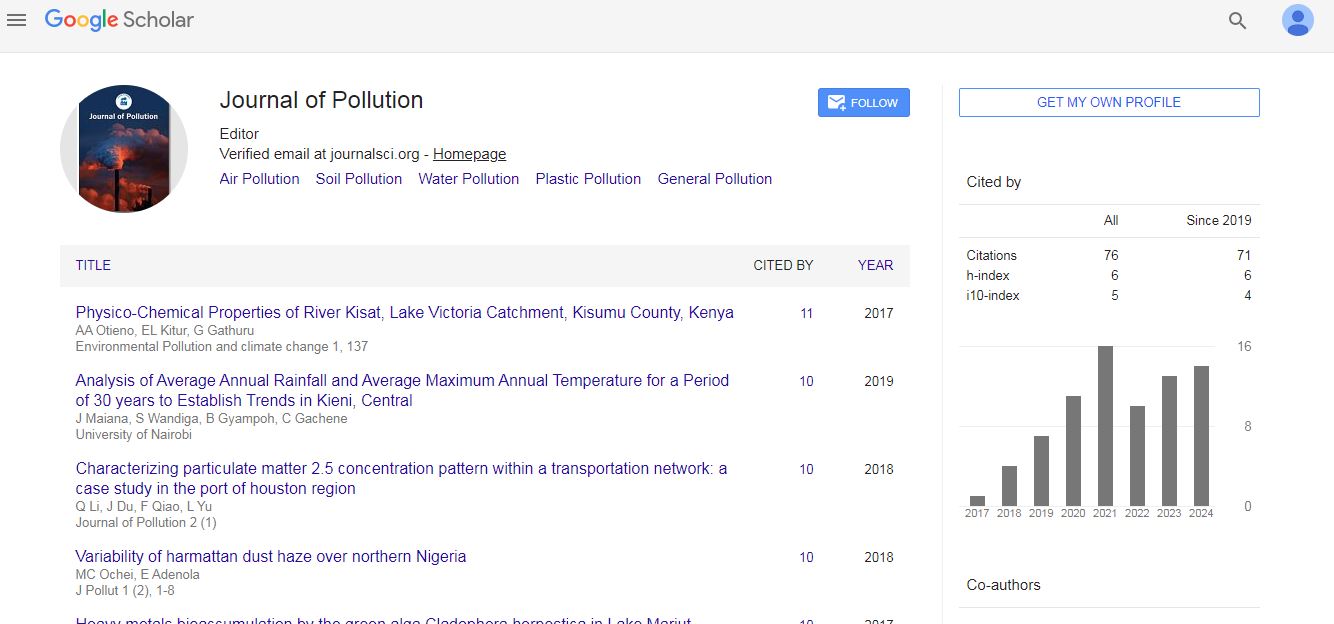
Journal of Pollution received 64 citations as per Google Scholar report