Short Communication - (2025) Volume 13, Issue 2
Received: 01-Apr-2025, Manuscript No. jpgeb-25-157465;
Editor assigned: 03-Apr-2025, Pre QC No. P-157465;
Reviewed: 17-Apr-2025, QC No. Q-157465;
Revised: 22-Apr-2025, Manuscript No. R-157465;
Published:
29-Apr-2025
, DOI: 10.37421/2329-9002.2025.13.375
Citation: Petrova, Sofia. ”Metagenomic Phylogenetics Transforms Microbial Understanding.” J Phylogenetics Evol Biol 13 (2025):375.
Copyright: © 2025 Petrova S. This is an open-access article distributed under the terms of the Creative Commons Attribution License, which permits unrestricted use,
distribution and reproduction in any medium, provided the original author and source are credited.
Metagenomic taxonomic classification has seen significant advances with the introduction of novel alignment-free methods. These innovative techniques offer a faster and more accurate alternative to traditional alignment-based approaches, which can be computationally intensive and time-consuming for large datasets. One such method leverages unique k-mer profiles for precise phylogenetic placement, greatly improving efficiency when dealing with extensive metagenomic datasets, making it a critical tool for modern microbial ecology and evolution studies [1].
Reconstructing intricate microbial community structures now often involves phylogenies derived from Metagenome-Assembled Genomes (MAGs). This research direction highlights how MAG-based phylogenetics provides deeper insights into taxonomic relationships and functional potential within complex environmental samples. Moving beyond the limitations of single-gene markers, MAGs offer a comprehensive view of microbial diversity and interaction, essential for understanding ecosystem dynamics [2].
Another groundbreaking alignment-free method, Metapars, facilitates the construction of genome-wide phylogenetic trees directly from metagenomic shotgun sequencing data. This approach effectively addresses the challenges inherent in traditional alignment-based methods. It enables more robust and comprehensive phylogenetic inference across diverse microbial communities, opening new avenues for exploring previously uncharacterized microbial lineages and their evolutionary connections [3].
The application of metagenome-assembled genome phylogenomics has extended to exploring the evolutionary history and diversification of human gut microbes. These detailed investigations provide a clearer picture of how these complex communities evolve, adapt to their environment, and impact host health. Such high-resolution phylogenetic analysis is proving invaluable for understanding disease mechanisms and developing targeted interventions in various microbiomes [4].
The utility of ribosomal protein sequences for metagenomic phylogenetic analysis has also been a key area of development. This approach provides a reliable framework for deep phylogenetic placement and taxonomic classification of diverse microbial taxa. It offers improved resolution compared to traditional marker genes, especially beneficial for resolving relationships within deeply branching lineages, which are often challenging to characterize using conventional methods [5].
An extensive global survey recently used metagenomic phylogenetics to uncover a vast dark matter of microbial life. This research revealed numerous uncharacterized lineages and significant novel biodiversity, fundamentally challenging existing understandings of microbial community structure. The findings underscore the immense, unexplored microbial phylogenetic space awaiting discovery, emphasizing the need for continued comprehensive metagenomic studies [6].
Further phylogenomic explorations have focused on gut microbiomes across humans and various animals. This research reveals common evolutionary patterns and host-specific adaptations among these diverse microbial communities. By using metagenomic approaches to trace the phylogenetic relationships of gut bacteria, scientists gain crucial insights into their co-evolution with hosts and their functional divergence, which is vital for understanding health and disease across species [7].
Strategies for integrating Metagenome-Assembled Genomes (MAGs) with Single-Cell Genomes (SAGs) have been developed to achieve an even more complete and higher-resolution view of microbial community structure and function. This combined phylogenomic approach significantly improves the reconstruction of individual microbial lineages and their intricate evolutionary relationships within complex ecosystems, offering unprecedented clarity into microbial interactions [8].
A monumental achievement in metagenomic phylogenetics involved the massive phylogenomic reconstruction of the Tree of Life, incorporating over a million species. This work provides a fundamental framework for precisely placing novel metagenomic sequences and understanding deep evolutionary relationships across all domains of life. It serves as a foundational resource for future studies aiming to map microbial diversity on a global scale [9].
Finally, phylogenomics derived from metagenomic data has been instrumental in illuminating the evolutionary history and metabolic potential of enigmatic groups, such as the Lokiarchaeota candidate phylum. This particular study offered critical insights into the early evolution of eukaryotes and the deep branching of life. It wonderfully demonstrates how metagenomic phylogenetics can reveal hidden microbial diversity and elucidate their vital ecological roles in shaping our planet's biosphere [10].
The field of metagenomic phylogenetics provides indispensable tools for dissecting the complex world of microbial communities without the need for cultivation. Recent advancements have introduced highly efficient alignment-free methods for taxonomic classification, which offer significant speed and accuracy improvements over traditional approaches [1]. These techniques, often utilizing unique k-mer profiles, enable precise phylogenetic placement for extensive datasets, streamlining the analysis of vast amounts of metagenomic sequencing data. A prime example is Metapars, an innovative alignment-free, genome-wide method that constructs phylogenetic trees directly from shotgun sequencing data, effectively overcoming challenges associated with older alignment-based inference methods [3]. This capability facilitates more comprehensive phylogenetic understanding across various microbial ecosystems.
A core component of these studies involves Metagenome-Assembled Genomes (MAGs). Research consistently shows how phylogenies derived from MAGs are crucial for reconstructing intricate microbial community structures and gaining deeper insights into taxonomic relationships and functional potential within complex environmental samples [2]. For instance, MAG phylogenomics has been instrumental in exploring the evolutionary history and diversification of human gut microbes, offering detailed perspectives on their adaptation and impact on host health [4]. These high-resolution analyses are transforming our view of microbiome evolution.
Further methodological progress includes the demonstrated utility of ribosomal protein sequences for robust metagenomic phylogenetic analysis. This framework provides reliable deep phylogenetic placement and taxonomic classification for diverse microbial taxa, offering enhanced resolution, particularly for deeply branching lineages where traditional markers often fall short [5]. Moreover, a sophisticated strategy integrates MAGs with Single-Cell Genomes (SAGs) to achieve an even more complete and higher-resolution understanding of microbial community structure and function. This combined phylogenomic approach refines the reconstruction of individual microbial lineages and their evolutionary relationships within complex ecosystems [8].
These powerful methodologies have enabled explorations into a wide array of biological questions. Global surveys utilizing metagenomic phylogenetics have uncovered a vast dark matter of microbial life, revealing numerous uncharacterized lineages and novel biodiversity, which significantly challenges our current understanding of microbial community composition [6]. Beyond environmental samples, phylogenomic studies of gut microbiomes across humans and various animals have illuminated common evolutionary patterns and host-specific adaptations. By tracing the phylogenetic relationships of gut bacteria, these studies offer key insights into co-evolution with hosts and functional divergence [7].
The collective impact of these efforts culminates in monumental achievements like the massive phylogenomic reconstruction of the Tree of Life, built from over a million species. This extensive work establishes a fundamental framework for accurately placing newly discovered metagenomic sequences and deciphering deep evolutionary relationships across all domains of life [9]. Such comprehensive analyses have even extended to shedding light on the evolutionary history and metabolic potential of enigmatic candidate phyla, like Lokiarchaeota, providing critical insights into the early evolution of eukaryotes and the deep branching of life [10]. Metagenomic phylogenetics continues to be a driving force in revealing hidden microbial diversity and their profound ecological roles.
Metagenomic phylogenetics has transformed our understanding of microbial life by enabling detailed analysis of complex communities without needing to culture individual organisms. Recent advancements include new alignment-free methods, like those leveraging k-mer profiles, providing faster and more accurate taxonomic classification for large datasets. One such method offers a genome-wide approach for building phylogenetic trees directly from shotgun sequencing data. The utility of Metagenome-Assembled Genomes (MAGs) has become clear, allowing researchers to reconstruct microbial community structures, explore evolutionary histories, and understand functional potential within environmental and host-associated samples. For instance, MAG phylogenomics has revealed insights into human gut microbe evolution and diversification. This field also benefits from specialized marker approaches, such as using ribosomal protein sequences, which offer high-resolution phylogenetic placement for diverse microbial taxa, even deeply branching lineages. Expanding the scope, studies have utilized phylogenomics to conduct global surveys, uncovering extensive microbial dark matter and novel biodiversity, fundamentally challenging existing views of community structures. Research into gut microbiomes, spanning humans and various animals, shows common evolutionary patterns and host-specific adaptations, tracing bacterial relationships and functional divergence. To further enhance resolution, strategies integrating MAGs with Single-Cell Genomes (SAGs) are being employed to reconstruct individual microbial lineages more completely. On a grander scale, massive phylogenomic reconstructions of the Tree of Life, based on millions of species, provide a crucial framework for classifying new metagenomic sequences and understanding deep evolutionary connections. Specific studies have also applied phylogenomics to illuminate the evolution and metabolic capabilities of enigmatic groups like Lokiarchaeota, offering insights into the early evolution of eukaryotes and deep life branches. These collective efforts underscore the power of metagenomic phylogenetics to reveal hidden diversity and ecological roles within microbial ecosystems.
None
None
1. Eric R, Vincent M, Sylvain T. "Fast and accurate metagenomic taxonomic classification using an alignment-free approach.".GigaScience 13 (2024):giad102.
Indexed at, Google Scholar, Crossref
2. Jennifer MB, Andreas S, Anna KH. "Reconstructing microbial community structure from metagenomic data with Metagenome-assembled genome (MAG) phylogenies.".Sci Rep 13 (2023):20387.
Indexed at, Google Scholar, Crossref
3. Trieu DN, Jordan ME, Benedict P. "Metapars: An alignment-free, genome-wide approach for inferring phylogenetic trees from metagenomic shotgun sequencing data.".Mol Biol Evol 39 (2022):msab366.
Indexed at, Google Scholar, Crossref
4. Mathieu P, M. G, B. L. "Metagenome-assembled genome phylogenomics reveals insights into the evolution of human gut microbes.".Nat Microbiol 4 (2019):2054–2064.
Indexed at, Google Scholar, Crossref
5. Donovan HP, Christian R, Maria C. "Metagenomic phylogenetics using ribosomal protein sequences.".Nat Biotechnol 40 (2022):1686–1693.
Indexed at, Google Scholar, Crossref
6. Edoardo P, Lisa S, Paolo M. "Global survey of microbial diversity reveals a "dark matter" of life.".Cell 178 (2019):494-505.e12.
Indexed at, Google Scholar, Crossref
7. Alexandra Z, Alexander K, Cisca W. "The Global Gut Microbiome: a phylogenomic exploration of human and animal-associated bacteria.".Cell Host Microbe 29 (2021):1686-1699.e5.
Indexed at, Google Scholar, Crossref
8. Carrie K, Christian R, Tanja W. "Integrating metagenome-assembled genomes and single-cell genomes for high-resolution microbial community analysis.".ISME J 15 (2021):2715–2727.
Indexed at, Google Scholar, Crossref
9. Laura AH, Brett JB, Karthik A. "Phylogenomic reconstruction of the Tree of Life from over 1 million species.".Nat Microbiol 8 (2023):1095–1108.
Indexed at, Google Scholar, Crossref
10. Anja S, Roland H, Karthik A. "Phylogenomic insights into the evolution and metabolic capabilities of the candidate phylum "Lokiarchaeota".".ISME J 13 (2019):2788–2802.
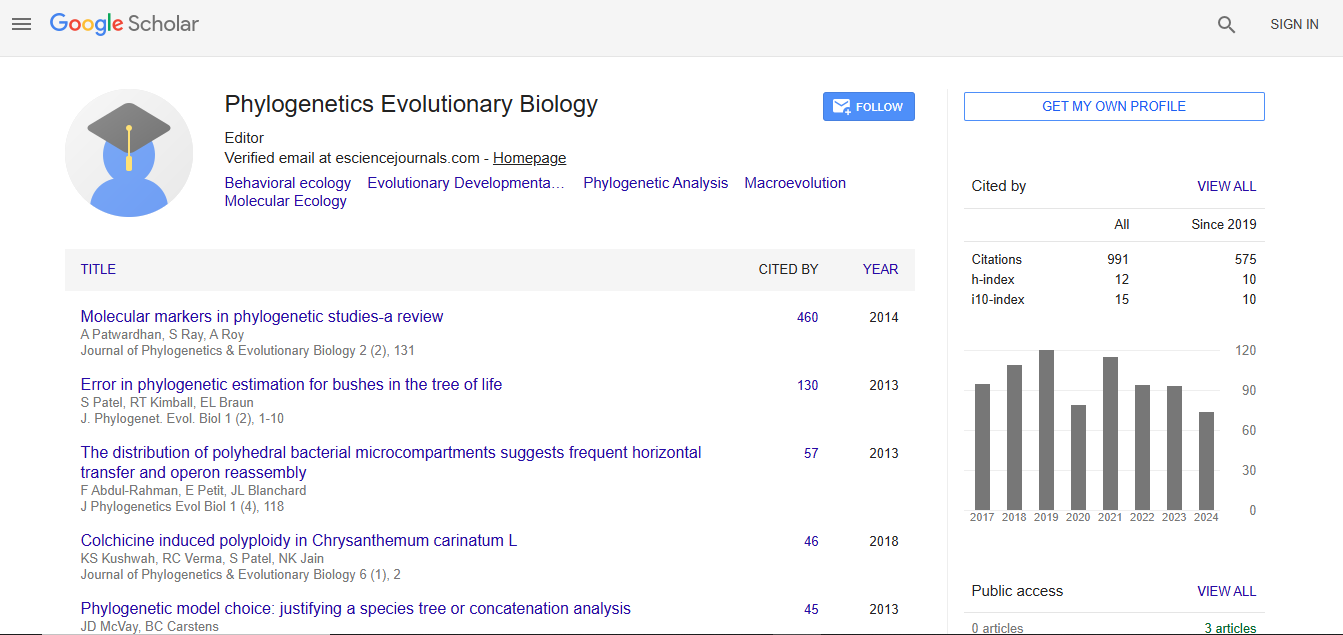
Journal of Phylogenetics & Evolutionary Biology received 911 citations as per Google Scholar report