Short Communication - (2025) Volume 13, Issue 6
Received: 01-Dec-2025, Manuscript No. jpgeb-26-184339;
Editor assigned: 03-Dec-2025, Pre QC No. P-184339;
Reviewed: 17-Dec-2025, QC No. Q-184339;
Revised: 22-Dec-2025, Manuscript No. R-184339;
Published:
29-Dec-2025
, DOI: 10.37421/2329-9002.2025.13.415
Citation: Okeke, Samuel T.. ”Metagenomic Phylogenetics: Microbial Evolution Across Environments.” J Phylogenetics Evol Biol 13 (2025):415.
Copyright: © 2025 Okeke T. Samuel This is an open-access article distributed under the terms of the Creative Commons Attribution License, which permits unrestricted use, distribution and reproduction in any medium, provided the original author and source are credited.
Metagenomics has revolutionized our understanding of microbial communities by enabling the analysis of collective genetic material directly from environmental samples, bypassing the limitations of culturing techniques. This approach provides a more comprehensive view of microbial diversity and their intricate relationships within complex ecosystems. Phylogenetic methods are crucial for this endeavor, allowing researchers to reconstruct evolutionary histories and infer ecological roles, adaptation strategies, and diversification patterns of microbes across various environments [1].
Whole-genome sequencing of microbial communities, coupled with phylogenetic analyses, offers powerful insights into evolutionary trajectories and the spread of crucial genetic elements, such as antibiotic resistance genes. This technique allows for the identification of microbial hosts carrying these determinants and facilitates the understanding of their dissemination pathways within both environmental and clinical settings, shedding light on microbial evolution under anthropogenic pressures [2].
The reconstruction of phylogenetic trees directly from metagenomic data presents unique challenges due to the fragmented nature of assembled genomes from mixed microbial populations. Novel computational methods are continuously being developed to overcome these hurdles, offering different approaches to reconstruct evolutionary lineages and their associated functions, thereby establishing a robust framework for phylogenetic inference in diverse environmental samples [3].
Viral communities, particularly in dynamic environments like the oceans, are increasingly being studied using metagenomic phylogenomics. This approach reveals the evolutionary history and ecological distribution of viruses, highlighting their significant roles in shaping microbial populations and influencing biogeochemical cycles. Understanding viral phylogenetics is thus essential for comprehending marine microbial ecosystems [4].
Environmental factors exert a profound influence on microbial community structure and evolution, which can be elucidated through metagenomic phylogenetics. By examining how changes in habitats, such as temperature or nutrient availability, impact phylogenetic diversity and the emergence of new microbial lineages, researchers can gain insights into the dynamic interplay between environmental conditions and microbial evolutionary processes [5].
Advanced computational algorithms are vital for overcoming the challenges inherent in metagenomic phylogenetic analysis, particularly concerning fragmented genomes and low-abundance taxa. These algorithms aim to improve the accuracy of phylogenetic tree reconstruction and taxonomic assignment, thereby enhancing our ability to study the evolutionary history of underrepresented microbial groups [6].
The human gut microbiome, a complex microbial ecosystem, has been a significant focus for phylogenomic investigations. Metagenomic data allows for the reconstruction of evolutionary histories of key bacterial taxa, uncovering patterns of co-evolution with the host and adaptations to the gut environment, leading to a deeper understanding of the microbiome's role in human health and disease [7].
Extreme environments, such as deep-sea hydrothermal vents, harbor unique microbial communities whose evolution can be effectively studied using metagenomic phylogenetics. This approach reconstructs the evolutionary trajectories of extremophiles and identifies genes and pathways associated with their adaptation to harsh conditions like high pressure, temperature, and chemical gradients [8].
Soil ecosystems, critical for global biogeochemical cycles, host diverse microbial communities whose phylogenetic structure can be illuminated by metagenomic data. Research in this area investigates how different land management practices influence microbial diversity and evolutionary trajectories, offering insights into the long-term ecological consequences of agricultural interventions [9].
The development of novel phylogenetic markers derived from metagenomic data is an active area of research. Methods for identifying conserved genes across diverse microbial communities are crucial for robust phylogenetic inference, aiming to improve the resolution of evolutionary relationships within complex environmental samples [10].
Metagenomic data analysis, particularly through the lens of phylogenetics, offers an unprecedented window into the evolutionary history of microbial communities. By analyzing the collective genetic material from an environmental sample, researchers can move beyond individual isolates to understand the broader evolutionary landscape of microbial life. The application of phylogenetic methods to this data allows for the reconstruction of evolutionary trajectories, shedding light on the ecological roles, adaptive strategies, and diversification patterns of microbes within complex ecosystems [1].
The integration of whole-genome sequencing with metagenomic phylogenetics has proven instrumental in deciphering the evolutionary pathways of microbial communities and tracking the dissemination of important genetic traits, such as antibiotic resistance. This powerful combination enables the identification of the specific microbial hosts harboring resistance determinants and provides detailed insights into their spread across various environmental and clinical niches. Consequently, these studies illuminate how microbial evolution is shaped by anthropogenic influences [2].
Building phylogenetic trees directly from metagenomic datasets poses significant computational challenges, primarily due to the inherent fragmentation of genomes assembled from mixed microbial populations. Researchers are actively developing and refining novel computational methodologies to address these complexities. These innovative approaches facilitate the reconstruction of evolutionary lineages and their functional attributes, establishing a resilient framework for conducting robust phylogenetic inferences across a wide spectrum of environmental samples [3].
In marine environments, the application of metagenomic phylogenomics to viral communities is revealing crucial aspects of their evolutionary dynamics and ecological significance. By analyzing viral metagenomes, scientists can reconstruct evolutionary histories and map ecological distributions, thereby uncovering the critical roles viruses play in shaping microbial populations and influencing global biogeochemical cycles. This underscores the importance of viral phylogenetics in understanding marine microbial ecology [4].
The profound impact of environmental factors on microbial community structure and evolution is a key area of investigation within metagenomic phylogenetics. Studies examining how alterations in habitat conditions, such as temperature fluctuations or variations in nutrient availability, influence phylogenetic diversity and the emergence of novel microbial lineages provide critical insights into the dynamic and intricate relationship between the environment and microbial evolutionary processes [5].
Improvements in computational algorithms are central to advancing the field of metagenomic phylogenetics. These sophisticated algorithms are designed to address specific challenges, including the analysis of fragmented genomes and the accurate identification of low-abundance taxa. By enhancing the precision of phylogenetic tree reconstruction and taxonomic classification, these methods significantly improve our capacity to explore the evolutionary history of microbial groups, particularly those that are typically underrepresented in traditional analyses [6].
Within the human gut microbiome, phylogenomic analyses utilizing metagenomic data are providing a deeper understanding of bacterial evolution and host-microbe interactions. These studies reconstruct the evolutionary histories of key bacterial taxa, revealing intricate patterns of co-evolution with the host and highlighting specific adaptations to the gut environment. Such research is pivotal for comprehending the microbiome's multifaceted role in human health and disease pathogenesis [7].
Microbial communities inhabiting extreme environments, such as the unique ecosystems found in deep-sea hydrothermal vents, are subjects of intense study through metagenomic phylogenetics. This investigative approach facilitates the reconstruction of the evolutionary pathways of extremophilic organisms and the identification of specific genes and metabolic pathways that confer adaptation to extreme conditions, including high pressures, temperatures, and complex chemical gradients [8].
In terrestrial ecosystems, metagenomic phylogenetics is employed to unravel the phylogenetic structure of soil microbial communities. Investigations into how diverse land management practices influence microbial diversity and evolutionary trajectories offer valuable perspectives on the long-term ecological ramifications of agricultural and land-use interventions, contributing to a more sustainable approach to soil management [9].
The ongoing development of novel phylogenetic markers derived from metagenomic data represents a significant advancement in microbial community analysis. The creation of methods that can reliably identify conserved genes across a broad range of microbial communities is essential for robust phylogenetic inference, ultimately leading to a more refined understanding of evolutionary relationships within complex environmental samples [10].
This collection of research explores the application of metagenomic phylogenetics for understanding microbial community evolution across diverse environments. Studies highlight how analyzing collective genetic material reconstructs evolutionary histories, identifies hosts of antibiotic resistance genes, and reveals adaptations to various ecological niches, including the human gut and extreme environments. Novel computational methods and phylogenetic markers are being developed to improve accuracy and resolve evolutionary relationships from fragmented data. The research also emphasizes the influence of environmental factors and land management practices on microbial evolution, providing a comprehensive view of microbial dynamics and their ecological significance.
None
None
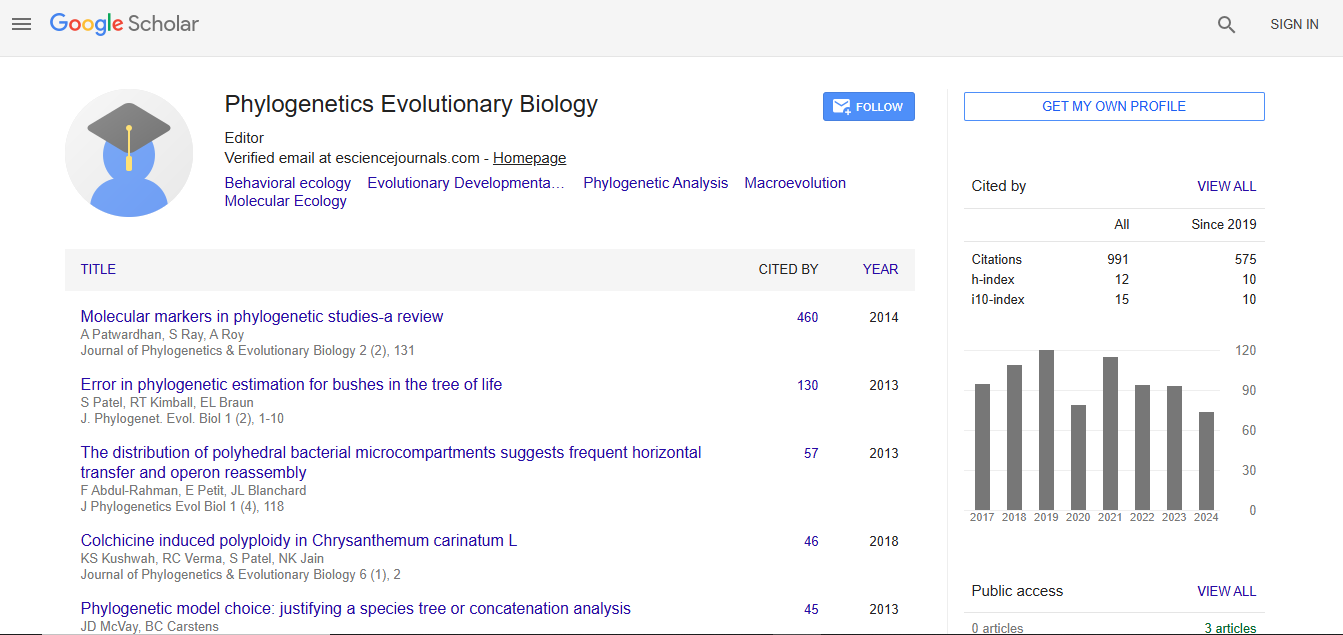
Journal of Phylogenetics & Evolutionary Biology received 911 citations as per Google Scholar report