Short Communication - (2025) Volume 15, Issue 6
Received: 01-Dec-2025, Manuscript No. jprm-25-174605;
Editor assigned: 03-Dec-2025, Pre QC No. P-174605;
Reviewed: 17-Dec-2025, QC No. Q-174605;
Revised: 22-Dec-2025, Manuscript No. R-174605;
Published:
29-Dec-2025
, DOI: 10.37421/2161-105X.2025.15.773
Citation: Meyer, Lucas. ”Mechanical Ventilation: Challenges, Strategies, Future.” J Pulm Respir Med 15 (2025):773.
Copyright: © 2025 Meyer L. This is an open-access article distributed under the terms of the Creative Commons Attribution License, which permits unrestricted use, distribution and reproduction in any medium, provided the original author and source are credited.
Lung protective ventilation strategies are essential for minimizing ventilator-induced lung injury (VILI), particularly in patients with acute respiratory distress syndrome (ARDS). This approach highlights current best practices, including low tidal volumes, appropriate positive end-expiratory pressure (PEEP), and personalized methods for setting ventilator parameters. It emphasizes the dynamic interplay between these settings and patient outcomes, also touching on adjunctive therapies and monitoring techniques vital for guiding ventilation optimization [1].
Successfully weaning patients from mechanical ventilation is a critical process, and clinical guidelines offer evidence-based recommendations for its discontinuation. These guidelines address comprehensive assessment criteria for readiness to wean, various liberation strategies such as spontaneous breathing trials, and the effective management of weaning failure. The overarching goal is to significantly reduce the duration of mechanical ventilation and its associated complications, with additional guidance provided on tracheostomy and long-term ventilation [2].
Ventilator-associated pneumonia (VAP) remains a serious and persistent complication of mechanical ventilation, contributing substantially to increased morbidity and mortality among patients. This area of study discusses a range of preventive strategies, which notably include bundles of care, maintaining head-of-bed elevation, rigorous oral hygiene protocols, implementing sedation holidays, and considering selective digestive decontamination. It critically evaluates the effectiveness of these diverse interventions and identifies crucial areas for future research and implementation efforts aimed at reducing the incidence of VAP [3].
Extracorporeal membrane oxygenation (ECMO) serves as a life-saving rescue therapy specifically for severe acute respiratory distress syndrome (ARDS) that is unresponsive to conventional mechanical ventilation. This review provides a detailed overview of ECMO indications, precise patient selection criteria, and fundamental management principles tailored for ARDS patients, including the intricacies of veno-venous ECMO configuration. It strongly emphasizes the importance of timely initiation and a cohesive multidisciplinary team approach for optimizing patient outcomes in this critically ill population [4].
Personalized mechanical ventilation represents a significant paradigm shift in critical care, moving beyond the traditional 'one-size-fits-all' approaches to patient management. This evolving concept explores innovative strategies to tailor ventilation settings precisely based on individual patient characteristics, such as unique lung mechanics, the specifics of their underlying disease, and their physiological responses to ventilation. It prominently emphasizes the use of advanced monitoring tools and sophisticated computational models to meticulously optimize ventilator settings, with the ultimate goal of further reducing lung injury and markedly improving overall patient outcomes [5].
Understanding and accurately interpreting mechanical ventilation graphics is of paramount importance for effective patient management and the early detection of issues like ventilator-patient asynchrony or worsening lung mechanics. This field details common problems and potential pitfalls frequently encountered when clinicians analyze ventilator waveforms, pressure-volume loops, and scalar displays. It offers practical guidance for identifying critical issues such as auto-PEEP, dynamic hyperinflation, flow starvation, and various forms of patient-ventilator dyssynchrony, thereby enabling timely and targeted interventions to improve patient care [6].
High-flow nasal cannula (HFNC) therapy has emerged as a valuable alternative or an effective adjunct to conventional oxygen therapy and non-invasive ventilation for patients experiencing acute respiratory failure. This systematic review investigates the various risk factors associated with HFNC failure in critically ill patients, a crucial step in helping clinicians identify individuals who might benefit more from earlier intubation or other forms of ventilatory support. A deeper understanding of these identified risk factors can significantly improve patient selection and refine management strategies for HFNC implementation [7].
Noninvasive ventilation (NIV) stands as a cornerstone therapy for acute hypercapnic respiratory failure, offering substantial benefits by supporting ventilation without the need for invasive endotracheal intubation. This comprehensive systematic review and meta-analysis synthesizes robust evidence regarding NIV's efficacy and safety across various etiologies of hypercapnic respiratory failure, including common conditions like Chronic Obstructive Pulmonary Disease (COPD) exacerbations. It provides invaluable insights into optimal application techniques, judicious patient selection, and expected outcomes, thereby helping to refine existing clinical practice guidelines for NIV use [8].
Ventilator-induced diaphragm dysfunction (VIDD) is recognized as a significant contributor to weaning failure and prolonged mechanical ventilation duration. This area of research explores the intricate mechanisms underlying VIDD, which include aspects like disuse atrophy and oxidative stress, alongside its profound clinical impact on patient recovery trajectories. It also reviews novel treatment strategies specifically aimed at preserving diaphragm function, such as diaphragm protective ventilation, electrical stimulation, and pharmacological interventions, all designed to improve patient liberation from mechanical ventilation [9].
The integration of Artificial Intelligence (AI) and machine learning within mechanical ventilation holds immense promise for significantly enhancing patient care. This systematic review investigates current and emerging applications of Artificial Intelligence (AI) in mechanical ventilation, covering diverse areas such as predictive analytics for weaning readiness, automated ventilator adjustments, early detection of complications, and the development of highly personalized ventilation strategies. It highlights the profound potential for Artificial Intelligence (AI) to optimize ventilator settings, substantially reduce clinician workload, and ultimately improve patient outcomes by providing data-driven insights and smarter interventions [10].
Mechanical ventilation is a life-sustaining intervention in critical care, yet its application requires careful management to mitigate significant risks. A primary concern is Ventilator-Induced Lung Injury (VILI), which necessitates the implementation of lung protective ventilation strategies. These strategies involve precise control over parameters like low tidal volumes and appropriate positive end-expiratory pressure (PEEP), particularly crucial for patients with acute respiratory distress syndrome (ARDS) [1]. Beyond direct lung protection, efforts are also focused on preventing common complications such as Ventilator-Associated Pneumonia (VAP). Effective VAP prevention bundles incorporate essential practices like elevating the head of the bed, maintaining stringent oral hygiene, implementing sedation holidays, and considering selective digestive decontamination. These interventions are continually evaluated for their efficacy in reducing VAP incidence and improving patient safety [3].
Optimizing patient liberation from mechanical ventilation is another cornerstone of critical care. Successfully weaning patients involves a structured approach, guided by evidence-based recommendations that outline assessment criteria for readiness and various liberation strategies, including spontaneous breathing trials. The goal is to minimize the duration of mechanical ventilation and its associated adverse outcomes [2]. A significant challenge in this process is Ventilator-Induced Diaphragm Dysfunction (VIDD), where the diaphragm weakens due to disuse atrophy and oxidative stress, directly contributing to weaning failure. Research into VIDD explores its mechanisms and seeks novel treatment strategies, such as diaphragm protective ventilation and electrical stimulation, to preserve function and facilitate liberation [9].
For patients with severe acute respiratory distress syndrome (ARDS) who do not respond to conventional mechanical ventilation, Extracorporeal Membrane Oxygenation (ECMO) acts as a crucial rescue therapy. Proper patient selection and timely initiation of veno-venous ECMO are vital, demanding a highly coordinated multidisciplinary team approach to manage these critically ill individuals and optimize their chances of recovery [4]. Furthermore, alternative and less invasive ventilatory supports are frequently employed. High-flow nasal cannula (HFNC) therapy, for instance, serves as an adjunct or alternative to traditional oxygen therapy, especially for acute respiratory failure. Identifying risk factors for HFNC failure is key to selecting appropriate patients and preventing delayed intubation [7]. Similarly, Noninvasive Ventilation (NIV) is a fundamental therapy for acute hypercapnic respiratory failure, with extensive systematic reviews synthesizing evidence on its efficacy and safety, particularly for conditions like COPD exacerbations, to refine clinical guidelines and patient outcomes [8].
The complexity of mechanical ventilation management is increasingly supported by advanced diagnostic and personalized approaches. Interpreting mechanical ventilation graphics, including waveforms and loops, is indispensable for clinicians to detect patient-ventilator asynchrony, dynamic hyperinflation, or auto-PEEP, allowing for timely interventions and improved patient comfort and safety [6]. This paves the way for personalized mechanical ventilation, a new paradigm that moves beyond generic settings. This approach tailors ventilation based on an individual's unique lung mechanics, underlying disease, and physiological responses, leveraging advanced monitoring tools and computational models to reduce lung injury and enhance patient outcomes [5]. Looking to the future, the integration of Artificial Intelligence (AI) and machine learning holds profound promise. These technologies are being explored for predictive analytics in weaning readiness, automated ventilator adjustments, early complication detection, and the development of highly individualized ventilation strategies, aiming to optimize care, reduce workload, and deliver data-driven insights in critical care settings [10].
Mechanical ventilation is a cornerstone of critical care, but managing it effectively requires addressing several challenges and adopting advanced strategies. Key among these are lung protective ventilation, which minimizes ventilator-induced lung injury (VILI) through practices like low tidal volumes and appropriate PEEP, especially for patients with acute respiratory distress syndrome (ARDS). Successfully weaning patients off mechanical ventilation is crucial, with guidelines outlining assessment criteria and various liberation strategies to reduce complications. Preventing ventilator-associated pneumonia (VAP) is another critical aspect, involving care bundles such as head-of-bed elevation, oral hygiene, and sedation holidays. For severe ARDS cases unresponsive to conventional methods, extracorporeal membrane oxygenation (ECMO) offers a vital rescue therapy, emphasizing timely initiation and a multidisciplinary approach. The field is rapidly evolving towards personalized mechanical ventilation, tailoring settings based on individual patient characteristics using advanced monitoring and computational models to further improve outcomes. Clinicians also rely on the accurate interpretation of ventilation graphics to identify issues like auto-PEEP or patient-ventilator dyssynchrony. Furthermore, alternative supports like high-flow nasal cannula (HFNC) therapy are evaluated, with ongoing research into risk factors for failure. Noninvasive ventilation (NIV) remains a primary therapy for acute hypercapnic respiratory failure. Addressing ventilator-induced diaphragm dysfunction (VIDD) is important for preventing weaning failure, leading to explorations of diaphragm protective strategies. Looking ahead, artificial intelligence (AI) and machine learning are being integrated to enhance predictive analytics, automate adjustments, and refine personalized ventilation, promising significant advancements in patient care.
None
None
Marcelo BA, Samir J, Annelise SN. "Lung Protective Ventilation: A Narrative Review of the State of the Art".Anesthesiology 138 (2023):709-722.
Indexed at, Google Scholar, Crossref
Gregory AS, Timothy DG, John PK. "Mechanical Ventilation Weaning and Discontinuation: An Official American Thoracic Society and American College of Chest Physicians Clinical Practice Guideline".Am J Respir Crit Care Med 204 (2021):e19-e33.
Indexed at, Google Scholar, Crossref
Mireia F, Antoni T, Rosario M. "Prevention of Ventilator-Associated Pneumonia in Adults: A Narrative Review".Respir Care 68 (2023):119-132.
Indexed at, Google Scholar, Crossref
Alain C, Daniel B, Robert HB. "ECMO for severe ARDS: a narrative review".Intensive Care Med 46 (2020):2248-2260.
Indexed at, Google Scholar, Crossref
Luciano G, John JM, Michael Q. "Personalized mechanical ventilation: a new paradigm in intensive care".Crit Care 28 (2024):21.
Indexed at, Google Scholar, Crossref
Tommaso M, Elena S, Roberto C. "Interpretation of mechanical ventilation graphics: common problems and pitfalls".Intensive Care Med 46 (2020):2200-2212.
Indexed at, Google Scholar, Crossref
Chengyue D, Dan D, Yu G. "Risk factors for high-flow nasal cannula failure in critically ill patients with acute respiratory failure: a systematic review and meta-analysis".Crit Care 25 (2021):183.
Indexed at, Google Scholar, Crossref
Bram R, Peter JD, Emilie C. "Noninvasive ventilation for acute hypercapnic respiratory failure: a systematic review and meta-analysis".Intensive Care Med 46 (2020):2316-2331.
Indexed at, Google Scholar, Crossref
Thomas S, Jean-Benoit T, David VS. "Ventilator-induced diaphragm dysfunction: mechanisms, impact, and novel treatment strategies".Crit Care 26 (2022):228.
Indexed at, Google Scholar, Crossref
Ming-Ta C, Chun-Yi L, Chun-Lung H. "Artificial intelligence for mechanical ventilation: a systematic review".Eur Respir Rev 32 (2023):230094.
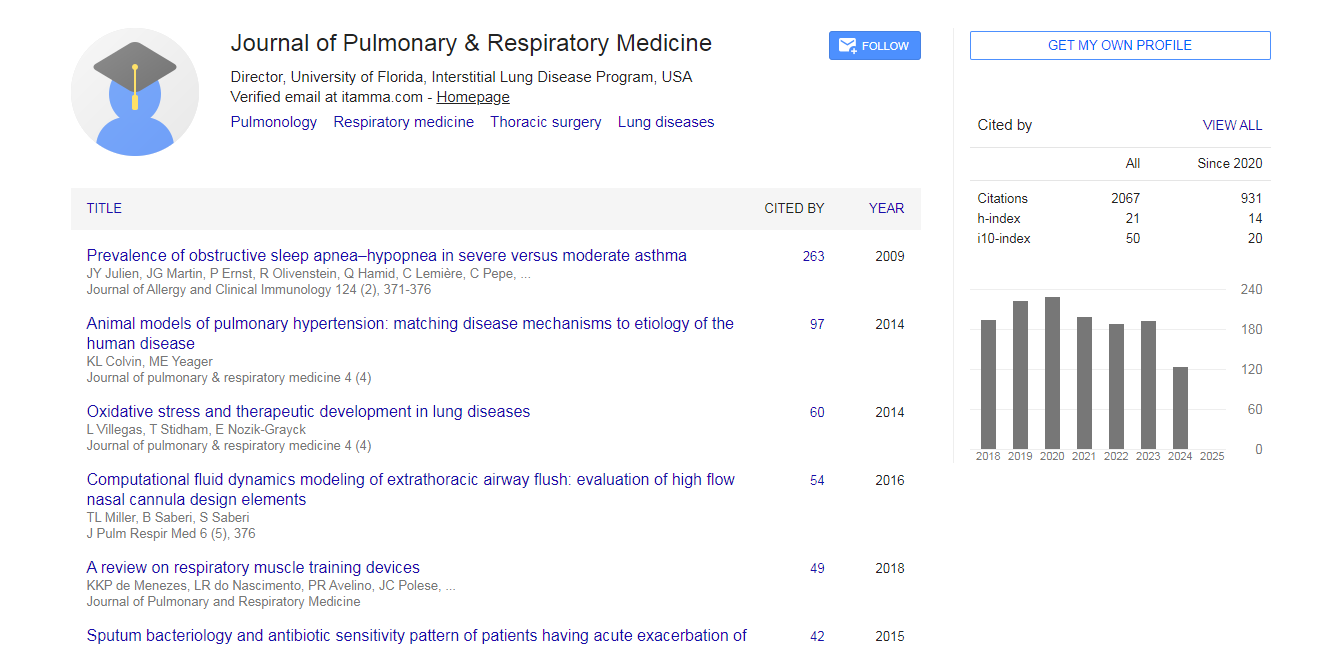
Pulmonary & Respiratory Medicine received 1690 citations as per Google Scholar report