Short Communication - (2025) Volume 10, Issue 3
Received: 02-Jun-2025, Manuscript No. arwm-26-182719;
Editor assigned: 04-Jun-2025, Pre QC No. P-182719;
Reviewed: 18-Jun-2025, QC No. Q-182719;
Revised: 23-Jun-2025, Manuscript No. R-182719;
Published:
30-Jun-2025
Citation: Pereira, Lucas. ”Smart Sensors and IoT Revolutionize Waste Management.” Adv Recycling Waste Manag 10 (2025):409.
Copyright: © 2025 Pereira L. This is an open-access article distributed under the terms of the Creative Commons Attribution License, which permits unrestricted use, distribution and reproduction in any medium, provided the original author and source are credited.
The transformative impact of smart sensors and the Internet of Things (IoT) on waste collection and sorting processes is a rapidly evolving area of research and development, offering significant potential for enhancing efficiency and sustainability in urban environments. This field is characterized by the integration of real-time data from smart bins, such as fill levels and waste types, which enables the optimization of collection routes, thereby reducing operational costs and environmental impact. The integration of IoT also facilitates the advancement of sorting technologies, leading to improved recycling rates and more effective resource recovery. Key insights into this domain highlight the potential for substantial efficiency gains in waste management operations. Furthermore, the development of predictive maintenance for waste management infrastructure is becoming increasingly feasible through the application of these smart technologies. This data-driven approach facilitates the creation of more sustainable urban environments by informing strategic decision-making in waste management. Intelligent waste bins equipped with IoT-enabled sensors play a crucial role in optimizing waste collection logistics, a key area of focus in current research. Sensor data on fill levels allows for the dynamic scheduling of collection routes, which in turn leads to reduced fuel consumption and lower emissions. Research also delves into the challenges and opportunities associated with implementing these smart systems in urban settings, emphasizing the critical need for interoperability and robust data security measures. These advancements collectively point towards a future where waste management is more efficient, cost-effective, and environmentally responsible, leveraging the power of connected devices and data analytics.
Smart waste management systems are fundamentally changing how urban areas handle refuse, primarily through the application of IoT and smart sensors. These systems leverage real-time data from smart bins to provide actionable insights for optimizing collection routes, thereby reducing fuel consumption and operational expenses. The integration of IoT platforms extends to advanced sorting technologies, which are crucial for improving recycling rates and maximizing resource recovery. For instance, smart sensors can identify different waste components, enabling more precise separation and higher quality recycled materials. Automated waste sorting technologies, often powered by sensor fusion and machine learning, are a significant area of innovation. These technologies employ various sensor types, including optical, near-infrared, and X-ray, to effectively identify and separate diverse waste materials. The use of computer vision and machine learning, particularly deep learning algorithms, is also a prominent approach for developing highly accurate automated waste sorting systems. These systems aim to address the challenges posed by the heterogeneity of real-world waste, ensuring robust classification and improved recycling efficiency. Emerging trends in smart waste management emphasize the synergistic role of IoT and artificial intelligence in creating more efficient collection processes, accurate sorting, and enhanced resource recovery. The economic and environmental implications of widespread adoption of these smart solutions are considerable, promising both cost savings and reduced ecological footprints. Studies exploring low-cost IoT systems for real-time waste monitoring highlight the scalability and potential benefits for urban environments, demonstrating practical implementations of these advanced concepts.
Smart sensors and the Internet of Things (IoT) are revolutionizing waste management by enabling real-time data collection for optimized collection routes, reduced operational costs, and improved recycling rates through advanced sorting technologies. These systems utilize data from smart bins to dynamically schedule collections, leading to lower fuel consumption and emissions. Research focuses on leveraging sensor fusion, machine learning, and computer vision for automated waste sorting, enhancing the purity and value of recycled materials. Key benefits include significant efficiency gains, predictive maintenance for infrastructure, and the creation of more sustainable urban environments. Challenges related to interoperability and data security are also being addressed. Ultimately, these technologies offer a pathway to more efficient, cost-effective, and environmentally friendly waste management practices.
None
None
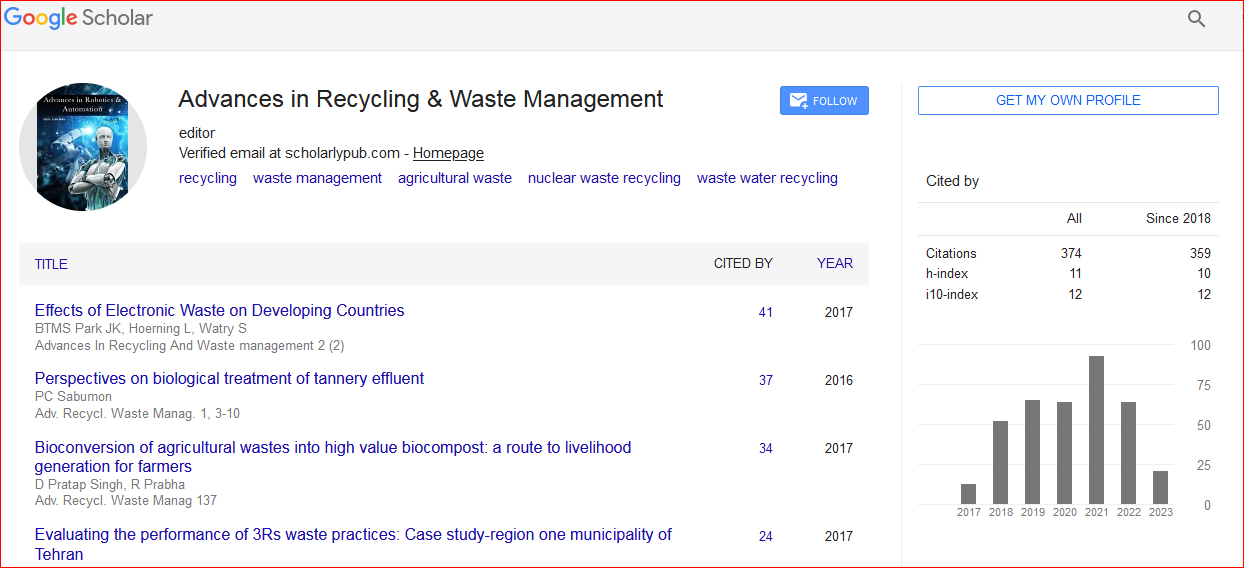
Advances in Recycling & Waste Management received 438 citations as per Google Scholar report