Short Communication - (2025) Volume 12, Issue 6
Received: 02-Dec-2025, Manuscript No. fmoa-26-187963;
Editor assigned: 04-Dec-2025, Pre QC No. P-187963;
Reviewed: 18-Dec-2025, QC No. Q-187963;
Revised: 23-Dec-2025, Manuscript No. R-187963;
Published:
30-Dec-2025
, DOI: 10.37421/2476-2296.2025.12.365
Citation: Nguyen, Linh. ”Marine Propeller Advancements: Efficiency, Noise, and Performance.” Fluid Mech Open Acc 12 (2025):365.
Copyright: © 2025 Nguyen L. This is an open-access article distributed under the terms of the Creative Commons Attribution License, which permits unrestricted use, distribution and reproduction in any medium, provided the original author and source are credited.
The field of marine propeller hydrodynamics is a critical area of research, directly impacting the efficiency, performance, and environmental sustainability of maritime vessels. Advanced simulation techniques and experimental validations are continuously being developed to better understand and predict the complex fluid interactions involved. This introduction will delve into various facets of marine propeller research, exploring areas such as propeller-hull interaction, unsteady forces, cavitation phenomena, specialized designs for emerging propulsion systems, maneuvering hydrodynamics, operation in extreme conditions, bio-inspired concepts, ducted propeller analysis, vibration and noise prediction, and the influence of shaft inclination. Each of these aspects contributes to the overarching goal of optimizing propeller design and operation for a more efficient and responsible maritime industry. The intricate interplay between a propeller and its surrounding water, especially when influenced by the hull, is a fundamental consideration for overall vessel performance. Advanced computational fluid dynamics (CFD) coupled with experimental data are instrumental in refining propeller designs for enhanced efficiency and the mitigation of cavitation, which is paramount for sustainable maritime operations [1].
Understanding the unsteady hydrodynamic forces generated by marine propellers is crucial, particularly in disturbed inflow conditions often encountered behind a ship hull. Accurate modeling of these unsteady effects is essential for reliable predictions of propeller cavitation and structural loads, ultimately leading to more robust propeller designs. This area of research is vital for ensuring the longevity and operational integrity of propeller systems [2].
Cavitation, a phenomenon involving the formation and collapse of vapor bubbles, poses significant challenges to propeller performance, structural integrity, and acoustic emissions. Advanced numerical methods are employed to investigate the inception, development, and collapse of these cavitation bubbles, providing insights into their impact on propeller performance and noise generation. This knowledge is key to mitigating cavitation-induced erosion and vibration [3].
The evolution of marine propulsion systems, particularly towards electric and hybrid vessels, necessitates specialized propeller designs. These designs must consider unique operational profiles and stringent efficiency demands. Novel propeller concepts and advanced analysis tools are explored to optimize performance for these emerging and increasingly important marine propulsion systems [4].
The propeller's influence extends beyond propulsion to affect the overall ship maneuvering capabilities. Quantifying the forces and moments generated by propeller-hull interaction during various maneuvering scenarios is essential for designing stable and controllable vessels. CFD simulations play a pivotal role in providing this critical data for ship stability and control system design [5].
Marine propellers are often subjected to extreme sea states, such as those encountered during storms. Investigating their hydrodynamic response under such severe loading conditions requires advanced numerical modeling to understand complex fluid-structure interactions. This research is vital for ensuring propeller efficiency and structural integrity in the most challenging environments [6].
In the pursuit of enhanced hydrodynamic efficiency and reduced noise, bio-inspired designs are gaining traction. By mimicking features found in natural aquatic propulsion systems, researchers aim to integrate these principles into conventional propeller designs for improved overall performance. This approach holds promise for more sustainable and quieter marine propulsion [7].
Ducted propellers offer distinct performance characteristics and interactions with their surrounding duct. Research in this area focuses on analyzing these characteristics to highlight the potential benefits, such as thrust augmentation and increased efficiency, particularly for specific types of vessels where these advantages can be most effectively realized [8].
Propeller-induced vibration and noise are significant concerns for ship comfort and operational stealth. The development and application of coupled CFD-CAA (Computational Aeroacoustics) methods enable the simulation of unsteady hydrodynamic loads and their resulting acoustic consequences, paving the way for quieter and less vibratory propeller designs [9].
Finally, the orientation of the propeller shaft has a direct impact on hydrodynamic performance. Analyzing how variations in shaft inclination affect thrust, torque, and efficiency through numerical simulations provides valuable guidance for optimal propeller installation and design, ensuring maximum performance under various operational configurations [10].
The intricate relationship between marine propellers and their operational environment necessitates a multifaceted approach to design and analysis. Computational Fluid Dynamics (CFD) has emerged as a powerful tool, often complemented by experimental data, to meticulously study propeller-hull interactions. This allows for the refinement of propeller designs to achieve enhanced efficiency and mitigate cavitation, which are vital components of sustainable maritime practices [1].
The accurate prediction of propeller performance under diverse operating conditions hinges on understanding the complex hydrodynamic forces at play. Furthermore, the analysis of unsteady hydrodynamic forces generated by propellers is of paramount importance, especially in non-uniform flow fields characteristic of the flow behind a ship's hull. Capturing these unsteady effects is crucial for correctly assessing propeller cavitation and the structural loads experienced by the propeller, leading to more reliable and durable designs [2].
This understanding is fundamental to preventing premature failure and ensuring optimal performance throughout the propeller's lifespan. Cavitation phenomena represent a significant challenge in marine propeller technology. Advanced numerical methods are employed to thoroughly investigate the inception, development, and collapse of cavitation bubbles. Understanding the intricate dynamics of these bubbles and their impact on propeller performance, noise generation, and material erosion is essential for developing effective mitigation strategies [3].
This research directly contributes to quieter and more efficient vessel operations. As the maritime industry shifts towards greener technologies, the hydrodynamic design of propellers for electric and hybrid vessels becomes increasingly important. These vessels often have unique operational profiles and stringent efficiency requirements. Research in this area focuses on exploring novel propeller concepts and advanced analytical tools to optimize performance for these emerging propulsion systems [4].
This adaptation is key to the successful integration of sustainable technologies. Beyond direct propulsion, propellers significantly influence ship maneuvering hydrodynamics. The forces and moments generated by propeller-hull interaction during various maneuvering maneuvers are quantified using CFD simulations. This data is indispensable for designing ships with enhanced stability and effective control systems, ensuring safe navigation in complex situations [5].
The interconnectedness of propulsion and maneuverability is a key consideration. Marine propellers must also contend with the challenging conditions presented by extreme sea states, such as severe storms. Investigating the hydrodynamic response of propellers under these extreme loading conditions involves advanced numerical modeling to understand complex fluid-structure interactions. This research is critical for maintaining propeller efficiency and structural integrity in the face of harsh environmental forces [6].
The exploration of bio-inspired designs offers a novel pathway to improve marine propeller efficiency and reduce noise. By drawing inspiration from natural aquatic propulsion systems, researchers aim to integrate unique features into conventional propeller designs. This interdisciplinary approach holds promise for developing more efficient and environmentally friendly propulsion solutions [7].
Ducted propellers present a distinct category with unique performance characteristics and interactions between the propeller and its surrounding duct. Hydrodynamic performance analysis in this domain highlights potential benefits such as thrust augmentation and improved efficiency, making them a viable option for specific vessel types where these advantages can be maximized [8].
The prediction of propeller-induced vibration and noise is a critical aspect of modern ship design. Coupled CFD-CAA methods are utilized to simulate unsteady hydrodynamic loads and their subsequent acoustic consequences. This sophisticated approach enables the development of propeller designs that significantly reduce vibration and noise levels, enhancing passenger comfort and reducing environmental impact [9].
Lastly, the influence of propeller shaft inclination on hydrodynamic performance is a practical consideration in propeller installation. Numerical simulations are employed to analyze how variations in shaft angle affect key performance metrics like thrust, torque, and efficiency. This analysis provides crucial guidance for optimizing propeller placement and ensuring maximum operational efficiency [10].
This collection of research highlights advancements in marine propeller hydrodynamics, focusing on improving efficiency, reducing noise and vibration, and enhancing performance in various conditions. Studies employ sophisticated numerical methods like CFD and CFD-CAA, often validated by experimental data, to analyze propeller-hull interactions, unsteady forces, and cavitation phenomena. Special attention is given to optimizing propellers for emerging electric and hybrid vessels, as well as exploring bio-inspired designs and ducted propellers. Research also covers propeller behavior in extreme sea states and the impact of shaft inclination, all contributing to the development of more sustainable and reliable maritime propulsion systems.
None
None
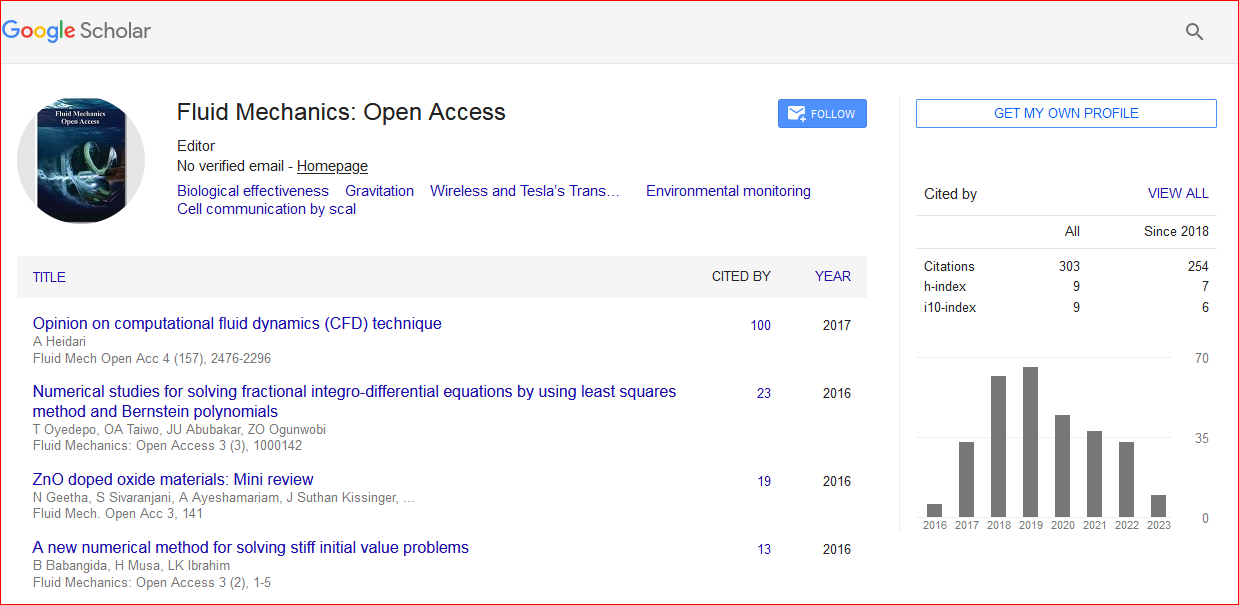
Fluid Mechanics: Open Access received 291 citations as per Google Scholar report