Perspective - (2025) Volume 12, Issue 4
Received: 01-Jul-2025, Manuscript No. jlop-26-179051;
Editor assigned: 03-Jul-2025, Pre QC No. P-179051;
Reviewed: 17-Jul-2025, QC No. Q-179051;
Revised: 22-Jul-2025, Manuscript No. R-179051;
Published:
29-Jul-2025
, DOI: 10.37421/2469-410X. 2025.12.214
Citation: Schmidt, Oliver. ”Laser-Induced Breakdown Spectroscopy: Versatile Elemental Analysis.” J Laser Opt Photonics 12 (2025):214.
Copyright: © 2025 Schmidt O. This is an open-access article distributed under the terms of the Creative Commons Attribution License, which permits unrestricted use, distribution and reproduction in any medium, provided the original author and source are credited.
Laser-Induced Breakdown Spectroscopy (LIBS) represents a significant advancement in atomic emission spectroscopy, offering a rapid and direct approach for elemental analysis across a wide spectrum of materials. Its fundamental principle involves directing a high-energy laser pulse onto a sample, thereby generating a localized plasma. The extreme temperatures within this plasma atomize and excite the constituent elements of the material. As these excited atoms and ions transition back to lower energy states, they emit photons at distinct wavelengths, creating a characteristic spectral signature. Subsequent analysis of this emitted light spectrum, facilitated by a spectrometer, allows for the precise identification and quantification of the sample's elemental composition. This technique requires minimal sample preparation and is adaptable to solids, liquids, and gases, making it suitable for in-situ, standoff, and remote sensing applications, proving invaluable in diverse fields [1].
Recent strides in LIBS instrumentation have further amplified its analytical capabilities, particularly with the integration of femtosecond lasers and sophisticated detector technologies. Femtosecond LIBS, for example, enhances analytical performance by achieving precise energy deposition and minimizing thermal diffusion, which collectively reduces matrix effects and improves signal-to-noise ratios. Alongside hardware advancements, significant progress has been made in algorithm development for spectral deconvolution and multivariate calibration, leading to more accurate and sensitive quantitative analyses. These ongoing improvements are steadily broadening the scope of LIBS applications, especially for complex matrices and the detection of trace elements [2].
The application of LIBS in environmental monitoring is experiencing notable expansion, with a particular focus on the detection of heavy metals in soil and water samples. Its inherent ability to perform in-situ analysis without extensive sample pretreatment makes it an exceptionally practical choice for field-based assessments of pollution levels. Numerous studies have validated its efficacy in identifying and quantifying elements such as lead, arsenic, and mercury in contaminated sites, providing swift data crucial for the development and implementation of effective remediation strategies [3].
Within the realm of industrial quality control, LIBS has emerged as a vital tool for real-time elemental analysis of various materials, including alloys, ceramics, and polymers. Its rapid analytical throughput enables immediate feedback on production processes, allowing for prompt adjustments to maintain product consistency and adhere to rigorous quality standards. A prime example of its utility is in the verification of elemental composition for metal scrap intended for recycling, ensuring accurate sorting and preventing contamination [4].
The field of cultural heritage has also benefited immensely from the application of LIBS, which facilitates non-destructive elemental analysis of artifacts and artworks. This capability is instrumental in material identification, provenance studies, and conservation efforts, as it allows for detailed analysis without causing any damage to valuable historical objects. For instance, LIBS can be effectively employed to identify the specific pigments used in paintings or to determine the composition of ancient pottery [5].
The development of portable and handheld LIBS systems has been a transformative innovation, significantly enhancing its applicability in the field. These compact and user-friendly devices enable on-site elemental analysis even in remote locations or challenging industrial environments, thereby eliminating the need for laborious sample transportation to laboratories. This enhanced portability dramatically boosts the speed and overall efficiency of material characterization processes [6].
In geological exploration and mining operations, LIBS plays a pivotal role by enabling the rapid identification of mineral compositions and ore grades directly in the field. This capability facilitates efficient site assessment, supports targeted exploration efforts, and optimizes extraction processes, ultimately leading to substantial cost savings and improved resource management practices [7].
The integration of LIBS with other analytical techniques, such as Raman spectroscopy or X-ray fluorescence, presents a powerful synergistic approach, yielding complementary information for a more comprehensive material analysis. This hyphenated methodology effectively overcomes the inherent limitations of individual techniques, offering enhanced specificity and sensitivity for complex analytical challenges [8].
LIBS is increasingly finding critical applications in the security and defense sectors, particularly for threat detection scenarios involving explosives, chemical agents, and other hazardous materials. Its unique standoff capability, allowing for analysis from a safe distance, represents a significant advantage in handling and assessing potentially dangerous situations without direct exposure [9].
Crucially, the advancement of sophisticated data analysis and machine learning algorithms is paramount to extracting the maximum valuable information from LIBS spectra. These advanced computational methods significantly accelerate and enhance the accuracy of element identification and quantification, especially when dealing with complex samples or resolving spectral interferences. This area represents a key focus of ongoing research aimed at further elevating the capabilities of LIBS technology [10].
Laser-Induced Breakdown Spectroscopy (LIBS) stands as a robust atomic emission technique designed for the rapid, direct elemental analysis of a wide array of materials. The operational mechanism involves focusing a high-energy laser pulse onto a sample, which induces the formation of a localized plasma. The intense heat generated within this plasma effectively atomizes and excites the fundamental elements comprising the sample. Subsequently, as these excited atomic species and ions revert to their lower energy states, they release characteristic photons at specific wavelengths. The analysis of this emitted light spectrum using a spectrometer enables the identification and quantification of the elemental composition present in the sample. Key advantages include minimal sample preparation requirements, the ability to analyze solids, liquids, and gases, and suitability for in-situ, standoff, and remote sensing applications, making it a versatile tool across various disciplines [1].
Contemporary advancements in LIBS instrumentation have markedly improved its analytical performance, notably through the incorporation of femtosecond lasers and cutting-edge detector technologies. The application of femtosecond lasers in LIBS, for instance, leads to reduced matrix effects and enhanced signal-to-noise ratios due to their precise energy deposition and minimal thermal diffusion. Furthermore, refinements in algorithm development, encompassing spectral deconvolution and multivariate calibration, have contributed to achieving more precise and sensitive quantitative analyses. These evolutionary steps are instrumental in expanding the applicability of LIBS to more intricate matrices and facilitating the detection of trace elements [2].
The deployment of LIBS for environmental monitoring is on a significant upward trajectory, especially for the detection of heavy metals in both soil and water. Its capacity for in-situ analysis, obviating the need for extensive sample preparation, renders it ideal for field-based assessments of pollution levels. Empirical studies have consistently demonstrated its effectiveness in identifying and quantifying elements such as lead, arsenic, and mercury in contaminated environments, thereby providing rapid data essential for the formulation of remediation strategies [3].
In the context of industrial quality control, LIBS functions as an indispensable instrument for the real-time analysis of diverse materials like alloys, ceramics, and polymers. Its capability for rapid analysis provides immediate feedback concerning production processes, enabling swift adjustments to ensure product consistency and compliance with stringent quality standards. For example, LIBS is effectively employed to ascertain the elemental composition of metal scrap destined for recycling, thereby ensuring appropriate sorting and preventing potential contamination [4].
LIBS has carved out a significant niche in the domain of cultural heritage, offering a non-destructive method for elemental analysis of artifacts and artworks. This approach is critical for material identification, provenance studies, and conservation initiatives, as it allows for detailed examination without compromising the integrity of valuable historical objects. Illustrations of its application include the identification of pigments in paintings or the characterization of the composition of ancient pottery [5].
The advent of portable and handheld LIBS systems has revolutionized its practical application in diverse field settings. These compact devices empower on-site elemental analysis in geographically remote areas or challenging industrial settings, thereby eliminating the logistical burden and time associated with sample transport to laboratories. This portability dramatically enhances both the speed and overall efficiency of material characterization tasks [6].
LIBS plays a crucial role in geological exploration and mining operations, facilitating the rapid identification of mineral compositions and ore grades directly within the exploration site. This capability supports efficient site assessment, guides targeted exploration efforts, and optimizes extraction processes, contributing to significant cost reductions and improved resource management [7].
The integration of LIBS with complementary analytical techniques, such as Raman spectroscopy or X-ray fluorescence, offers a pathway to obtain a more holistic understanding of material composition. This synergistic approach leverages the strengths of multiple techniques to overcome individual limitations, thereby providing enhanced specificity and sensitivity in material characterization [8].
In the security and defense sectors, LIBS is increasingly employed for threat detection, encompassing the identification of explosives, chemical agents, and other hazardous materials. A critical advantage in such scenarios is its standoff capability, which permits analysis from a secure distance, thereby minimizing exposure risks [9].
The development and application of advanced data analysis and machine learning algorithms are fundamental to maximizing the information gleaned from LIBS spectra. These sophisticated methods facilitate faster and more accurate identification and quantification, particularly for complex sample matrices and in situations involving spectral interferences. This research domain is vital for the continued enhancement of LIBS capabilities [10].
Laser-Induced Breakdown Spectroscopy (LIBS) is a versatile technique for rapid elemental analysis, generating a plasma with a laser pulse and analyzing emitted light. It requires minimal sample preparation and can analyze solids, liquids, and gases for in-situ, standoff, and remote sensing applications. Recent advancements include femtosecond lasers and improved algorithms, enhancing accuracy and sensitivity, particularly for complex matrices and trace elements. LIBS is widely applied in environmental monitoring for heavy metal detection, industrial quality control for real-time analysis, and cultural heritage for non-destructive artifact analysis. Its portability has revolutionized field applications, aiding geological exploration, mining, and security threat detection. Integrated with other techniques and enhanced by machine learning, LIBS continues to expand its capabilities.
None
None
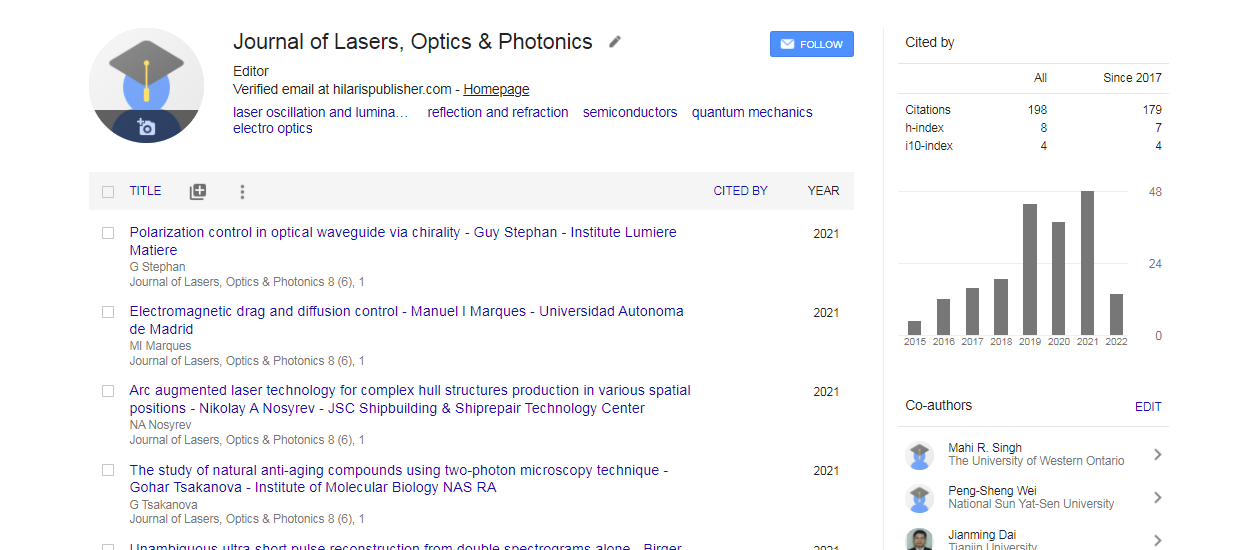
Journal of Lasers, Optics & Photonics received 279 citations as per Google Scholar report