Opinion - (2025) Volume 13, Issue 6
Received: 01-Dec-2025, Manuscript No. JCMG-26-185569;
Editor assigned: 03-Dec-2025, Pre QC No. P-185569;
Reviewed: 17-Dec-2025, QC No. Q-185569;
Revised: 22-Dec-2025, Manuscript No. R-185569;
Published:
29-Dec-2025
, DOI: 10.37421/2472-128X.2025.13.373
Citation: Hrytsenko, Olena. ”Interpreting Genetic Variants: A Path to Precision Medicine.” J Clin Med Genomics 13 (2025):373.
Copyright: © 2025 Hrytsenko O. This is an open-access article distributed under the terms of the Creative Commons Attribution License, which permits unrestricted use, distribution and reproduction in any medium, provided the original author and source are credited.
The accurate interpretation of genetic variants is a cornerstone of modern clinical genomics, essential for diagnosing inherited diseases and guiding personalized treatment strategies. Distinguishing pathogenic from benign variants is central to interpreting genomic data in clinical settings, requiring a multi-faceted approach that integrates evidence from population databases, functional studies, variant frequency, evolutionary conservation, and predictive algorithms. Clinicians must carefully consider the pathogenicity predictions of different tools and their limitations, especially for rare variants or those in genes with incomplete variant-disease knowledge. The ACMG/AMP guidelines provide a standardized framework for variant classification, but ongoing research and expert consensus are crucial for refining interpretation, particularly for variants of uncertain significance [1].
The interpretation of genetic variants is fundamental to diagnosing inherited diseases and guiding personalized medicine. This article reviews the challenges and advancements in classifying variants, focusing on the integration of diverse data sources. It highlights the necessity of standardized classification systems like ACMG/AMP and discusses emerging technologies that enhance variant detection and characterization, ultimately improving diagnostic yield and clinical utility [2].
Population frequency data, such as from gnomAD, plays a critical role in the interpretation of rare genetic variants. The absence of a variant in large control cohorts can strengthen its potential pathogenicity, but caution is advised against overreliance, especially for variants in genes with extreme rarity or specific population stratification [3].
Functional studies are crucial for definitively classifying variants, particularly those that remain uncertain after in silico analysis and population data review. Various experimental approaches, including protein expression, enzyme activity assays, and cellular phenotype analysis, provide direct evidence of a variant's impact on gene function, aiding in pathogenicity assessment [4].
Machine learning and artificial intelligence are increasingly employed in predicting variant pathogenicity. Algorithms trained on large datasets identify patterns associated with disease-causing variants, offering a powerful tool for prioritizing variants for further investigation and aiding in the interpretation of complex genomic data [5].
The classification of variants of uncertain significance (VUS) presents ongoing challenges, with continuous efforts to reclassify them as new evidence emerges. Systematic re-evaluation from research studies, patient registries, and clinical testing aims to reduce diagnostic uncertainty for patients and clinicians [6].
Interpreting variants in genes with complex inheritance patterns or mosaicism poses particular challenges for standard classification. Integrating evidence considering incomplete penetrance and variable expressivity necessitates specialized approaches for accurate interpretation [7].
The ethical considerations and clinical implications of variant interpretation are significant, particularly concerning incidental findings and the communication of results to patients. Informed consent and shared decision-making are paramount in the context of genomic testing [8].
Novel in silico tools for variant pathogenicity prediction are being developed and validated, with the potential to improve diagnostic accuracy and efficiency. Continuous updating and benchmarking of these tools are essential for their ongoing utility in clinical genomics [9].
The global landscape of genomic variant interpretation reveals diverse approaches to standardization and harmonization of classification guidelines across different countries and regions. International collaboration is underscored as vital for advancing genomic medicine on a global scale [10].
The process of interpreting genetic variants in clinical settings hinges on the critical distinction between pathogenic and benign alterations. This endeavor necessitates a comprehensive, multi-faceted strategy that synergistically integrates data from various sources. These include extensive population databases that catalog variant frequencies, detailed functional studies that elucidate a variant's impact on gene product, evolutionary conservation analyses that reveal selective pressures on genomic regions, and sophisticated predictive algorithms designed to forecast pathogenicity. Clinicians must meticulously evaluate the predictions generated by different analytical tools, recognizing their inherent limitations, particularly when dealing with rare variants or those residing in genes where the association with disease is not fully elucidated. The established ACMG/AMP guidelines offer a structured framework for consistent variant classification, yet the dynamic nature of genomic research and the ongoing need for expert consensus are indispensable for refining these interpretations, especially in cases of variants of uncertain significance [1].
At the core of diagnosing inherited diseases and tailoring personalized medicine lies the precise interpretation of genetic variants. This field is continually evolving, with ongoing efforts to refine classification methodologies and enhance diagnostic yield. The integration of diverse data sources is paramount, as is the adherence to standardized classification systems like the ACMG/AMP guidelines. Furthermore, advancements in emerging technologies are significantly improving both the detection and detailed characterization of genetic variants, thereby amplifying their clinical utility and impact on patient care [2].
The utility of population allele frequency data, such as that provided by resources like gnomAD, is a key component in the interpretation of rare genetic variants. The observation that a specific variant is absent from large control cohorts can substantially bolster the evidence for its potential pathogenicity. However, it is imperative to temper this conclusion with caution, avoiding overreliance, particularly when encountering variants within genes that exhibit extreme rarity or are subject to significant population stratification, which can complicate frequency-based assessments [3].
Functional studies serve as a critical determinant in definitively classifying genetic variants, especially those for which in silico analyses and population data reviews have yielded ambiguous results. A variety of experimental methodologies, encompassing the assessment of protein expression levels, the measurement of enzyme activity, and the analysis of cellular phenotypes, can provide direct, empirical evidence of a variant's functional consequences. This direct evidence is invaluable for strengthening pathogenicity assessments and resolving diagnostic ambiguities [4].
The burgeoning field of artificial intelligence and machine learning is making significant strides in the prediction of genetic variant pathogenicity. These advanced algorithms are trained on vast datasets to discern intricate patterns that are characteristic of disease-causing variants. This capability positions AI as a potent tool for prioritizing variants that warrant further in-depth investigation and for assisting in the interpretation of complex genomic data, thereby enhancing the efficiency and accuracy of diagnostic workflows [5].
Variants of uncertain significance (VUS) present a persistent challenge within clinical genomics, prompting continuous efforts aimed at their reclassification. This dynamic process relies heavily on the systematic evaluation of newly emerging evidence derived from a spectrum of sources, including ongoing research studies, patient registries, and routine clinical testing. The ultimate goal is to reduce the diagnostic uncertainty that affects both patients and their treating physicians, leading to more informed clinical decisions [6].
Interpreting variants located within genes characterized by complex inheritance patterns or exhibiting mosaicism introduces specific challenges that deviate from standard classification approaches. Successfully navigating these complexities requires the integration of evidence that accounts for factors such as incomplete penetrance and variable expressivity, necessitating the adoption of specialized interpretive strategies tailored to these unique genetic architectures [7].
The interpretation of genetic variants carries substantial ethical considerations and profound clinical implications, particularly concerning the identification of incidental findings and the effective communication of complex genetic information to patients. Emphasizing the principles of informed consent and fostering shared decision-making are fundamental to the responsible practice of genomic testing and the ethical delivery of genetic healthcare [8].
Advancements in the development and validation of novel in silico tools designed for variant pathogenicity prediction are continuously emerging, promising to enhance both the diagnostic accuracy and the overall efficiency of clinical genomics workflows. Recognizing the need for ongoing improvement, these efforts are often accompanied by a focus on the continuous updating and rigorous benchmarking of these computational tools to ensure their sustained reliability and efficacy [9].
Examining the global landscape of genetic variant classification and interpretation reveals a diverse array of approaches being adopted by different countries and regions. Efforts toward standardization and harmonization of classification guidelines are underway worldwide, highlighting the critical importance of robust international collaboration to propel the field of genomic medicine forward and ensure equitable access to its benefits globally [10].
Genetic variant interpretation is crucial for diagnosing diseases and guiding personalized medicine. It involves a multi-faceted approach integrating population data, functional studies, and predictive algorithms. Standardized guidelines like ACMG/AMP exist, but refinement is ongoing. Variants of uncertain significance (VUS) pose challenges, requiring continuous re-evaluation as new evidence emerges. Complex genetic architectures and ethical considerations, including informed consent, also impact interpretation. Advances in in silico tools and machine learning enhance diagnostic accuracy, while international collaboration is vital for global progress in genomic medicine. The absence of variants in large control cohorts strengthens pathogenicity evidence, but caution is advised for rare genes. Functional studies provide direct evidence of a variant's impact. Ultimately, accurate interpretation aims to reduce diagnostic uncertainty and improve patient care.
None
None
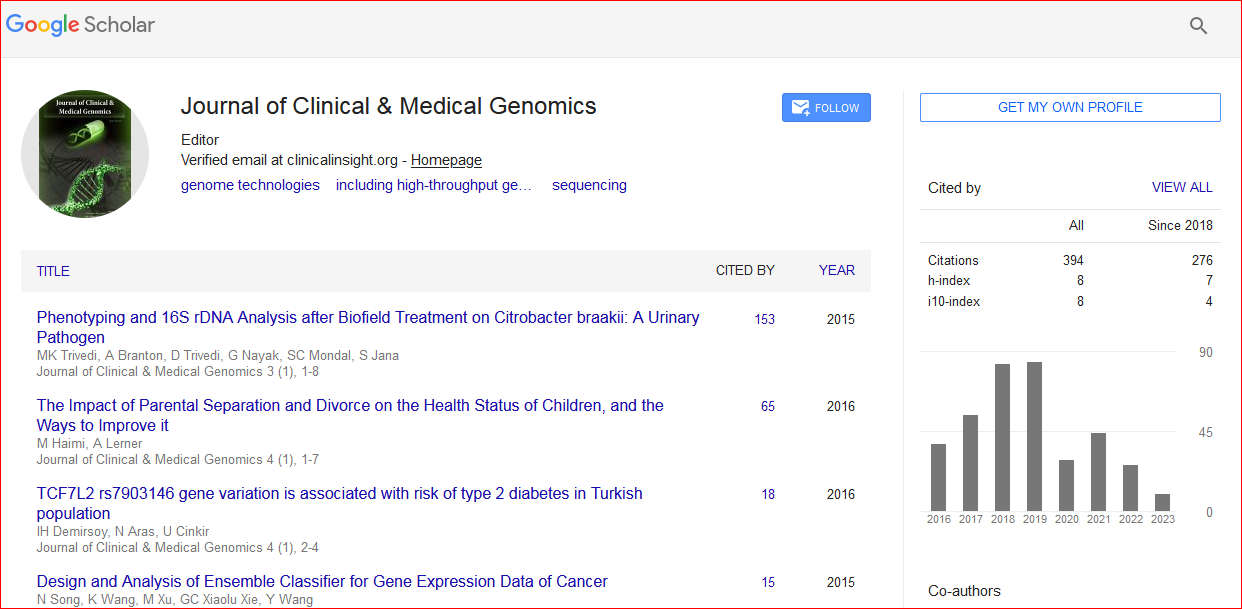
Journal of Clinical & Medical Genomics received 391 citations as per Google Scholar report