Perspective - (2025) Volume 14, Issue 2
Received: 01-Mar-2025, Manuscript No. jtm-25-172839;
Editor assigned: 03-Mar-2025, Pre QC No. P-172839;
Reviewed: 17-Mar-2025, QC No. Q-172839;
Revised: 24-Mar-2025, Manuscript No. R-172839;
Published:
31-Mar-2025
, DOI: 10.37421/2167-1222.2025.14.674
Citation: Andersen, Peter. ”Integrated Trauma Care: Principles and Optimization.” J Trauma Treat 14 (2025):674.
Copyright: © 2025 Andersen P. This is an open-access article distributed under the terms of the Creative Commons Attribution License, which permits unrestricted use, distribution and reproduction in any medium, provided the original author and source are credited.
This update on massive transfusion protocols highlights the critical importance of early and balanced blood component resuscitation in severe trauma. The focus is on rapid delivery of red blood cells, plasma, and platelets to prevent coagulopathy, emphasizing a shift towards a more balanced ratio approach guided by patient response and viscoelastic hemostatic assays[1].
This overview of prehospital trauma care outlines current challenges in field triage, airway management, hemorrhage control, and transport. It explores future directions, including the integration of telemedicine, advanced medical devices, and improved data collection for continuous quality improvement, aiming to optimize patient outcomes before hospital arrival[2].
This guideline provides comprehensive recommendations for the emergency management of pediatric traumatic brain injury. It covers initial assessment, neuroimaging, intracranial pressure monitoring, fluid management, and surgical interventions, emphasizing age-specific considerations and the need for a standardized approach to improve outcomes in children[3].
This section from the AHA guidelines addresses critical aspects of trauma resuscitation, covering initial assessment, airway management, ventilation, circulatory support, and hemorrhage control. It emphasizes rapid identification of life-threatening injuries, standardized approaches to fluid and blood product administration, and early definitive care to optimize patient survival and minimize morbidity[4].
This critical review examines the impact of organized trauma systems on patient outcomes, highlighting how structured care pathways, regionalization of resources, and specialized trauma centers significantly reduce mortality and morbidity. It underscores the importance of prehospital care integration, inter-facility transfer protocols, and continuous quality improvement in optimizing outcomes across diverse settings[5].
This comprehensive European guideline provides evidence-based recommendations for managing major bleeding and coagulopathy in trauma patients. It covers early diagnosis, hemostatic resuscitation strategies, including massive transfusion protocols, tranexamic acid administration, and goal-directed therapy. The guideline aims to standardize practice and improve outcomes for severely injured patients[6].
This practice management guideline offers evidence-based recommendations for managing thoracic trauma, covering initial assessment, diagnostic imaging, and treatment strategies for injuries such as pneumothorax, hemothorax, flail chest, and cardiac contusion. It emphasizes prompt recognition and intervention to prevent respiratory and circulatory compromise, aiming for standardized care[7].
This review critically examines the evidence supporting various emergency department protocols for trauma patients, evaluating their effectiveness in improving patient outcomes. It discusses protocols for initial assessment, imaging, hemorrhage control, and resuscitation, highlighting areas where standardization has proven beneficial and where further research is needed to optimize care delivery[8].
This review focuses on the unique challenges and management considerations for geriatric trauma patients. It discusses age-related physiological changes, polypharmacy, and pre-existing comorbidities that influence injury patterns and outcomes. The article advocates for tailored assessment, resuscitation, and diagnostic protocols to optimize care for this vulnerable population, emphasizing early identification of subtle injuries[9].
This systematic review and meta-analysis evaluates the diagnostic accuracy of Focused Assessment with Sonography for Trauma (FAST) in pediatric blunt abdominal trauma. It highlights FAST's utility as a rapid, non-invasive screening tool for detecting intra-abdominal fluid, emphasizing its role in guiding immediate management decisions and reducing the need for more invasive or radiation-exposing diagnostics in children[10].
Effective trauma resuscitation forms the bedrock for optimizing patient survival and minimizing morbidity, covering initial assessment, sophisticated airway management, controlled ventilation, circulatory support, and precise hemorrhage control [4]. A cornerstone of this critical care involves modern massive transfusion protocols, which underscore the paramount importance of early and balanced blood component resuscitation in cases of severe trauma. These protocols advocate for the rapid and coordinated delivery of red blood cells, plasma, and platelets, fundamentally aimed at preventing trauma-induced coagulopathy. This strategy emphasizes a dynamic shift towards a more balanced ratio approach, meticulously guided by individual patient response and advanced viscoelastic hemostatic assays [1]. Reinforcing these principles, comprehensive European guidelines provide robust, evidence-based recommendations for the adept management of major bleeding and coagulopathy in acutely injured trauma patients. These extensively cover early diagnosis, sophisticated hemostatic resuscitation strategies, including the aforementioned massive transfusion protocols, the judicious administration of tranexamic acid, and goal-directed therapy. The overarching goal of such guidelines is to standardize clinical practice globally and significantly improve outcomes for severely injured patients across various healthcare settings [6]. These standardized approaches are not just theoretical; they are crucial in the high-stakes environment of the emergency department, where existing protocols for initial patient assessment, advanced imaging modalities, immediate hemorrhage control, and ongoing resuscitation are subject to continuous review and rigorous evaluation for their tangible effectiveness in improving overall patient outcomes [8].
The trajectory towards optimal patient outcomes frequently commences even before hospital admission, with prehospital trauma care emerging as a profoundly significant determinant. This critical phase directly addresses current challenges inherent in field triage, urgent airway management, effective hemorrhage control, and the safe, expedient transport of patients. Simultaneously, it proactively explores innovative future directions, including the seamless integration of telemedicine, the deployment of advanced medical devices, and the implementation of improved data collection methodologies for continuous quality improvement. All these efforts are strategically aimed at optimizing patient outcomes during the vital period preceding hospital arrival [2]. Underpinning these widespread efforts is the undeniable impact of organized trauma systems on overall patient recovery. A critical review highlights how structured care pathways, the intelligent regionalization of specialized resources, and the establishment of dedicated trauma centers collectively and significantly reduce both mortality and morbidity. This underscores the profound importance of deeply integrating prehospital care, establishing robust and efficient inter-facility transfer protocols, and maintaining a steadfast commitment to continuous quality improvement, all vital for optimizing outcomes across diverse geographical and clinical settings [5].
Beyond generalized resuscitation efforts, the management of specific traumatic injuries necessitates distinctly tailored guidelines and specialized approaches. For instance, the expert management of thoracic trauma involves a set of evidence-based recommendations covering thorough initial assessment, advanced diagnostic imaging techniques, and specific treatment strategies for a range of critical injuries, including pneumothorax, hemothorax, flail chest, and cardiac contusion. In these complex cases, prompt recognition of the injury and immediate intervention are absolutely paramount to effectively prevent severe respiratory and circulatory compromise, striving always for a consistent, standardized level of care [7]. Similarly, the emergency management of pediatric traumatic brain injury (TBI) demands a comprehensive set of recommendations that specifically account for the unique vulnerabilities of younger patients. These guidelines meticulously cover initial assessment, advanced neuroimaging, precise intracranial pressure monitoring, careful fluid management, and appropriate surgical interventions. A significant emphasis is placed on age-specific physiological considerations and the undeniable need for a highly standardized approach, all designed to dramatically improve outcomes in affected children [3].
Addressing the unique needs of specific patient populations, such as geriatric trauma patients, uncovers a distinct set of challenges and complexities. Age-related physiological changes, the presence of polypharmacy, and existing comorbidities collectively influence injury patterns and, crucially, overall patient outcomes. This demographic distinctly benefits from tailored assessment, individualized resuscitation strategies, and specific diagnostic protocols meticulously designed to optimize care for this particularly vulnerable population, placing a strong emphasis on the early and accurate identification of subtle injuries that might otherwise be overlooked [9]. Advancements in diagnostic tools are also continually evolving, with systematic reviews meticulously evaluating their accuracy and utility in specific clinical contexts. For example, Focused Assessment with Sonography for Trauma (FAST) in pediatric blunt abdominal trauma has proven its undeniable utility as a rapid, non-invasive screening tool. FAST plays a pivotal role in efficiently detecting intra-abdominal fluid, which in turn guides immediate management decisions and significantly reduces the need for more invasive or radiation-exposing diagnostics in the sensitive pediatric population [10]. This holistic and specialized approach across all phases of trauma care is critical for improving patient outcomes.
Effective trauma care relies on several interconnected principles, from prehospital interventions to specialized hospital management. Early and balanced blood component resuscitation, guided by massive transfusion protocols, is crucial for severe trauma patients to prevent coagulopathy [1, 6]. Prehospital care emphasizes rapid triage, airway management, and hemorrhage control, with future directions pointing towards telemedicine integration and advanced devices for improved outcomes [2, 5]. Within hospitals, trauma resuscitation guidelines cover initial assessment, airway, circulation, and hemorrhage control, advocating for standardized fluid and blood product administration [4, 8]. Organized trauma systems, with structured care pathways and specialized centers, are vital for reducing mortality and morbidity, emphasizing prehospital integration and inter-facility transfers [5]. Specific guidelines address managing pediatric traumatic brain injury, focusing on age-specific considerations and standardized approaches [3]. Managing major bleeding and coagulopathy in trauma is further detailed by European guidelines, including hemostatic resuscitation and tranexamic acid [6]. Thoracic trauma management requires prompt recognition and intervention for conditions like pneumothorax and hemothorax [7]. Emergency department protocols are continuously reviewed for effectiveness in assessment, imaging, and hemorrhage control [8]. Geriatric trauma patients present unique challenges due to physiological changes and comorbidities, necessitating tailored assessment and diagnostic protocols [9]. Finally, diagnostic tools like Focused Assessment with Sonography for Trauma (FAST) are critical in pediatric blunt abdominal trauma for rapid, non-invasive assessment and guiding management decisions [10]. Collectively, these approaches highlight the ongoing efforts to standardize and optimize trauma care across diverse patient populations and injury types.
None
None
Indexed at, Google Scholar, Crossref
Indexed at, Google Scholar, Crossref
Indexed at, Google Scholar, Crossref
Indexed at, Google Scholar, Crossref
Indexed at, Google Scholar, Crossref
Indexed at, Google Scholar, Crossref
Indexed at, Google Scholar, Crossref
Indexed at, Google Scholar, Crossref
Indexed at, Google Scholar, Crossref
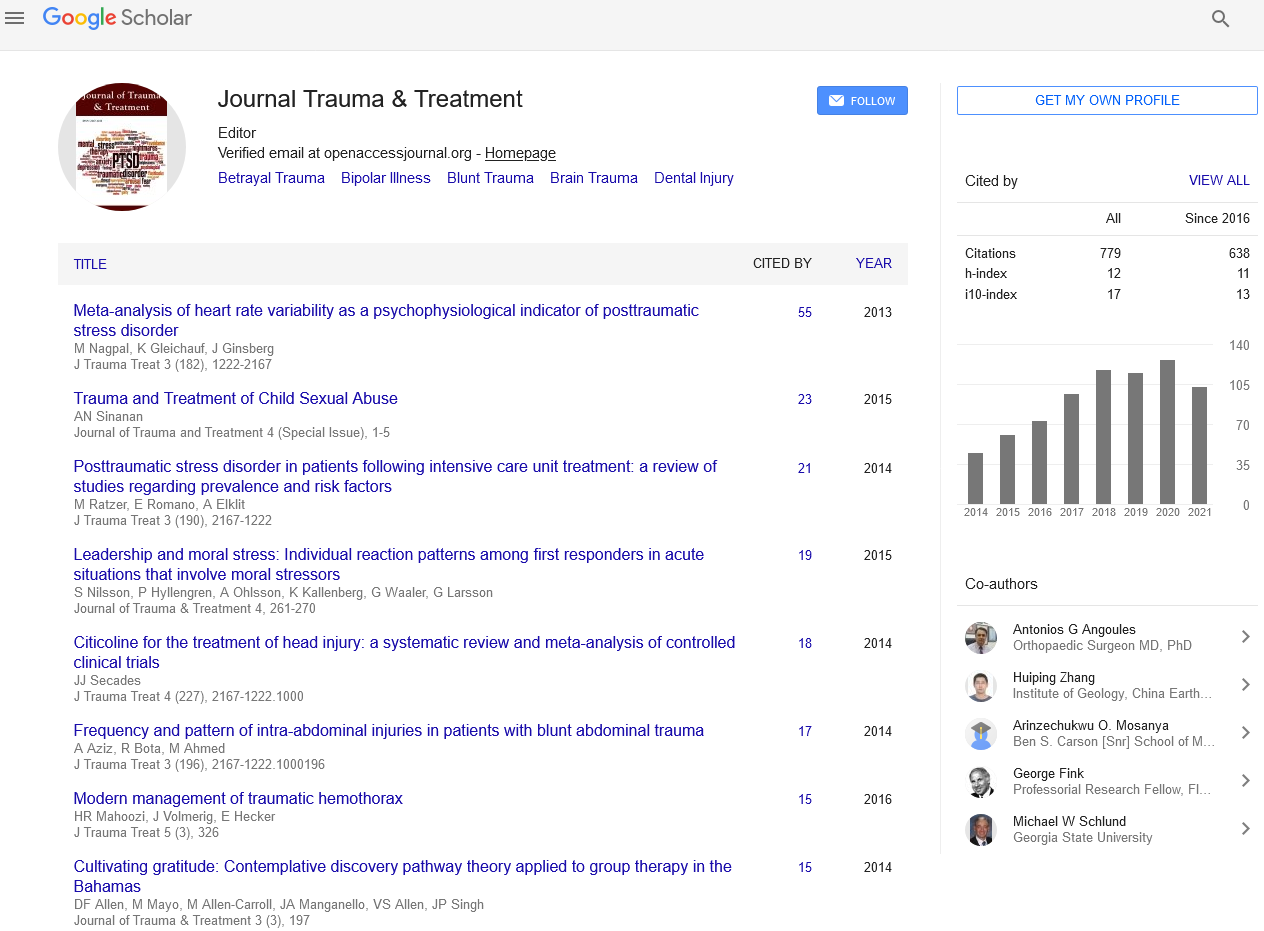
Journal of Trauma & Treatment received 1048 citations as per Google Scholar report