Opinion - (2025) Volume 17, Issue 6
Received: 03-Nov-2025, Manuscript No. jcst-25-176311;
Editor assigned: 05-Nov-2025, Pre QC No. P-176311;
Reviewed: 19-Nov-2025, QC No. Q-176311;
Revised: 24-Nov-2025, Manuscript No. R-176311;
Published:
01-Dec-2025
, DOI: 10.37421/1948-5956.2025.17.735
Citation: Pedro Lima. ”Integrated Strategies for Effective Cancer
Pain Management.” J Cancer Sci Ther 17 (2025):735.
Copyright: © 2025 L. Pedro This is an open-access article distributed under the terms of the Creative Commons Attribution License, which permits unrestricted use, distribution
and reproduction in any medium, provided the original author and source are credited.
Effectively managing cancer pain is a multifaceted endeavor that requires a comprehensive, multidisciplinary strategy. This approach is essential for integrating various methodsâ??pharmacological, interventional, and non-pharmacologicalâ??to address the unique needs of each patient. It underscores the importance of thorough assessment and continuous monitoring to optimize pain relief and improve overall quality of life [1].
Neuropathic cancer pain stands out as a particularly challenging type of pain, posing significant hurdles for both patients experiencing it and the clinicians striving to alleviate it. Research in this area explores current diagnostic methodologies and a wide array of treatment options, from pharmacological agents to advanced interventional strategies, while also looking ahead to future research and emerging therapies designed to enhance patient well-being and life quality [2].
Opioid-induced constipation (OIC) represents a highly prevalent and distressing side effect experienced by cancer patients receiving opioid therapy for pain. A systematic review highlights its widespread occurrence, the profound impact it has on patients' quality of life, and the diverse management strategies available, including the use of traditional laxatives and newer peripherally acting μ-opioid receptor antagonists [3].
Beyond conventional drug treatments, non-pharmacological interventions offer promising avenues for cancer pain management. A meta-analysis has evaluated the efficacy of techniques such as acupuncture, massage, and various relaxation methods, conclusively showing that these approaches can significantly reduce pain intensity when utilized as complementary treatments alongside standard pharmacological therapies [4].
At the heart of effective cancer pain management lies accurate and thorough pain assessment. A critical review of current practices examines various pain assessment tools, including simple numerical rating scales, visual analogue scales, and more comprehensive multidimensional tools. The discussion covers their respective strengths, limitations, and potential future developments in clinical application, emphasizing the foundational role of precise evaluation [5].
Palliative care serves a vital function in managing pain for patients with advanced cancer, placing a central emphasis on enhancing comfort and overall quality of life. This comprehensive review meticulously details both pharmacological and non-pharmacological pain management strategies within a palliative care framework, stressing the necessity of individualized care plans and rigorous symptom control to meet patient needs [6].
For cancer patients whose pain proves refractory to conventional pharmacological treatments, interventional pain management techniques present essential alternative solutions. These techniques encompass nerve blocks, neurolysis, and advanced spinal drug delivery systems. A review explores their specific indications, the evidence demonstrating their efficacy, and critical safety considerations, providing valuable insights into these advanced therapeutic options [7].
The potential role of cannabinoids in managing cancer pain has garnered significant interest. A systematic review and meta-analysis of randomized controlled trials synthesize compelling evidence regarding their use. This research carefully assesses the efficacy and safety profiles of cannabinoids, offering crucial insights into their potential as either an adjunctive therapy or an alternative treatment option for patients [8].
Addressing the emotional and psychological dimensions of cancer pain is crucial, and psychological interventions play a significant role here. Approaches like cognitive behavioral therapy (CBT) and mindfulness-based stress reduction (MBSR) have shown documented effectiveness. A review highlights their ability to reduce pain intensity and significantly enhance patients' coping mechanisms, contributing to a more holistic pain management strategy [9].
Breakthrough cancer pain (BTcP), characterized by its transient yet severe pain flares, demands highly specific and rapid-acting management strategies. This review explores various pharmacological options, with a notable focus on transmucosal fentanyl formulations. It critically emphasizes the importance of developing individualized treatment plans to effectively control these challenging and often debilitating episodes, ensuring timely and effective relief [10].
Effective cancer pain management hinges on a multidisciplinary strategy, integrating pharmacological, interventional, and non-pharmacological methods to tailor care to individual patient needs and optimize outcomes [1]. This holistic approach necessitates accurate pain assessment, which is foundational for developing effective treatment plans. Various assessment tools, including numerical rating scales, visual analogue scales, and comprehensive multidimensional tools, are critically examined for their strengths and limitations in clinical practice, informing future developments in evaluation techniques [5]. These tools are vital for ensuring comprehensive understanding of a patient's pain experience.
Specific challenges in cancer pain include neuropathic pain and breakthrough cancer pain (BTcP). Neuropathic cancer pain presents significant diagnostic and treatment complexities, prompting exploration of current techniques and various pharmacological agents, alongside interventional strategies and emerging therapies aimed at improving patient quality of life [2]. Breakthrough cancer pain, characterized by transient yet severe pain flares, requires specific, rapid-acting management strategies, prominently involving pharmacological options like transmucosal fentanyl formulations. Individualized treatment plans are crucial for effectively controlling these challenging episodes [10]. While opioids are primary pharmacological agents, opioid-induced constipation (OIC) is a pervasive and distressing side effect. Systematic reviews synthesize evidence on OICâ??s prevalence, impact on quality of life, and management strategies, including laxatives and peripherally acting μ-opioid receptor antagonists [3]. Furthermore, cannabinoids are being investigated for their role in managing cancer pain, with systematic reviews and meta-analyses assessing their efficacy and safety profile as potential adjunctive or alternative therapeutic options, synthesizing compelling evidence from randomized controlled trials [8].
Beyond medication, non-pharmacological interventions play a significant role. Meta-analyses demonstrate the effectiveness of approaches such as acupuncture, massage, and relaxation techniques in significantly reducing pain intensity when used complementarily with conventional pharmacological therapies [4]. These methods offer patients additional avenues for pain relief and improved coping. For pain resistant to conventional treatments, interventional pain management techniques provide vital alternatives. These include nerve blocks, neurolysis, and spinal drug delivery systems. Reviews explore their specific indications, demonstrated efficacy, and important safety considerations, highlighting their role in advanced pain control [7].
Psychological interventions directly address the emotional and psychological dimensions of cancer pain. Cognitive behavioral therapy (CBT) and mindfulness-based stress reduction (MBSR) are effective methods for reducing pain intensity and enhancing patients' coping mechanisms, contributing to a holistic approach to care [9]. Palliative care is crucial for advanced cancer patients, focusing on improving comfort and overall quality of life. Comprehensive reviews detail both pharmacological and non-pharmacological pain management strategies within this framework, emphasizing individualized care plans and meticulous symptom control to provide comprehensive support [6]. These integrated approaches underline the importance of addressing all facets of a patient's experience for truly effective pain management.
Managing cancer pain involves a complex, multidisciplinary strategy, integrating various pharmacological, interventional, and non-pharmacological methods to address individual patient needs and optimize outcomes. Effective pain management requires accurate assessment using tools like numerical and visual analogue scales, forming the foundation for personalized care plans. Beyond general pain, specific challenges like neuropathic cancer pain and breakthrough pain demand specialized diagnostic techniques, advanced treatment options, and rapid-acting strategies, respectively. Pharmacological interventions remain central, but they also bring concerns such as opioid-induced constipation, necessitating careful management with approaches like laxatives and peripherally acting μ-opioid receptor antagonists. A growing body of evidence supports non-pharmacological methods, including acupuncture, massage, relaxation techniques, and psychological interventions like cognitive behavioral therapy and mindfulness, as effective complementary treatments for reducing pain intensity and enhancing coping mechanisms. Interventional techniques, such as nerve blocks and spinal drug delivery systems, provide crucial alternatives for pain resistant to conventional treatments, while cannabinoids are being explored for their potential as adjunctive or alternative therapies. Finally, palliative care focuses holistically on improving comfort and quality of life for advanced cancer patients, emphasizing individualized plans and meticulous symptom control, encompassing both pharmacological and non-pharmacological strategies.
Indexed at, Google Scholar, Crossref
Indexed at, Google Scholar, Crossref
Indexed at, Google Scholar, Crossref
Indexed at, Google Scholar, Crossref
Indexed at, Google Scholar, Crossref
Indexed at, Google Scholar, Crossref
Indexed at, Google Scholar, Crossref
Indexed at, Google Scholar, Crossref
Indexed at, Google Scholar, Crossref
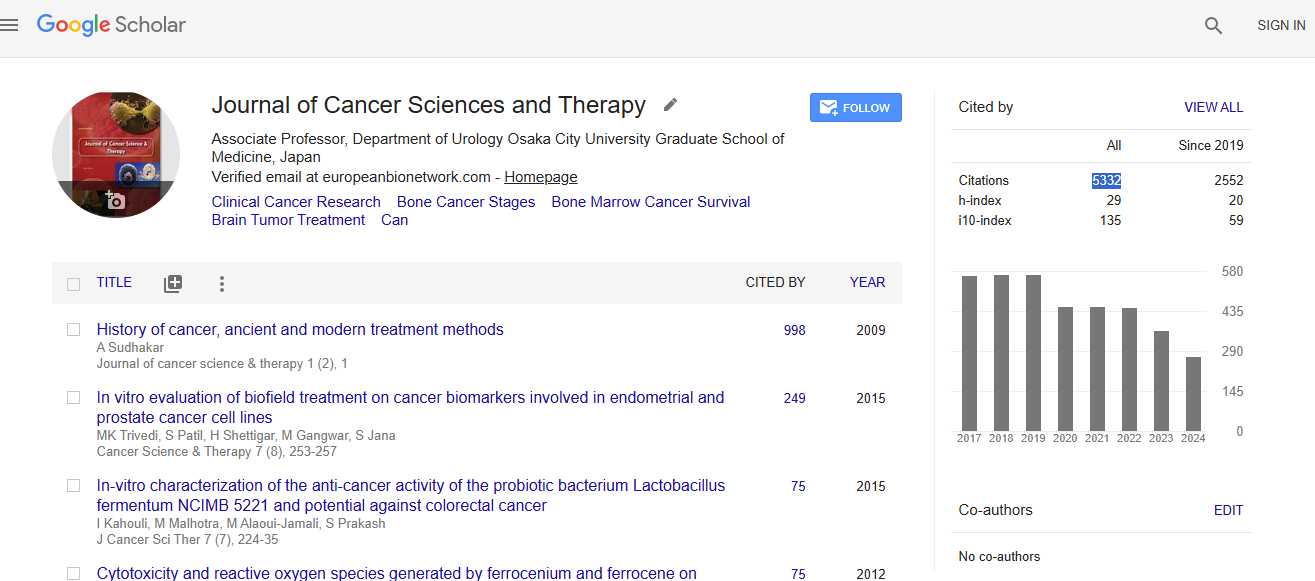
Cancer Science & Therapy received 5332 citations as per Google Scholar report