Commentary - (2025) Volume 12, Issue 6
Received: 02-Dec-2025, Manuscript No. fmoa-26-187974;
Editor assigned: 04-Dec-2025, Pre QC No. P-187974;
Reviewed: 18-Dec-2025, QC No. Q-187974;
Revised: 23-Dec-2025, Manuscript No. R-187974;
Published:
30-Dec-2025
, DOI: 10.37421/2476-2296.2025.12.371
Citation: Deshpande, Rohan. ”Advancements in Flow Measurement: Accuracy, Adaptability, Non-Intrusiveness.” Fluid Mech Open Acc 12 (2025):371.
Copyright: © 2025 Deshpande R. This is an open-access article distributed under the terms of the Creative Commons Attribution License, which permits unrestricted use, distribution and reproduction in any medium, provided the original author and source are credited.
The precise measurement of fluid flow is a cornerstone of many scientific and engineering disciplines, driving advancements across diverse fields from aerospace to biomedical engineering. Recent years have witnessed a significant push beyond traditional flow measurement methods, embracing sophisticated techniques that offer enhanced accuracy, higher resolution, and greater adaptability to complex scenarios. Optical methods, in particular, have emerged as powerful tools for non-intrusive flow characterization. Techniques such as Particle Image Velocimetry (PIV) and Laser Doppler Velocimetry (LDV) are now capable of providing detailed, high-resolution velocity field mappings, offering unprecedented insights into fluid dynamics. These advanced optical approaches are crucial for understanding phenomena ranging from turbulent flows to microfluidic phenomena [1].
Ultrasonic flow measurement, a long-established technology, is also undergoing substantial evolution. Traditional ultrasonic techniques can face limitations in noisy environments or when dealing with complex fluid properties. However, the integration of deep learning algorithms into signal analysis is revolutionizing this field. By employing convolutional neural networks to interpret scattered ultrasonic signals, researchers are achieving improved accuracy and robustness, enabling better identification of flow patterns and velocity profiles, which is critical for challenging industrial settings [2].
The miniaturization trend in scientific instrumentation has also spurred innovation in micro-scale flow measurement. Micro-Electro-Mechanical Systems (MEMS) have enabled the development of highly sensitive and rapid-response Coriolis flow sensors. These miniature devices are essential for precise fluid handling in microfluidic systems, finding applications in biomedical diagnostics and chemical analysis where accurate control of micro-volumes is paramount. The fabrication and calibration of these tiny sensors present unique challenges that are being actively addressed [3].
Further advancements in optical flow measurement are evident in the ability to reconstruct three-dimensional velocity fields with remarkable precision. Sophisticated PIV techniques, such as tomographic PIV coupled with algorithms like Shake-The-Box, allow for the detailed characterization of complex turbulent flows. These methods are invaluable for gaining fundamental insights into turbulent structures and dynamics, particularly in scenarios involving intricate geometries or strong vortical motions, which are frequently encountered in aerospace and energy applications [4].
Multiphase flow measurement, a particularly challenging area, is also benefiting from technological progress. Capacitance-based sensors, when augmented with advanced signal processing techniques like wavelet analysis and machine learning, are showing significant improvements in accurately quantifying void fraction and flow regimes in gas-liquid and gas-solid mixtures. This enhanced capability is vital for process optimization in industries such as chemical engineering and oil and gas exploration [5].
Optical diagnostics continue to play a crucial role in microfluidic research. A comprehensive review of techniques like Laser-Induced Fluorescence (LIF) and Micro-Particle Image Velocimetry (Micro-PIV) highlights their capabilities and limitations in studying microscale phenomena. Advances in illumination, detection, particle seeding, and data processing are enabling a deeper understanding of fundamental transport processes relevant to drug delivery, microreactors, and lab-on-a-chip devices [6].
For applications demanding high performance in low-flow regimes and potentially harsh environments, thermal-based flow sensors are being refined. New sensor designs, leveraging advanced materials and microfabrication, aim to improve sensitivity, long-term stability, and reduce issues like drift and fouling. These improvements are critical for reliable process monitoring in sectors such as automotive and industrial automation where precise measurement of micro- and milli-liter per minute flows is required [7].
Laser Doppler Velocimetry (LDV) is also being adapted and optimized for more demanding flow conditions. Its application to pulsating flows, common in biomedical and industrial systems, is being rigorously evaluated. By exploring the impact of pulsation characteristics and employing advanced data acquisition and processing strategies, LDV's inherent non-intrusive nature and high spatial resolution can be effectively utilized to capture complex dynamic flow behaviors [8].
In the realm of environmental and hydrological studies, Acoustic Doppler Velocimetry (ADV) is proving to be a valuable tool. Its ability to measure flow direction and velocity, coupled with advancements in signal processing to handle noise and biofouling, makes it effective for characterizing turbulent flows in open channels and natural water bodies. ADV's non-intrusive and continuous measurement capabilities are essential for environmental monitoring [9].
Finally, novel spectroscopic techniques are emerging for non-intrusive flow velocimetry. Raman spectroscopy, for instance, offers a particle-seeding-free approach by detecting the Doppler shift of scattered photons. While experimental and data acquisition challenges exist, particularly in high-temperature or reactive environments, advanced spectral analysis holds promise for improving signal-to-noise ratios and enhancing measurement accuracy, opening new avenues for flow diagnostics in specialized applications [10].
The exploration of advanced fluid flow measurement techniques signifies a paradigm shift towards greater precision and versatility in understanding fluid dynamics. Optical methods, such as Particle Image Velocimetry (PIV) and Laser Doppler Velocimetry (LDV), have been significantly enhanced, enabling high-resolution mapping of velocity fields. These techniques are instrumental in analyzing complex flow phenomena, including turbulent flows, providing detailed insights into fluid behavior without physical intrusion [1].
The domain of ultrasonic flow measurement is being revitalized through the integration of artificial intelligence. Deep learning models, particularly convolutional neural networks, are now being employed to analyze ultrasonic signals. This advanced signal processing allows for more accurate and robust flow velocity estimations, even in environments characterized by high noise levels or complex fluid properties, thereby overcoming limitations of conventional ultrasonic methods and enhancing reliability in industrial applications [2].
Microfluidics presents unique challenges for flow measurement, necessitating specialized sensor technologies. Micro-Electro-Mechanical Systems (MEMS) have facilitated the development of Coriolis flow sensors that offer exceptional sensitivity and rapid response times. These sensors are critical for precise fluid management in lab-on-a-chip devices and other microfluidic systems, where accurate control over minute fluid volumes is essential for experiments and diagnostics [3].
Further refinements in optical velocimetry are enabling the reconstruction of intricate three-dimensional velocity fields. Advanced PIV implementations, such as tomographic PIV combined with algorithms like Shake-The-Box, are crucial for characterizing complex turbulent flows. This capability is vital for gaining fundamental understanding of turbulent structures and dynamics, particularly in complex geometrical configurations and vortical flow regimes relevant to engineering applications [4].
Measuring multiphase flows, which involve mixtures of different phases like gas-liquid or gas-solid, remains a significant challenge. However, capacitance-based sensors are seeing improved performance through the application of sophisticated signal processing techniques, including machine learning and wavelet analysis. These methods enhance the accuracy of flow regime identification and phase holdup measurement, critical for optimizing industrial processes [5].
In the context of microfluidics, optical diagnostic techniques are continuously evolving. Reviews of methods such as Laser-Induced Fluorescence (LIF) and Micro-Particle Image Velocimetry (Micro-PIV) highlight their utility and limitations. Innovations in illumination, detection systems, and data processing are key to advancing our understanding of microscale transport phenomena essential for various biotechnological and chemical applications [6].
For low-flow applications, especially those in demanding industrial settings, thermal-based flow sensors are being engineered for superior performance. Advances in materials science and microfabrication techniques are leading to sensors with enhanced sensitivity, stability, and resistance to common issues like drift and fouling, ensuring accurate measurements in critical industrial automation and automotive systems [7].
Laser Doppler Velocimetry (LDV) is being adapted to address the complexities of pulsating flow measurement. Research into the effects of pulsation frequency and amplitude, alongside the development of advanced data processing strategies, is aimed at maximizing the accuracy of this non-intrusive technique. This optimization is particularly important for applications involving dynamic flow behavior, such as in the biomedical field [8].
Environmental flow monitoring in natural water bodies benefits from the application of Acoustic Doppler Velocimetry (ADV). Enhancements in signal processing have improved ADV's accuracy in challenging conditions, such as the presence of noise and biofouling. Its non-intrusive nature and continuous measurement capabilities make it an invaluable tool for hydrological studies and environmental assessments [9].
Emerging non-intrusive velocimetry techniques are expanding the possibilities for flow measurement. Raman spectroscopy, for example, leverages the Doppler shift of scattered photons to determine velocity without the need for seeding particles. Despite inherent challenges in signal acquisition and processing, this spectroscopic approach offers a promising alternative for flow diagnostics in environments where conventional methods are impractical, such as high-temperature or reactive settings [10].
This collection of research highlights significant advancements in fluid flow measurement across various technological domains. Optical methods like PIV and LDV are achieving unprecedented resolution for turbulent flow analysis. Ultrasonic flowmeters are enhanced by deep learning for improved accuracy in noisy conditions. MEMS-based sensors are enabling precise microfluidic flow control. Capacitance and thermal sensors are being refined for multiphase and low-flow applications, respectively, often incorporating machine learning for better performance. Emerging techniques such as Raman spectroscopy offer non-intrusive flow velocimetry. These developments collectively push the boundaries of accuracy, adaptability, and non-intrusiveness in flow measurement for diverse scientific and industrial needs.
None
None
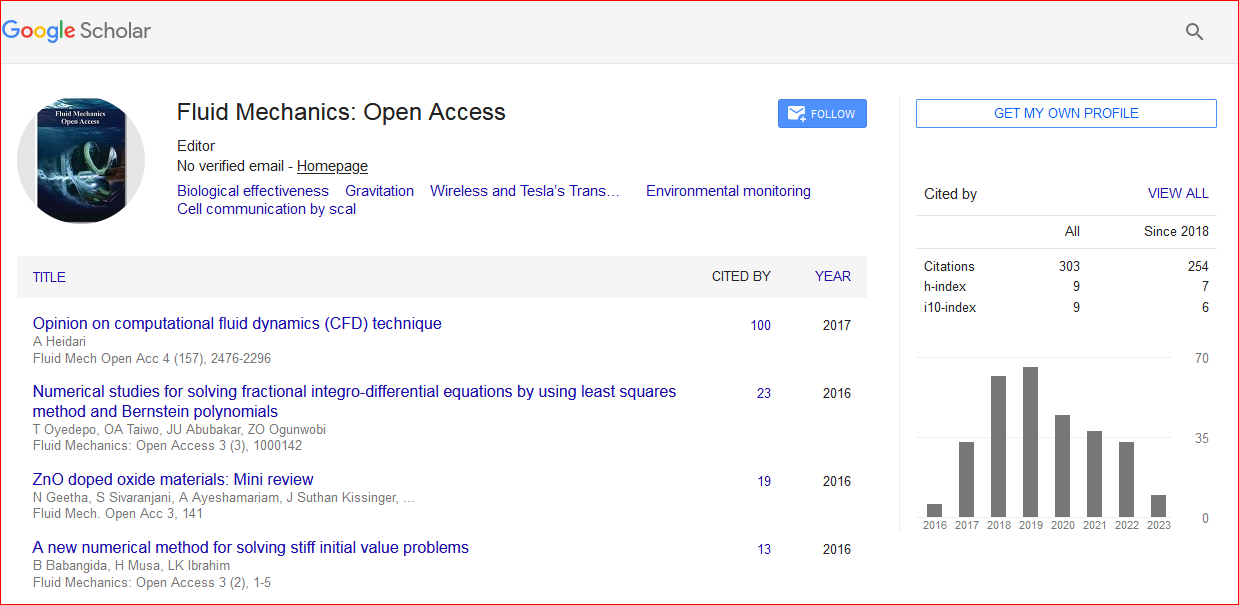
Fluid Mechanics: Open Access received 291 citations as per Google Scholar report