Commentary - (2025) Volume 16, Issue 3
Received: 29-May-2025, Manuscript No. gjto-25-175437;
Editor assigned: 02-May-2025, Pre QC No. P-175437;
Reviewed: 16-Jun-2025, QC No. QC-175437;
Revised: 23-Jun-2025, Manuscript No. R-175437;
Published:
30-Jun-2025
, DOI: 10.37421/2229-8711.2025.16.446
Citation: Moretti, Alicia. ”Innovation Evolution: Digital Strategies and Culture.” Global J Technol Optim 16 (2025):446.
Copyright: © 2025 Moretti A. This is an open-access article distributed under the terms of the Creative Commons Attribution License, which permits unrestricted use,
distribution and reproduction in any medium, provided the original author and source are credited.
This article meticulously explains how digital transformation fundamentally reshapes innovation management. It reviews extensive current studies, pinpointing the critical and undeniable role of technology adoption and agile practices in consistently driving new ideas. What this really means is that businesses must deeply integrate digital tools into every single step of their innovation process to not just survive but to thrive and stay highly competitive in today's market landscape [1]. This paper thoroughly explores the intricate connections between open innovation strategies and how companies subsequently develop new business models. It offers a comprehensive overview and clearly indicates promising future research directions, emphatically stressing that collaboration extending far beyond traditional organizational boundaries is absolutely key for generating novel value and ensuring robust market adaptation [2].
This study meticulously examines how organizational ambidexterity, which is essentially the ability to explore brand new opportunities while simultaneously exploiting existing ones, directly impacts overall innovation performance. The authors compellingly argue that achieving a delicate yet crucial balance between these two capabilities, often perceived as conflicting, is absolutely essential for sustained success and resilience in increasingly dynamic and unpredictable markets [3]. This article profoundly explores the complex management of sustainable innovation, placing significant emphasis on the vital role played by dynamic capabilities and advanced digital technologies. It articulates that businesses must possess the agility to adapt quickly and strategically leverage cutting-edge new technology to consistently develop innovations that are both inherently environmentally friendly and demonstrably economically viable over the long term [4]. This research deeply delves into the nuances of innovation management specifically within small and medium-sized enterprises (SMEs), unequivocally highlighting how a robust entrepreneurial orientation and continuous organizational learning significantly contribute to their innovative success. The core idea here is that an adventurous and proactive mindset, combined with an inherent knack for rapid learning, genuinely helps smaller firms punch well above their weight in competitive arenas [5].
This systematic literature review critically examines how modern design thinking methods profoundly contribute to radical innovation. It convincingly demonstrates that by consistently putting human needs squarely at the center of the process and employing rigorous iterative problem-solving, organizations can effectively generate truly novel, groundbreaking, and impactful solutions, thereby moving far beyond mere incremental improvements [6]. This insightful study focuses keenly on how Artificial Intelligence (AI) can be strategically leveraged for superior innovation management, adopting a comprehensive capabilities perspective. It powerfully argues that developing very specific AI-related organizational capabilities empowers firms to significantly enhance all aspects of their innovation processes, spanning from initial idea generation right through to successful market launch, ultimately making them considerably smarter, faster, and more efficient [7]. This article provides an insightful introductory review of the burgeoning literature on innovation ecosystems, meticulously defining their various components and intricate dynamics. It clearly clarifies how effectively managing complex networks of diverse actors, ranging from nascent startups to established universities, is absolutely fundamental for fostering truly complex, systemic, and far-reaching innovation across various sectors [8]. This systematic review rigorously explores the practical implementation of Lean Startup methodologies specifically within established organizations. It clearly highlights both the inherent challenges and the significant benefits of applying agile, customer-centric approaches within larger, often more traditional corporate structures to efficiently and effectively drive new innovation [9]. This vital research examines how leadership, trust, and knowledge sharing are inextricably interconnected in successfully fostering a vibrant innovation culture. The authors persuasively argue that a truly supportive and open environment where new ideas can flow freely and individuals genuinely feel empowered is undeniably essential for driving continuous and sustainable innovation within any forward-thinking organization [10].
The contemporary landscape of innovation management is undergoing a profound transformation, primarily driven by digital advancements. Businesses face an imperative to fundamentally integrate digital tools and adopt agile practices across every stage of their innovation processes to maintain and enhance competitiveness. This strategic integration is crucial for generating new ideas and staying relevant in fast-evolving markets [1]. Expanding on this digital imperative, the effective management of sustainable innovation also critically relies on robust dynamic capabilities and advanced digital technologies. Organizations must demonstrate agility in adapting to new conditions and strategically leverage technological solutions to develop innovations that are both ecologically sound and economically viable in the long term [4]. Further emphasizing the digital shift, Artificial Intelligence (AI) presents a powerful opportunity to elevate innovation management. By developing and nurturing specific AI-related organizational capabilities, firms can significantly enhance their innovation processes, making them notably smarter and more efficient from the initial stages of idea generation through to successful market launch [7]. These technological drivers are not just supportive elements; they are foundational to shaping the future of innovative endeavors.
Beyond technological integration, strategic frameworks are indispensable for cultivating a vibrant innovation environment. Open innovation strategies, for instance, are pivotal in influencing how companies conceptualize and develop novel business models. Here, the emphasis is on fostering collaboration that extends significantly beyond traditional organizational boundaries, which is essential for creating unique value propositions and ensuring robust adaptation to rapidly changing market dynamics [2]. In parallel, organizational ambidexterity—the challenging yet crucial ability to concurrently explore new, unproven opportunities while skillfully exploiting existing, well-established competencies—profoundly impacts innovation performance. Achieving a delicate but firm balance between these often-conflicting capabilities is paramount for sustained success and resilience in complex, dynamic markets [3]. Furthermore, a comprehensive understanding and proactive management of innovation ecosystems are fundamental. These intricate networks comprise a diverse array of actors, including nascent startups, established corporations, government entities, and academic institutions, like universities. Effectively managing these interconnected relationships is vital for fostering complex, systemic, and far-reaching innovation across various sectors [8]. These strategic considerations collectively offer a holistic perspective on navigating and leading in an increasingly innovative landscape.
The application of specific methodologies and attention to unique contextual factors also hold considerable importance in advancing innovation management. Design thinking methods, which inherently place human needs at the epicenter of an iterative problem-solving process, are potent catalysts for achieving radical innovation. This human-centered approach empowers organizations to conceive and generate truly novel, groundbreaking, and impactful solutions, transcending mere incremental improvements to achieve significant breakthroughs [6]. Similarly, the adoption and implementation of Lean Startup methodologies within established organizations, despite presenting inherent challenges, offer substantial strategic benefits. Applying agile, customer-centric approaches in larger, often more traditional corporate structures can drive innovation with remarkable efficiency by emphasizing rapid experimentation, continuous learning, and validated market feedback [9]. Moreover, innovation management within the realm of Small and Medium-sized Enterprises (SMEs) vividly illustrates the critical role of entrepreneurial orientation and continuous organizational learning. An adventurous, proactive mindset, combined with an inherent and robust capacity for learning and adaptation, genuinely empowers smaller firms to achieve notable innovative success, often enabling them to compete effectively and even punch above their weight against larger industry players [5].
Finally, the deeply human and cultural dimensions within an organization are absolutely indispensable for fostering and sustaining long-term innovation. Cultivating a robust and vibrant innovation culture critically depends on the intricate interplay of strong leadership, mutual trust, and effective knowledge sharing. A truly supportive and open environment where new ideas can flow freely, individuals feel genuinely empowered to take calculated risks, and information is readily exchanged, is unequivocally essential for driving continuous and sustainable innovation within any forward-thinking organization [10]. Dynamic and inspiring leadership is instrumental in building and maintaining trust, which in turn encourages open and transparent knowledge sharing. This creates a virtuous cycle that consistently reinforces innovative behaviors and leads to impactful outcomes. Without a strong, positive cultural foundation that values and champions innovation, even the most advanced technologies, sophisticated strategies, or brilliant methodologies may ultimately falter in achieving their full innovative potential.
Innovation management is undergoing significant evolution, driven by digital transformation, demanding businesses integrate digital tools and agile practices into their processes to remain competitive [1]. Strategic approaches like open innovation, which emphasizes cross-boundary collaboration for new business models [2], and organizational ambidexterity, balancing exploration and exploitation for sustained success [3], are crucial. Sustainable innovation is also gaining traction, necessitating dynamic capabilities and digital technologies for environmentally friendly and economically viable solutions [4]. Small and Medium-sized Enterprises (SMEs) thrive through entrepreneurial orientation and organizational learning, enabling them to achieve innovative success [5]. Methodologies such as design thinking foster radical innovation by focusing on human needs and iterative problem-solving [6], while Artificial Intelligence (AI) capabilities enhance innovation processes from idea generation to market launch [7]. Understanding and managing innovation ecosystems, which involve diverse actors, is key for systemic innovation [8]. Furthermore, implementing Lean Startup methods in established organizations offers an efficient, customer-centric approach to drive innovation [9]. Ultimately, fostering an innovation culture relies on strong leadership, trust, and knowledge sharing to empower individuals and promote continuous idea flow [10].
None
None
Brijesh DA, Divya S, Ravindra KS. "Digital transformation and innovation management: A systematic literature review and future research agenda".Journal of Business Research 168 (2023):114227.
Indexed at, Google Scholar, Crossref
JinHyo JY, Dalsung W, Kwangho P. "Open innovation and business model innovation: A systematic review and future research agenda".Technological Forecasting and Social Change 150 (2020):119771.
Indexed at, Google Scholar, Crossref
Yu L, Yang L, Jianhua W. "Organizational ambidexterity and innovation performance: A dynamic capabilities perspective".Journal of Business Research 147 (2022):202-211.
Indexed at, Google Scholar, Crossref
Paola F, Alfredo DM, Philipp K. "Managing sustainable innovation: The role of dynamic capabilities and digital technologies".Journal of Business Research 154 (2023):113264.
Indexed at, Google Scholar, Crossref
Jianjun C, Hong C, Yu C. "Innovation management in small and medium-sized enterprises: The role of entrepreneurial orientation and organizational learning".Journal of Business Research 130 (2021):649-659.
Indexed at, Google Scholar, Crossref
Fredrik L, Anders L, Lars C. "Design Thinking for Radical Innovation: A Systematic Literature Review".Journal of Engineering Design 31 (2020):257-278.
Indexed at, Google Scholar, Crossref
Siraj AK, Sadia IK, Sohail H. "Leveraging artificial intelligence for innovation management: A capabilities perspective".Journal of Business Research 147 (2022):409-419.
Indexed at, Google Scholar, Crossref
Erkko A, Martin K, Philippe M. "Innovation Ecosystems: An Introductory Review of the Literature".Research Policy 50 (2021):104301.
Indexed at, Google Scholar, Crossref
Giuditta B, Federico C, Nicola S. "Implementing Lean Startup in established organizations: A systematic literature review".Journal of Engineering and Technology Management 63 (2022):101662.
Indexed at, Google Scholar, Crossref
Shaukat N, Raheel A, Muhammad F. "Fostering an innovation culture: The role of leadership, trust, and knowledge sharing".Journal of Knowledge Management 27 (2023):1819-1836.
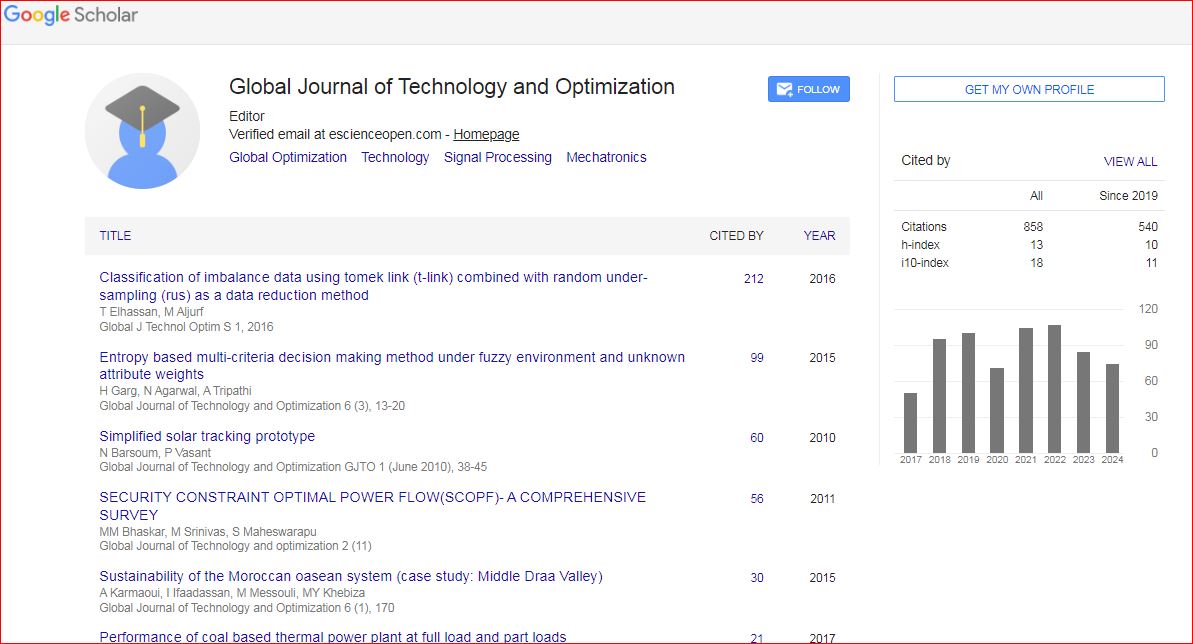
Global Journal of Technology and Optimization received 847 citations as per Google Scholar report