Short Communication - (2025) Volume 9, Issue 3
Received: 01-Sep-2025, Manuscript No. rrms-25-175071;
Editor assigned: 03-Sep-2025, Pre QC No. P-175071;
Reviewed: 17-Sep-2025, QC No. Q-175071;
Revised: 22-Sep-2025, Manuscript No. R-175071;
Published:
29-Sep-2025
, DOI: 10.37421/2952-8127.2025.9.233
Citation: Kowalski, Marek. ”Innovating Medical Education for Holistic Growth.” Res Rep Med Sci 09 (2025):233.
Copyright: © 2025 Kowalski M. This is an open-access article distributed under the terms of the Creative Commons Attribution License, which permits unrestricted use, distribution and reproduction in any medium, provided the original author and source are credited.
Medical education continually evolves to meet the demands of a changing healthcare landscape, focusing on effective evaluation strategies and holistic trainee development. Modern approaches challenge traditional assessment methods, advocating for programmatic assessment that integrates various data points over time to provide robust feedback for learning and development, moving beyond mere high-stakes decision-making for future doctors [1].
Curriculum reform, while essential, frequently encounters challenges such as 'change fatigue' among faculty and staff. Successful implementation of new educational models depends heavily on effective communication, clear leadership, and adequate support systems to mitigate resistance [2].
Technological advancements are rapidly transforming how medical students learn. The integration of augmented reality (AR) and virtual reality (VR) offers significant potential to enhance anatomical understanding, surgical skills training, and patient simulation. Despite current challenges, these technologies are set to become widespread in medical curricula [3].
Addressing the mental health of medical students is paramount. Positive psychology interventions prove beneficial in promoting well-being, reducing burnout, and improving resilience, highlighting the critical need for psychological support within medical education [4].
Cultivating professional identity is another complex, multi-faceted aspect of medical training. Current practices in teaching and assessing professionalism involve various pedagogical approaches and assessment tools, underscoring the necessity for consistent and comprehensive strategies to foster ethical and responsible medical practitioners [5].
Entrustable Professional Activities (EPAs) offer a practical framework for assessing competence. EPAs provide a meaningful way to evaluate a trainee's readiness to perform key professional tasks unsupervised, bridging the gap between theoretical knowledge and clinical practice, which is central to competency-based medical education [6].
Simulation plays an increasingly vital role in training, with broad applications from basic skills to complex team-based scenarios. It significantly enhances clinical reasoning, patient safety, and communication skills, with emerging technologies and pedagogical strategies continuing to shape its future implementation [7].
Interprofessional education (IPE) is crucial for preparing future healthcare professionals to work effectively in team-based environments. It positively impacts collaborative practice, patient outcomes, and professional competencies, thereby supporting the delivery of patient-centered care [8].
Global health education (GHE) is essential for developing culturally competent and globally-minded physicians. Current practices involve diverse pedagogical approaches and curriculum models, emphasizing the importance of standardized learning objectives and ethical considerations in international health placements [9].
Finally, narrative medicine enriches the humanistic aspects of medical training. Incorporating patient narratives, personal reflections, and literary works enhances empathy, communication skills, and holistic patient care among medical students, demonstrating its value in comprehensive medical education [10].
Medical education is experiencing a profound transformation, moving towards more dynamic and comprehensive assessment methods. Traditional approaches are being challenged by programmatic assessment, which integrates diverse data points over time. This shift aims to provide robust feedback for continuous learning and development rather than merely serving high-stakes decision-making, ultimately creating more effective and meaningful evaluation strategies for future doctors [1]. Alongside this, curriculum reform is a persistent theme, though it often comes with the challenge of 'change fatigue' among faculty and staff. Effective communication, strong leadership, and adequate support systems are critical for mitigating resistance and ensuring the successful implementation of new educational models [2]. This emphasis on continuous improvement and adaptability is key to preparing medical professionals for complex healthcare environments.
Technology is a major driver of innovation in medical training. Augmented reality (AR) and virtual reality (VR) are increasingly being integrated into medical education, offering powerful tools to enhance anatomical understanding, refine surgical skills, and provide realistic patient simulations. While challenges remain in their widespread adoption, these technologies hold immense potential to revolutionize how medical students acquire practical skills [3]. Complementing this, the role of simulation in medical education continues to expand, encompassing everything from basic skills training to complex team-based scenarios. Simulation significantly improves clinical reasoning, fosters patient safety, and strengthens communication skills, with continuous advancements in technologies and pedagogical strategies further shaping its future use [7]. These technological interventions provide immersive and safe learning environments.
Beyond technical skills, the well-being and professional development of medical students are gaining increased focus. Positive psychology interventions have proven beneficial in addressing the mental health and stress levels of students, promoting well-being, reducing burnout, and improving resilience. This underscores the crucial importance of integrating psychological support into medical education curricula [4]. Concurrently, teaching and assessing professionalism is vital for fostering ethical and responsible medical practitioners. A systematic review of current practices highlights the complexity and multi-faceted nature of this endeavor, identifying various pedagogical approaches and assessment tools, all pointing to the need for consistent and comprehensive strategies to cultivate professional identity in medical trainees [5]. These elements together build a more resilient and ethically grounded physician.
Frameworks for competence assessment are also evolving. Entrustable Professional Activities (EPAs) offer a practical and meaningful way to evaluate a trainee's readiness to perform key professional tasks without direct supervision. EPAs effectively bridge the gap between theoretical knowledge and actual clinical practice, thereby facilitating robust competency-based medical education [6]. This systematic approach ensures that trainees are not only knowledgeable but also capable of applying their learning in real-world scenarios, a critical step in modern medical training. It moves beyond abstract knowledge to demonstrable skill and responsibility.
Broader educational strategies also play a significant role. Interprofessional education (IPE) is affirmed for its positive impact on collaborative practice, patient outcomes, and professional competencies, proving crucial for preparing future healthcare professionals to work effectively in team-based environments and deliver patient-centered care [8]. Similarly, global health education (GHE) for medical students fosters culturally competent and globally-minded physicians. This systematic review identifies diverse pedagogical approaches and curriculum models, emphasizing the necessity for standardized learning objectives and careful ethical considerations in international health placements [9]. Lastly, narrative medicine, through incorporating patient narratives, personal reflections, and literary works, enhances empathy, communication skills, and holistic patient care, enriching the humanistic aspects of medical training [10]. These diverse approaches collectively ensure a well-rounded and socially conscious medical professional.
Medical education is undergoing substantial innovation, driven by evolving assessment methodologies and a growing emphasis on holistic trainee development. Modern strategies move beyond traditional evaluations to embrace programmatic assessment, which uses integrated data points for continuous feedback, fostering learning and growth rather than just high-stakes decisions [1]. Curriculum reforms, though essential for progress, often encounter 'change fatigue,' highlighting the need for strong communication, leadership, and support systems for successful implementation [2]. Technological integration, particularly augmented reality (AR) and virtual reality (VR), is enhancing anatomical understanding and surgical skills through immersive simulations [3]. Simulation broadly supports clinical reasoning, patient safety, and communication, with ongoing advancements continually refining its application [7]. These tools are vital for practical skill development. Student well-being and professional identity are also central concerns. Positive psychology interventions are shown to improve mental health, reduce burnout, and build resilience among students, emphasizing the importance of psychological support [4]. Concurrently, cultivating professionalism requires varied pedagogical approaches and consistent assessment strategies to foster ethical and responsible practitioners [5]. Competency assessment is streamlined through frameworks like Entrustable Professional Activities (EPAs), which evaluate a trainee's readiness to perform professional tasks unsupervised, linking theory to clinical practice [6]. Broader educational approaches include interprofessional education (IPE), which bolsters collaborative practice and patient outcomes [8], and global health education (GHE), fostering culturally competent physicians with standardized objectives and ethical considerations [9]. Narrative medicine further enriches medical training by enhancing empathy and communication through patient stories and reflections, adding a crucial humanistic dimension [10].
None
None
Cees PMvdV, Lambert WTS, Erik WD. "Rethinking assessment in medical education for the 21st century.".Med Educ 53 (2019):23-34.
Indexed at, Google Scholar, Crossref
Karen MFdS, Eliana GC, Ricardo AC. "Curriculum reform and change fatigue in medical education: a qualitative study.".Rev Bras Educ Med 45 (2021):e069.
Indexed at, Google Scholar, Crossref
Shuo Z, Zhi-Gang Z, Bin Y. "Augmented reality and virtual reality in medical education: an updated overview.".J Med Syst 47 (2023):16.
Indexed at, Google Scholar, Crossref
Trupti J, Emily LS, Laura ED. "Medical student well-being: the effect of positive psychology interventions on mental health and stress-a systematic review.".Acad Psychiatry 45 (2021):213-222.
Indexed at, Google Scholar, Crossref
Rebecca HS, Karen BS, Walter PMVDB. "Teaching and assessing professionalism in medical education: a systematic review of the literature.".Med Educ 54 (2020):212-227.
Indexed at, Google Scholar, Crossref
Deborah EP, Ann DD, Eric WD. "Entrustable Professional Activities: An Answer to the Question of Assessing Competence in Medical Education.".Acad Med 94 (2019):11-14.
Indexed at, Google Scholar, Crossref
Adam WR, Ryan WM, Michael HN. "Use of simulation in medical education: current trends and future directions.".J Med Educ Curric Dev 9 (2022):23821205221147575.
Indexed at, Google Scholar, Crossref
Hugh CB, Christine BD, Joanne KVW. "Interprofessional education in health care: an overview of systematic reviews.".J Interprof Care 33 (2019):300-305.
Indexed at, Google Scholar, Crossref
Jennifer EW, Jennifer AC, David WTL. "Global health education for medical students: a systematic review of current practices and future directions.".Med Educ 55 (2021):169-183.
Indexed at, Google Scholar, Crossref
Livia ASE, Marcia RC, Liane MDQ. "Narrative medicine in medical education: an integrative review.".Rev Bras Educ Med 44 (2020):e099.
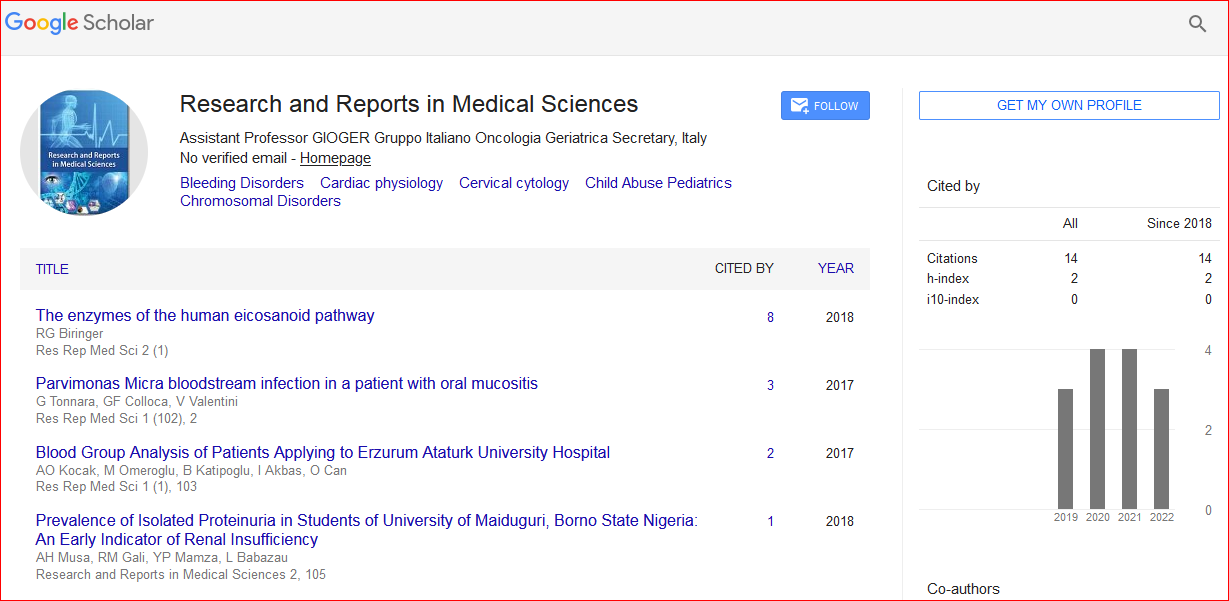
Research and Reports in Medical Sciences received 13 citations as per Google Scholar report