Brief Report - (2025) Volume 15, Issue 3
Received: 02-Jun-2025, Manuscript No. jprm-25-174447;
Editor assigned: 04-Jun-2025, Pre QC No. P-174447;
Reviewed: 18-Jun-2025, QC No. Q-174447;
Revised: 23-Jun-2025, Manuscript No. R-174447;
Published:
30-Jun-2025
, DOI: 10.37421/2161-105X.2025.15.740
Citation: Kapoor, Rina. ”ILDs: Advancing Diagnosis, Management and Fibrosis.” J Pulm Respir Med 15 (2025):740.
Copyright: © 2025 Kapoor R. This is an open-access article distributed under the terms of the Creative Commons Attribution License, which permits unrestricted use, distribution and reproduction in any medium, provided the original author and source are credited.
This article updates clinicians on the diagnosis and management strategies for interstitial lung diseases (ILDs), emphasizing the importance of a multidisciplinary approach and high-resolution computed tomography (HRCT) for accurate classification. It reviews current therapeutic options, including antifibrotics and immunomodulators, tailored to specific ILD subtypes to improve patient outcomes[1].
This review explores the definition, diagnosis, and clinical management of progressive fibrosing interstitial lung diseases (PF-ILDs), emphasizing the common trajectory of fibrosis progression across various ILD subtypes. It highlights the importance of early recognition and the use of antifibrotic therapies to slow disease progression and improve patient quality of life[2].
This article discusses the evolving understanding and therapeutic landscape of interstitial lung diseases, particularly focusing on the shift towards a more precise phenotyping of fibrotic ILDs. It covers recent advances in antifibrotic treatments and the recognition of progressive fibrosing phenotypes, underscoring the need for individualized treatment strategies[3].
This comprehensive review examines autoimmune interstitial lung disease (AI-ILD), highlighting the diverse clinical presentations and diagnostic challenges. It covers the association of ILD with various connective tissue diseases, stressing the importance of early diagnosis and multidisciplinary management to mitigate disease progression and improve patient prognosis[4].
This article provides an update on the current understanding and management strategies for Idiopathic Pulmonary Fibrosis (IPF), a progressive and fatal form of ILD. It reviews the latest diagnostic criteria, advances in antifibrotic therapies, and emerging treatment options, emphasizing the need for timely diagnosis and comprehensive care[5].
This review provides current perspectives on the complex pathogenesis of interstitial lung disease, focusing on the interplay of genetic predisposition, environmental triggers, and immune dysregulation. It discusses various cellular and molecular mechanisms driving fibrosis and inflammation, which are crucial for developing targeted therapies[6].
This review details new advances in the diagnosis and treatment of interstitial lung diseases associated with autoimmune rheumatic diseases. It covers improved diagnostic techniques, including advanced imaging and serological markers, and discusses targeted immunomodulatory and antifibrotic therapies that aim to preserve lung function and enhance patient survival[7].
This article reviews the current landscape of drug development for interstitial lung diseases, highlighting the challenges and successes in bringing new therapies to market. It discusses the shift from broad immunosuppression to targeted antifibrotic and anti-inflammatory strategies, emphasizing the need for innovative trial designs to accelerate drug discovery[8].
This narrative review underscores the critical role of multidisciplinary team discussions (MDTs) in the diagnosis and management of interstitial lung diseases. It highlights how MDTs facilitate accurate diagnosis, guide personalized treatment plans, and improve patient outcomes by integrating expertise from various specialties, including pulmonology, radiology, and pathology[9].
This review explores the current status and future perspectives of biomarkers in interstitial lung diseases, discussing their potential roles in diagnosis, prognosis, and monitoring treatment response. It highlights various circulating and imaging biomarkers, emphasizing the need for robust validation studies to integrate them into routine clinical practice for personalized medicine[10].
Interstitial Lung Diseases (ILDs) represent a complex and heterogeneous group of chronic respiratory conditions characterized by progressive fibrosis and inflammation within the lung parenchyma. Recent clinical updates strongly emphasize the crucial role of a comprehensive, multidisciplinary approach for their effective diagnosis and management [C001]. High-resolution computed tomography (HRCT) remains an indispensable tool for accurate classification, guiding clinicians toward precise diagnoses among the diverse array of ILD subtypes [C001]. Moreover, the therapeutic landscape has evolved significantly, now incorporating targeted options such as antifibrotics and immunomodulators. These treatments are carefully selected and tailored to the specific ILD subtype, with the ultimate goal of improving patient outcomes and quality of life [C001]. The overarching principle here is that early and accurate identification of the disease is fundamental to any successful management strategy.
A major clinical challenge addressed in recent research is Progressive Fibrosing Interstitial Lung Diseases (PF-ILDs), a designation recognizing that fibrosis can relentlessly progress across various ILD subtypes, leading to significant morbidity and mortality [C002]. Studies underscore the critical importance of early recognition of this progressive fibrosing trajectory, as it allows for the timely initiation of antifibrotic therapies, which are proven to slow disease progression and thereby enhance patient quality of life [C002]. The understanding of fibrotic ILDs is continuously evolving, prompting a shift towards more precise phenotyping. This detailed classification aids in developing and applying individualized treatment strategies, particularly given the recent advancements in antifibrotic treatments available [C003]. Idiopathic Pulmonary Fibrosis (IPF), a particularly aggressive and fatal form of ILD, stands as a prime example where updated diagnostic criteria and significant breakthroughs in antifibrotic therapies are paramount [C005]. For IPF patients, timely diagnosis and comprehensive, patient-centered care are essential for managing this severe condition effectively [C005].
Another critical subset of ILDs involves those associated with autoimmune conditions, collectively known as Autoimmune Interstitial Lung Disease (AI-ILD). These conditions present a diverse range of clinical manifestations and significant diagnostic complexities [C004]. The association of ILD with various connective tissue diseases (CTDs) demands a heightened awareness from clinicians. Emphasizing early diagnosis and a robust multidisciplinary management approach is crucial to mitigate the progression of the disease and improve patient prognosis in these challenging cases [C004]. Significant advances have been made in the diagnosis and treatment of ILDs specifically linked to autoimmune rheumatic diseases [C007]. These include improved diagnostic techniques, such as advanced imaging and serological markers, alongside the development of targeted immunomodulatory and antifibrotic therapies. The goal of these therapies is to preserve lung function and ultimately enhance patient survival, marking a hopeful trend in a previously difficult-to-manage patient population [C007].
Delving into the underlying biology, current research provides vital perspectives on the complex pathogenesis of interstitial lung disease, unraveling the intricate interplay of genetic predisposition, environmental triggers, and immune dysregulation [C006]. Detailed studies are shedding light on various cellular and molecular mechanisms that drive both fibrosis and inflammation, which are critically important for the design of truly targeted therapies [C006]. This mechanistic understanding directly informs the current landscape of drug development for ILDs. The field has notably shifted from broad-spectrum immunosuppression towards more precise antifibrotic and anti-inflammatory strategies [C008]. This evolution underscores the urgent need for innovative trial designs that can accelerate drug discovery and bring promising new treatments to patients more efficiently [C008]. In parallel, the role of biomarkers is rapidly expanding, exploring their potential for improved diagnosis, more accurate prognostication, and effective monitoring of treatment response in ILDs [C010]. Various circulating and imaging biomarkers are under rigorous investigation, with a clear emphasis on robust validation studies to seamlessly integrate them into routine clinical practice, thereby paving the way for truly personalized medicine approaches [C010].
Finally, the indispensable role of multidisciplinary team discussions (MDTs) in the diagnosis and management of interstitial lung diseases cannot be overstated [C009]. These collaborative discussions are fundamental in achieving accurate diagnoses, developing personalized treatment plans, and ultimately improving patient outcomes [C009]. MDTs effectively integrate the specialized expertise from pulmonologists, radiologists, and pathologists, ensuring a holistic and comprehensive understanding of each patientâ??s unique condition. This integrated approach helps navigate the complexities of ILDs, leading to more informed decisions and better overall patient care.
Interstitial Lung Diseases (ILDs) represent a complex group of respiratory conditions, with recent updates highlighting evolving diagnostic and management strategies. A multidisciplinary approach, often involving high-resolution computed tomography (HRCT), is crucial for accurate classification and tailoring therapeutic options like antifibrotics and immunomodulators to specific ILD subtypes. A key focus is on Progressive Fibrosing Interstitial Lung Diseases (PF-ILDs), recognized by their common trajectory of fibrosis progression across various ILD subtypes. Early detection and antifibrotic therapies are vital to slow disease progression and enhance patient quality of life. The understanding of fibrotic ILDs is continuously advancing, leading to more precise phenotyping and individualized treatment strategies, incorporating new antifibrotic advancements. Autoimmune Interstitial Lung Disease (AI-ILD) presents diverse clinical challenges, often associated with connective tissue diseases. Multidisciplinary management and early diagnosis are critical to managing progression and improving prognosis for AI-ILD patients. Idiopathic Pulmonary Fibrosis (IPF), a severe and often fatal form of ILD, benefits from updated diagnostic criteria and significant progress in antifibrotic treatments, underscoring the need for timely and comprehensive care. Current perspectives on ILD pathogenesis delve into genetic predisposition, environmental triggers, and immune dysregulation, uncovering molecular mechanisms that drive fibrosis and inflammation to inform targeted therapies. Drug development for ILDs is shifting towards targeted antifibrotic and anti-inflammatory strategies, necessitating innovative trial designs. Multidisciplinary Team discussions (MDTs) are essential for accurate diagnosis, personalized treatment planning, and improved patient outcomes by integrating diverse expertise. Biomarkers are also emerging as important tools for diagnosis, prognosis, and monitoring treatment response in ILDs, though they require robust validation for clinical integration.
None
None
1. Monisha G, Elena AR, Athol UW. "Diagnosis and Management of Interstitial Lung Disease: An Update".Clin Chest Med 44 (2023):521-536.
Indexed at, Google Scholar, Crossref
2. Katerina MA, Athol UW, Luca R. "Progressive Fibrosing Interstitial Lung Diseases: Diagnosis, Clinical Management, and Pathophysiology".Respiration 101 (2022):257-272.
Indexed at, Google Scholar, Crossref
3. Helen EJ, Elena AR, Athol UW. "Evolving landscape of interstitial lung disease".Respirology 26 (2021):122-133.
Indexed at, Google Scholar, Crossref
4. Samuel G, Izhar K, Noor A. "Autoimmune Interstitial Lung Disease: a Comprehensive Review".Curr Rheumatol Rep 25 (2023):367-377.
Indexed at, Google Scholar, Crossref
5. Debarshi C, Sachin S, Margaret KH. "Current understanding and management of idiopathic pulmonary fibrosis".Expert Rev Respir Med 17 (2023):57-73.
Indexed at, Google Scholar, Crossref
6. Anoop MN, Kavitha B, Ruchi V. "Pathogenesis of interstitial lung disease: current perspectives".Curr Opin Pulm Med 28 (2022):442-447.
Indexed at, Google Scholar, Crossref
7. Karoline OV, Renan SV, Luis FRJ. "New advances in the diagnosis and treatment of interstitial lung diseases in autoimmune rheumatic diseases".Rev Bras Reumatol (Engl Ed) 61 (2021):669-679.
Indexed at, Google Scholar, Crossref
8. Irena N, Justin AK, Vincent C. "Drug Development for Interstitial Lung Diseases".Am J Respir Crit Care Med 201 (2020):1472-1482.
Indexed at, Google Scholar, Crossref
9. Said AA, Hadeer K, Sadeq A. "Multidisciplinary team discussion in interstitial lung diseases: a narrative review".Ann Med Surg (2012) 85 (2023):5690-5696.
Indexed at, Google Scholar, Crossref
10. Ganesh R, Athol UW, Luca R. "Biomarkers in Interstitial Lung Diseases: Current Status and Future Perspectives".Am J Respir Crit Care Med 206 (2022):541-552.
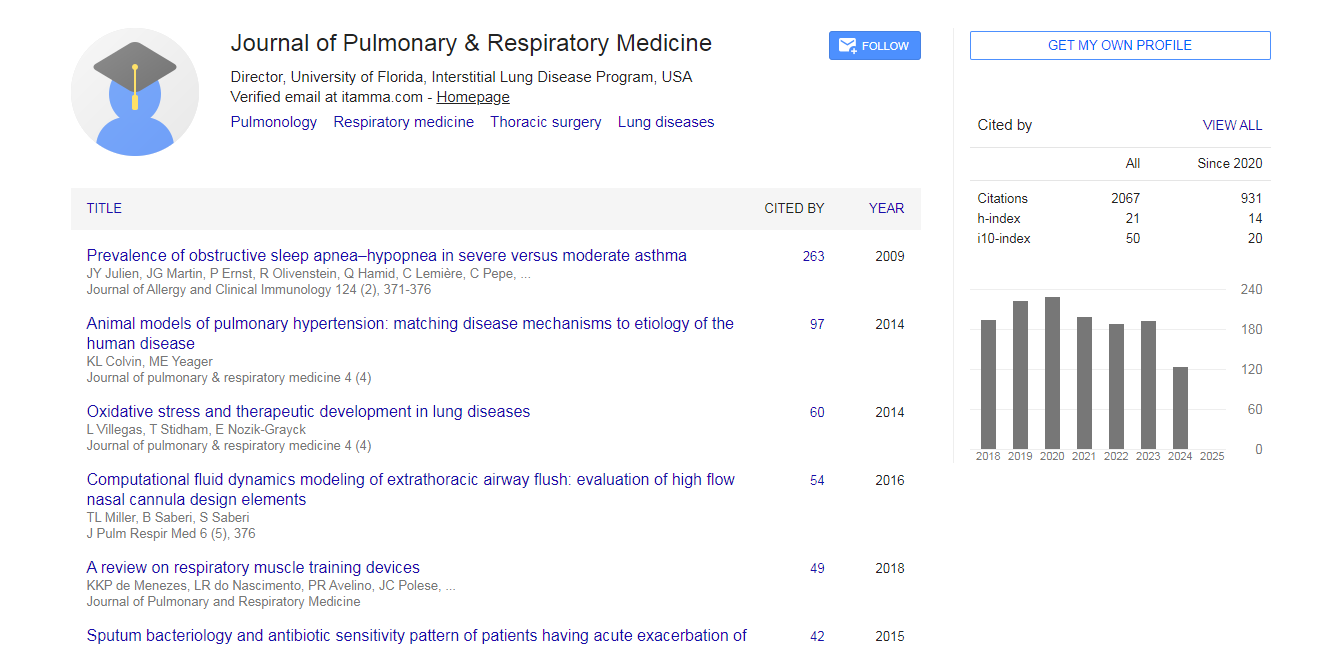
Pulmonary & Respiratory Medicine received 1690 citations as per Google Scholar report