Perspective - (2025) Volume 14, Issue 4
Received: 01-Dec-0025, Manuscript No. jms-25-177892;
Editor assigned: 03-Dec-2025, Pre QC No. P-177892;
Reviewed: 17-Dec-2025, QC No. Q-177892;
Revised: 22-Dec-2025, Manuscript No. R-177892;
Published:
29-Dec-2025
, DOI: 10.37421/2167-0943.2024.13.427
Citation: Sund, Linnea. ”Hypertension: Guidelines, Novel Treatments, Personalized Care.” J Metabolic Synd 14 (2025):427.
Copyright: © 2025 Sund L. This is an open-access article distributed under the terms of the Creative Commons Attribution License, which permits unrestricted use, distribution and reproduction in any medium, provided the original author and source are credited.
The 2023 European Society of Hypertension (ESH) guidelines simplify hypertension diagnosis and treatment, promoting early, individualized care. They underscore out-of-office blood pressure monitoring, lifestyle changes, and initial dual combination therapy for many patients. The guidelines also update recommendations for specific groups, like those with diabetes or chronic kidney disease, aiming to achieve blood pressure targets and reduce cardiovascular risk.[1]
A review explores novel pharmacological targets for hypertension, moving beyond traditional pathways. It examines mineralocorticoid receptor antagonists, endothelin receptor antagonists, and therapies influencing nitric oxide pathways. These emerging agents present solutions for patients not responding to conventional treatments, offering more precise blood pressure control by targeting mechanisms of vascular dysfunction and organ damage.[2]
Resistant hypertension, defined as blood pressure above target despite optimal triple therapy, is a challenging condition. This article reviews diagnostic approaches, stressing the exclusion of pseudoresistance and secondary causes. It explores new therapeutic strategies, including mineralocorticoid receptor antagonists, renal denervation, novel drug classes, and lifestyle interventions, all designed to improve patient outcomes.[3]
Hypertension management in older adults poses unique challenges from comorbidities, polypharmacy, and adverse effect risks. A review discusses tailored approaches, recommending individualized blood pressure targets based on frailty and comorbidity. It emphasizes careful medication selection, dose titration, and managing orthostatic hypotension, while affirming the benefits of controlled blood pressure for cardiovascular protection.[4]
A practical framework outlines diagnosing and managing secondary hypertension, a significant subset of cases. It highlights systematic screening for primary aldosteronism, renovascular hypertension, and obstructive sleep apnea, especially in resistant or early-onset severe hypertension. Accurate diagnosis and targeted treatment of these underlying conditions can lead to cure or substantial blood pressure improvement, lessening reliance on lifelong drugs.[5]
The American Heart Association (AHA) emphasizes the fundamental role of lifestyle modifications in hypertension prevention and control. It details the impact of dietary changes (like DASH), sodium reduction, regular physical activity, moderate alcohol intake, and weight management. These evidence-based interventions can significantly lower blood pressure, reduce medication needs, and improve cardiovascular health, often serving as first-line therapy.[6]
The American Heart Association's (AHA) statement on telehealth for hypertension management highlights remote blood pressure monitoring and virtual care efficacy. Telehealth can improve adherence, provide more frequent blood pressure data, and facilitate timely treatment adjustments, benefiting underserved populations. Implementation considerations, including technology, data security, and patient engagement, are crucial for optimizing telehealth in hypertension care.[7]
Hypertension profoundly impacts brain health, acting as a major risk factor for cognitive decline, stroke, and vascular dementia. This paper consolidates evidence linking elevated blood pressure to structural and functional brain changes. Recommendations for blood pressure control strategies emphasize early and sustained treatment, aiming to protect the cardiovascular system and preserve cognitive function, mitigating long-term neurological consequences.[8]
A review summarizes device-based therapies for resistant hypertension, evaluating renal denervation, carotid baroreceptor activation, and arteriovenous anastomoses. It discusses their mechanisms, clinical trial outcomes, and patient selection. These procedures offer potential for durable blood pressure lowering when drugs are insufficient, though further research and careful patient stratification are necessary.[9]
This review explores precision medicine in hypertension, advocating for individualized management strategies. It considers a patient's genetic profile, biomarkers, and phenotypic characteristics. Genomics, proteomics, and metabolomics can identify specific pathways, enabling targeted therapies and improved prediction of treatment response. This approach moves beyond 'one-size-fits-all,' leading to more effective, personalized hypertension care.[10]
The 2023 European Society of Hypertension (ESH) guidelines simplify hypertension diagnosis and treatment, promoting early, individualized care. They underscore out-of-office blood pressure monitoring, lifestyle changes, and initial dual combination therapy for many patients. The guidelines also update recommendations for specific groups, like those with diabetes or chronic kidney disease, aiming to achieve blood pressure targets and reduce cardiovascular risk [1].
A review explores novel pharmacological targets for hypertension, moving beyond traditional pathways. It examines mineralocorticoid receptor antagonists, endothelin receptor antagonists, and therapies influencing nitric oxide pathways. These emerging agents present solutions for patients not responding to conventional treatments, offering more precise blood pressure control by targeting mechanisms of vascular dysfunction and organ damage [2].
Resistant hypertension, defined as blood pressure above target despite optimal triple therapy, is a challenging condition. This article reviews diagnostic approaches, stressing the exclusion of pseudoresistance and secondary causes. It explores new therapeutic strategies, including mineralocorticoid receptor antagonists, renal denervation, novel drug classes, and lifestyle interventions, all designed to improve patient outcomes [3].
Hypertension management in older adults poses unique challenges from comorbidities, polypharmacy, and adverse effect risks. A review discusses tailored approaches, recommending individualized blood pressure targets based on frailty and comorbidity. It emphasizes careful medication selection, dose titration, and managing orthostatic hypotension, while affirming the benefits of controlled blood pressure for cardiovascular protection [4].
A practical framework outlines diagnosing and managing secondary hypertension, a significant subset of cases. It highlights systematic screening for primary aldosteronism, renovascular hypertension, and obstructive sleep apnea, especially in resistant or early-onset severe hypertension. Accurate diagnosis and targeted treatment of these underlying conditions can lead to cure or substantial blood pressure improvement, lessening reliance on lifelong drugs [5].
The American Heart Association (AHA) emphasizes the fundamental role of lifestyle modifications in hypertension prevention and control. It details the impact of dietary changes (like DASH), sodium reduction, regular physical activity, moderate alcohol intake, and weight management. These evidence-based interventions can significantly lower blood pressure, reduce medication needs, and improve cardiovascular health, often serving as first-line therapy [6].
The American Heart Association's (AHA) statement on telehealth for hypertension management highlights remote blood pressure monitoring and virtual care efficacy. Telehealth can improve adherence, provide more frequent blood pressure data, and facilitate timely treatment adjustments, benefiting underserved populations. Implementation considerations, including technology, data security, and patient engagement, are crucial for optimizing telehealth in hypertension care [7].
Hypertension profoundly impacts brain health, acting as a major risk factor for cognitive decline, stroke, and vascular dementia. This paper consolidates evidence linking elevated blood pressure to structural and functional brain changes. Recommendations for blood pressure control strategies emphasize early and sustained treatment, aiming to protect the cardiovascular system and preserve cognitive function, mitigating long-term neurological consequences [8].
A review summarizes device-based therapies for resistant hypertension, evaluating renal denervation, carotid baroreceptor activation, and arteriovenous anastomoses. It discusses their mechanisms, clinical trial outcomes, and patient selection. These procedures offer potential for durable blood pressure lowering when drugs are insufficient, though further research and careful patient stratification are necessary [9].
This review explores precision medicine in hypertension, advocating for individualized management strategies. It considers a patient's genetic profile, biomarkers, and phenotypic characteristics. Genomics, proteomics, and metabolomics can identify specific pathways, enabling targeted therapies and improved prediction of treatment response. This approach moves beyond 'one-size-fits-all,' leading to more effective, personalized hypertension care [10].
New European Society of Hypertension (ESH) guidelines simplify arterial hypertension diagnosis and treatment, emphasizing early, individualized care, out-of-office blood pressure measurements, lifestyle changes, and initial dual combination therapy for many patients, with updated recommendations for those with comorbidities like diabetes or chronic kidney disease [1]. Beyond traditional methods, novel pharmacological targets, including mineralocorticoid receptor antagonists and nitric oxide pathway therapies, offer precise solutions for patients unresponsive to conventional treatments [2]. Addressing resistant hypertension involves new diagnostic approaches to rule out pseudoresistance and secondary causes, alongside therapeutic strategies like mineralocorticoid receptor antagonists, renal denervation, and lifestyle interventions [3]. Managing hypertension in older adults presents specific challenges due to comorbidities and polypharmacy, requiring individualized targets, careful medication selection, and attention to orthostatic hypotension for cardiovascular protection [4]. A practical framework exists for diagnosing and managing secondary hypertension, focusing on systematic screening for underlying conditions like primary aldosteronism, which can lead to significant blood pressure improvement or cure [5]. The American Heart Association (AHA) champions lifestyle modificationsâ??diet, sodium reduction, physical activity, alcohol moderation, and weight managementâ??as foundational for prevention and control, often serving as first-line treatment [6]. Telehealth is emerging as an effective tool for hypertension management, enhancing remote monitoring, adherence, and timely treatment adjustments, particularly benefiting underserved populations [7]. Understanding hypertension's profound impact on brain health, including cognitive decline and stroke, highlights the need for early, sustained blood pressure control to preserve cognitive function [8]. For resistant cases, device-based therapies such as renal denervation and carotid baroreceptor activation show promise in achieving durable blood pressure lowering when pharmacological options are insufficient, though further research is ongoing [9]. Finally, precision medicine is transforming hypertension care by using genetic profiles, biomarkers, and phenotypic characteristics to develop individualized management strategies, moving away from a 'one-size-fits-all' approach towards more personalized and effective treatment [10].
None
None
Indexed at, Google Scholar, Crossref
Indexed at, Google Scholar, Crossref
Indexed at, Google Scholar, Crossref
Indexed at, Google Scholar, Crossref
Indexed at, Google Scholar, Crossref
Indexed at, Google Scholar, Crossref
Indexed at, Google Scholar, Crossref
Indexed at, Google Scholar, Crossref
Indexed at, Google Scholar, Crossref
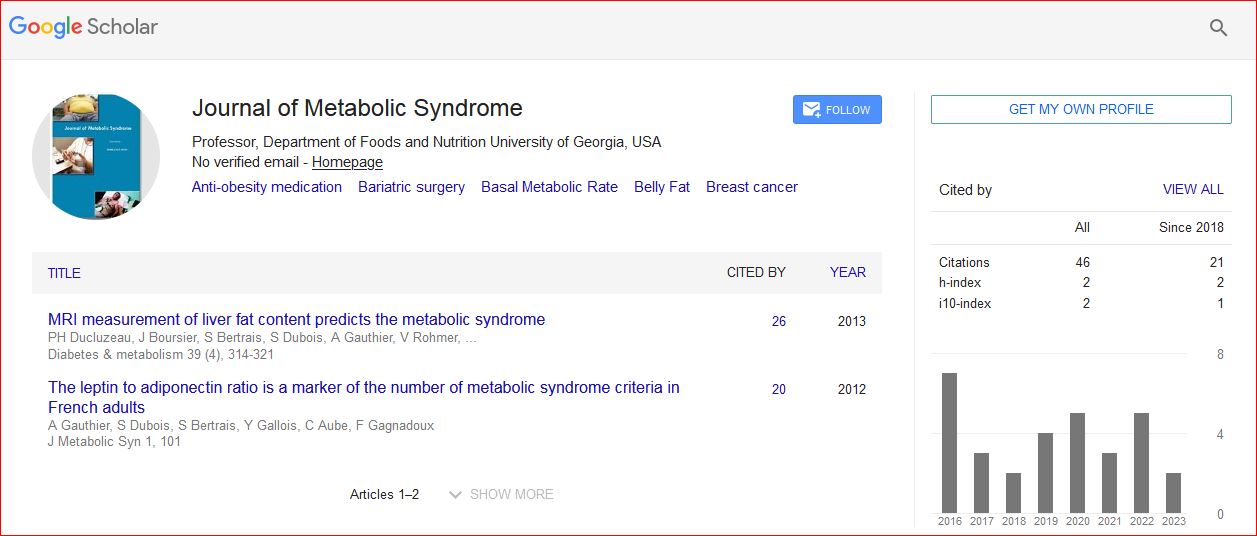
Journal of Metabolic Syndrome received 48 citations as per Google Scholar report