Perspective - (2025) Volume 12, Issue 4
Received: 01-Aug-2025, Manuscript No. ijn-26-183992;
Editor assigned: 04-Aug-2025, Pre QC No. P-183992;
Reviewed: 18-Aug-2025, QC No. Q-183992;
Revised: 22-Aug-2025, Manuscript No. R-183992;
Published:
29-Aug-2025
, DOI: 10.37421/2376-0281.2025.12.645
Citation: Mensah, Kofi. ”Holistic Neurorehabilitation Enhances MND Quality Of Life.” Int J Neurorehabilitation Eng 12 (2025):645.
Copyright: © 2025 Mensah K. This is an open-access article distributed under the terms of the Creative Commons Attribution License, which permits unrestricted use, distribution and reproduction in any medium, provided the original author and source are credited.
The field of neurorehabilitation for Motor Neuron Disease (MND) is undergoing significant evolution, characterized by a strong emphasis on multidisciplinary care and personalized interventions designed to optimize patient outcomes and enhance quality of life [1].
Central to this evolving landscape is the recognition of the importance of tailored exercise programs aimed at preserving muscle strength and functional capacity, particularly in the early stages of Amyotrophic Lateral Sclerosis (ALS), a common form of MND [2].
Communication is another critical aspect of MND management, with assistive technologies playing an increasingly vital role in enabling individuals to maintain social participation and independence through augmentative and alternative communication (AAC) strategies [3].
Dysphagia, or difficulty swallowing, presents a significant challenge for individuals with MND, necessitating proactive management frameworks that include nutritional support and compensatory strategies to prevent complications such as aspiration [4].
Respiratory dysfunction is a hallmark of MND progression, underscoring the necessity of robust respiratory management protocols, including non-invasive ventilation (NIV) and cough augmentation, to improve survival and reduce exacerbations [5].
Beyond the physical manifestations, the psychological burden of MND is substantial, highlighting the indispensable role of psychosocial support services, such as counseling and support groups, for both patients and their families [6].
The efficacy of neurorehabilitation in MND is significantly amplified by a multidisciplinary team (MDT) approach, which ensures coordinated care across various specialists for a holistic management plan [7].
Emerging technologies, including virtual reality (VR) and telerehabilitation, are poised to revolutionize neurorehabilitation for MND by offering innovative tools for exercise, cognitive engagement, and remote patient monitoring [8].
A systematic review of physiotherapy interventions provides valuable insights into the effectiveness of approaches targeting strength, mobility, fatigue, and spasticity, guiding clinical practice and identifying areas for future research [9].
Finally, occupational therapy plays a pivotal role in maintaining independence and adapting the home environment for individuals with MND, utilizing strategies such as energy conservation and adaptive equipment to enhance daily living activities and overall quality of life [10].
The neurorehabilitation of Motor Neuron Disease (MND) is increasingly framed by a comprehensive, multidisciplinary approach that prioritizes individualized interventions aimed at maintaining function, mitigating symptoms, and improving the overall quality of life for affected individuals [1].
Research has demonstrated the profound benefits of personalized exercise interventions implemented in the early stages of Amyotrophic Lateral Sclerosis (ALS), focusing on the preservation of muscle strength and functional capabilities through carefully balanced activity and rest protocols, thereby minimizing overexertion and fatigue [2].
The integration of augmentative and alternative communication (AAC) strategies is crucial for individuals with MND, with various technologies, including eye-gaze systems and communication boards, being reviewed for their potential to enhance communication, social participation, and independence [3].
A proactive framework for dysphagia management in MND patients is essential, encompassing strategies for nutritional support, swallowing compensation techniques, and the judicious use of feeding tubes to ensure adequate hydration and nutrition while preventing aspiration risks [4].
Effective management of respiratory dysfunction, a significant factor in MND progression and quality of life, relies on current best practices in respiratory support, such as non-invasive ventilation (NIV) and cough augmentation, with early NIV initiation showing promise in improving survival rates [5].
The psychological well-being of individuals with MND is a critical consideration, and robust psychosocial support, including counseling and support groups, is recognized as an integral component of neurorehabilitation, addressing challenges like anxiety and depression for patients and their families [6].
The synergy of a multidisciplinary team (MDT) approach is paramount in optimizing neurorehabilitation outcomes for MND patients, facilitating coordinated care from a range of specialists to ensure comprehensive and effective management plans [7].
Innovations in neurorehabilitation for MND are being driven by emerging technologies like virtual reality (VR) and telerehabilitation, which offer novel methods for delivering exercise, cognitive stimulation, and remote monitoring, thereby expanding access to care [8].
A systematic review of physiotherapy interventions for MND provides a critical evaluation of evidence supporting various approaches to address strength, mobility, fatigue, and spasticity, offering guidance for clinicians and identifying areas requiring further investigation [9].
Occupational therapy contributes significantly to maintaining independence in individuals with MND by focusing on strategies for daily living activities, including energy conservation techniques, adaptive equipment, and home modifications, all aimed at improving quality of life and promoting active participation [10].
Neurorehabilitation for Motor Neuron Disease (MND) emphasizes a personalized, multidisciplinary approach to enhance quality of life. Key interventions include tailored exercise programs to preserve function, assistive technologies for communication, and proactive management of dysphagia and respiratory issues. Psychosocial support is crucial for patients and caregivers. Emerging technologies and coordinated care by multidisciplinary teams are improving outcomes. Physiotherapy and occupational therapy play vital roles in maintaining independence and managing symptoms. The focus is on a holistic strategy to address the complex needs of individuals with MND.
None
None
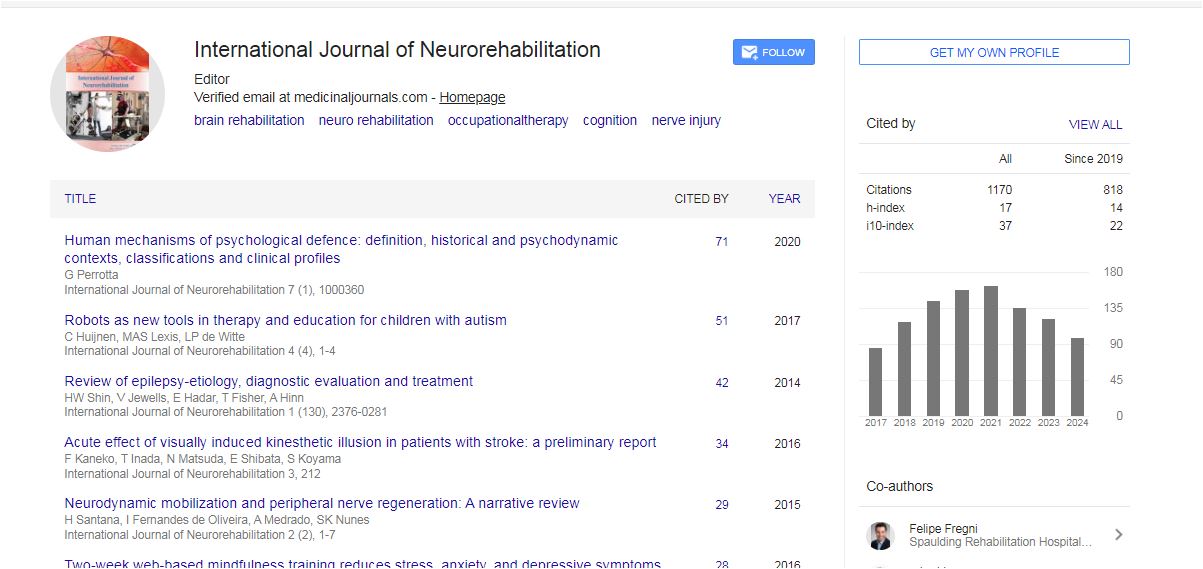
International Journal of Neurorehabilitation received 1078 citations as per Google Scholar report