Opinion - (2025) Volume 9, Issue 3
Received: 01-Sep-2025, Manuscript No. rrms-25-175065;
Editor assigned: 03-Sep-2025, Pre QC No. P-175065;
Reviewed: 17-Sep-2025, QC No. Q-175065;
Revised: 22-Sep-2025, Manuscript No. R-175065;
Published:
29-Sep-2025
, DOI: 10.37421/2952-8127.2025.9.227
Citation: Petrova, Elena. ”Health Policy: Evolution, Challenges, Opportunities.” Res Rep Med Sci 09 (2025):227.
Copyright: © 2025 Petrova E. This is an open-access article distributed under the terms of the Creative Commons Attribution License, which permits unrestricted use, distribution and reproduction in any medium, provided the original author and source are credited.
Contemporary discussions in global health policy consistently underscore the intricate challenges and opportunities inherent in establishing robust governance structures to effectively manage complex, cross-border health threats. The discourse often emphasizes the indispensable role of political will, synchronized international cooperation, and adaptable legal frameworks as foundational elements for securing global health and fostering equity in an ever-evolving world [1].
Beyond the global scope, the pursuit of universal health coverage (UHC) within the broader framework of the Sustainable Development Goals is presented as a demanding endeavor that necessitates not just technical solutions, but profoundly significant political commitment. Analyses reveal persistent discrepancies between ambitious policy intentions and their actual implementation, highlighting that substantial financing, equitable access to services, and resilient primary healthcare systems are absolutely pivotal for achieving genuine progress towards UHC [2].
In a rapidly advancing technological landscape, digital health policy emerges as a critical and new frontier for public health. Policies must dynamically adapt to fully harness the transformative potential of digital technologies in various aspects, including healthcare delivery, sophisticated public health surveillance, and impactful health promotion initiatives. Simultaneously, these policies must diligently mitigate inherent risks related to data privacy, ensure equity in access, and cater to the diverse needs of various population groups [3].
The escalating health impacts stemming from climate change necessitate a comprehensive re-evaluation of global health policy. A thorough review of the current landscape identifies an urgent imperative for integrated, multi-sectoral policies that proactively prioritize health adaptation strategies and robust mitigation efforts across all national and international governance levels. The overarching goal remains to provide robust protection for the most vulnerable populations affected by environmental shifts [4].
Critically assessing mental health policy, particularly within low-income and middle-income countries, reveals a crucial shift in focus from mere policy formulation to the more challenging realm of effective implementation. It is strongly argued that successful mental health outcomes are inextricably linked to the presence of robust policy frameworks that are adequately supported by sufficient resources, a well-trained workforce, and active community engagement, all essential for surmounting systemic barriers to care [5].
Within the United States, a detailed review of health equity policies and their tangible progress identifies key policy levers, notably interventions addressing social determinants of health. The effectiveness of these measures in reducing systemic health disparities is evaluated, leading to a strong advocacy for holistic, multi-sectoral approaches and a sustained political commitment to genuinely advance health equity across the nation [6].
Further, the systematic review of pharmaceutical policies is instrumental in understanding how to improve the affordability and widespread access to essential medicines. Evidence is synthesized on a range of policy interventions, including strategic pricing controls, efficient procurement strategies, and the vigorous promotion of generic drugs. This synthesis provides invaluable insights into identifying which policies are most effective in carefully balancing the imperative for pharmaceutical innovation with the public's fundamental right to access essential medicines [7].
A fundamental argument for achieving universal health coverage firmly rests on strengthening primary health care as its core pillar. Policies must unequivocally prioritize significant investment in comprehensive primary care services, robust workforce development initiatives, and the implementation of integrated care models. These strategic efforts are designed to ensure the delivery of equitable, accessible, and truly comprehensive healthcare for all population segments [8].
Addressing the challenges posed by an aging global population, health policy discussions center on the imperative for adaptive policies that support healthy aging, effectively manage the rise of chronic diseases, guarantee access to long-term care facilities, and actively promote social inclusion for older adults. The emphasis here is on proactive, person-centered approaches that cater to the evolving needs of this demographic [9].
Finally, drawing crucial lessons from the profound experience of the COVID-19 pandemic significantly informs future health policy responses to public health emergencies. The pandemic underscored the critical need for resilient health systems, transparent and clear communication strategies, strong global coordination mechanisms, and flexible legal and regulatory frameworks. These elements are vital for effectively managing and mitigating the widespread impact of any future public health crises [10].
The landscape of contemporary health policy is characterized by a complex interplay of global challenges and localized imperatives, all aiming to foster healthier populations and ensure equitable access to care. One pervasive theme across various analyses is the critical need for robust governance structures and unwavering political will to navigate intricate health threats and drive meaningful progress. For instance, global health policy faces persistent challenges in establishing effective governance, emphasizing that political commitment, international collaboration, and flexible legal frameworks are fundamental for global health security and equity [1]. This sentiment is echoed in the pursuit of universal health coverage (UHC) within the Sustainable Development Goals framework, which explicitly demands substantial political will, beyond mere technical solutions, to bridge gaps between policy intentions and actual implementation [2].
A significant focus within health policy discourse is dedicated to strengthening foundational elements of healthcare delivery. The argument for strengthening primary health care, in particular, emerges as a fundamental pillar for achieving universal health coverage. Policies must strategically prioritize investment in primary care services, foster robust workforce development, and implement integrated care models to ensure equitable, accessible, and comprehensive healthcare for all populations [8]. Similarly, mental health policy in low-income and middle-income countries requires a critical shift from mere formulation to effective implementation, highlighting that successful outcomes depend on strong policy frameworks backed by sufficient resources, a trained workforce, and active community engagement to overcome systemic barriers [5]. These areas collectively emphasize that policy effectiveness is often contingent on tangible support and dedicated execution.
Emerging frontiers in health policy reflect the rapidly changing global environment. Digital health policy, for example, is identified as an essential new frontier for public health, where policies must adapt to harness the vast potential of digital technologies in healthcare delivery, public health surveillance, and health promotion. Concurrently, these policies must diligently mitigate associated risks related to data privacy, ensure equity, and enhance access for diverse populations [3]. In parallel, the escalating health impacts of climate change necessitate a comprehensive review of health policy. This area calls for integrated, multisectoral policies that prioritize health adaptation and mitigation strategies across national and international governance levels to safeguard vulnerable populations [4]. Both digital health and climate change demonstrate the evolving nature of public health challenges and the corresponding need for adaptive policy responses.
Moreover, specific policy interventions are crucial for addressing disparities and ensuring accessibility. Pharmaceutical policies, for example, are systematically reviewed to improve medicine affordability and access. The evidence synthesizes various interventions, including pricing controls, procurement strategies, and the promotion of generic drugs, offering vital insights into balancing innovation with public access to essential medicines [7]. In the United States, a review of health equity policies and progress identifies key policy levers, such as social determinants of health interventions, and advocates for multisectoral approaches and sustained political commitment to advance health equity and reduce disparities [6]. These examples illustrate targeted policy efforts to tackle specific systemic issues.
Finally, the invaluable lessons learned from significant global events like the COVID-19 pandemic critically inform future health policy. The pandemic highlighted the urgent need for resilient health systems, clear communication strategies, robust global coordination, and flexible legal and regulatory frameworks to effectively manage and mitigate the impact of future public health emergencies [10]. Furthermore, as global demographics shift, health policy for an aging population poses unique challenges and opportunities. Policies must adapt to support healthy aging, manage chronic diseases, ensure access to long-term care, and promote social inclusion for older adults, advocating for proactive, person-centered approaches [9]. These overarching themes collectively underscore the dynamic, multi-faceted nature of health policy and its critical role in shaping public well-being.
The provided data offers a comprehensive overview of critical areas within health policy, highlighting persistent challenges and emerging opportunities across global, national, and specific health domains. Key themes include the crucial role of robust governance, political will, and international cooperation for global health security and universal health coverage [1, 2]. The importance of effective implementation, particularly for mental health policies in lower-income countries, and the need for significant investment in primary healthcare are emphasized [5, 8]. The evolving landscape of health policy also addresses new frontiers like digital health, which demands adaptable policies to leverage technology while mitigating risks [3], and climate change, which requires integrated, multisectoral approaches for adaptation and mitigation [4]. Further discussions cover strategies for enhancing health equity, such as addressing social determinants in the United States [6], and pharmaceutical policies aimed at improving medicine affordability and access [7]. The impact of demographic shifts, like an aging population, necessitates proactive, person-centered health policies [9]. Finally, lessons from public health emergencies, exemplified by COVID-19, underscore the need for resilient health systems, clear communication, and strong global coordination for future crises [10]. This collection collectively illustrates the multi-faceted nature of health policy, its constant evolution, and the imperative for sustained commitment to address complex health challenges worldwide.
None
None
Lawrence OG, Alexandra LP, Thomas DK. "Global health policy: Challenges and opportunities for strengthening governance".Lancet Glob Health 8 (2020):e7-e8.
Indexed at, Google Scholar, Crossref
Margaret EK, Anna DG, Catherine A. "Universal health coverage in the era of sustainable development goals: a call for political will".Lancet Glob Health 8 (2020):e458-e460.
Indexed at, Google Scholar, Crossref
Sherry AG, Michael SL, Mark F. "Digital health policy: a new frontier for public health".Milbank Q 99 (2021):1-13.
Indexed at, Google Scholar, Crossref
Marina R, Claudia DN, Paul D. "Climate change and health policy: a review of the global landscape".Lancet Planet Health 6 (2022):e791-e824.
Indexed at, Google Scholar, Crossref
Mark S, Gamou A, Rose K. "Mental health policy in low-income and middle-income countries: beyond policy to implementation".Lancet Psychiatry 8 (2021):74-80.
Indexed at, Google Scholar, Crossref
Steven HW, Paula AB, Jonathan SM. "Health equity in the United States: A review of policies and progress".JAMA 329 (2023):1845-1859.
Indexed at, Google Scholar, Crossref
Samuel MB, Rasheda AK, An TH. "Pharmaceutical policies to improve affordability and access to medicines: A systematic review".Health Policy 125 (2021):441-450.
Indexed at, Google Scholar, Crossref
Rifat A, Margaret EK, Adeiza A. "Strengthening primary health care: a key pillar for universal health coverage".Lancet Glob Health 9 (2021):e1209-e1210.
Indexed at, Google Scholar, Crossref
Robert NB, Phyllis RK, Daniel CM. "Health policy for an aging population: Challenges and opportunities".J Am Geriatr Soc 68 (2020):S3-S10.
Indexed at, Google Scholar, Crossref
Lawrence OG, Deborah AS, Alexandra LP. "Responding to public health emergencies: Lessons from COVID-19 for health policy".Lancet 397 (2021):351-353.
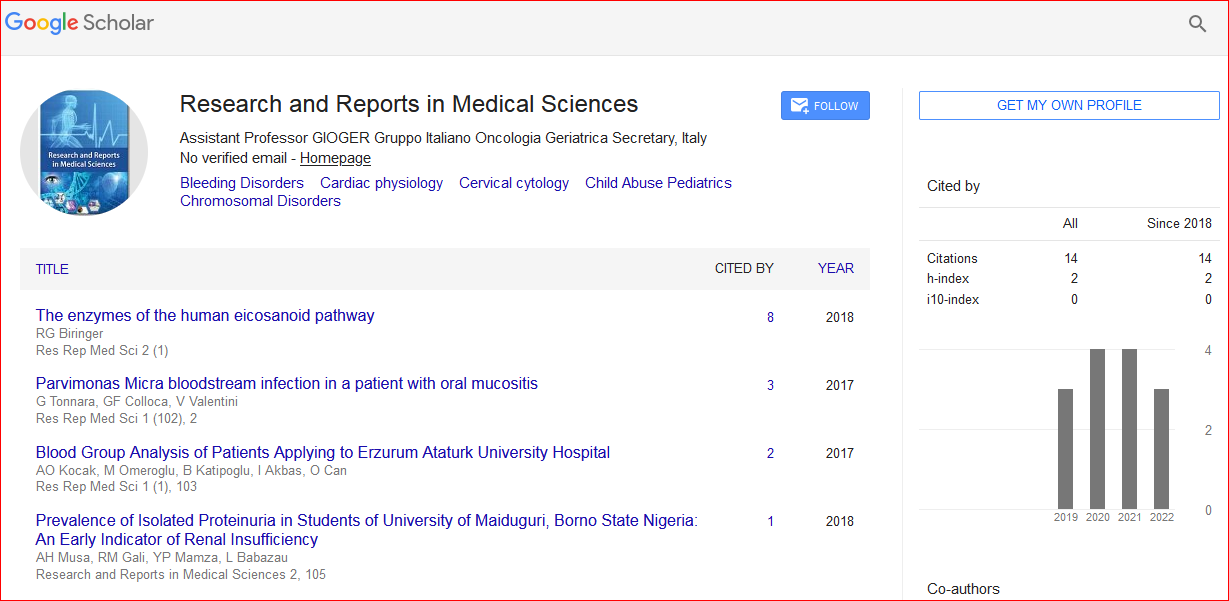
Research and Reports in Medical Sciences received 13 citations as per Google Scholar report