Short Communication - (2025) Volume 8, Issue 3
Received: 01-Sep-2025, Manuscript No. pollution-25-176610;
Editor assigned: 03-Sep-2025, Pre QC No. P-176610;
Reviewed: 17-Sep-2025, QC No. Q-176610;
Revised: 22-Sep-2025, Manuscript No. R-176610;
Published:
29-Sep-2025
, DOI: 10.37421/2684-4958.2025.8.389
Citation: AlMazrouei, Ahmed. ”Green Technologies: Essential for Global Sustainability.” Pollution 08 (2025):389.
Copyright: © 2025 AlMazrouei A. This is an open-access article distributed under the terms of the Creative Commons Attribution License, which permits unrestricted use,
distribution and reproduction in any medium, provided the original author and source are credited.
Green technologies are central to addressing global environmental challenges. For example, the role of green technologies in achieving sustainable waste management goals, focusing on innovative approaches for waste reduction, reuse, recycling, and energy recovery, emphasizing their environmental and economic benefits and contributions to a circular economy [1].
Beyond waste management, green technologies are crucial for energy generation and environmental protection. This includes comprehensive assessments of various green technologies covering solar, wind, biomass, and geothermal energy, along with discussions on their integration challenges and future prospects in the global energy transition [2].
Integrating green technologies into broader sustainable development strategies is also vital. A roadmap outlines key areas such as renewable energy, resource efficiency, and pollution control, underscoring their potential to foster ecological balance and economic growth [3].
Addressing climate change directly involves advanced green technologies. Recent developments in carbon dioxide capture and utilization, for instance, highlight innovative materials and processes that offer enhanced efficiency and reduced environmental impact, which are essential for mitigating climate change and achieving decarbonization goals [4].
In agriculture, green technologies promote sustainable food production. Practices like precision farming, organic agriculture, and bio-pesticides are explored, all aimed at reducing environmental impact and enhancing resource efficiency in this critical sector [5].
Water sustainability also benefits immensely from green innovations. Cutting-edge green technologies for wastewater treatment, including phytoremediation, advanced oxidation processes, and membrane bioreactors, demonstrate efficiency in removing pollutants and contribute significantly to water sustainability and resource recovery [6].
Furthermore, green technologies are advancing the production of sustainable biofuels. Latest advancements cover various feedstocks and conversion pathways, with assessments of their environmental implications and potential contributions to energy security and reduced carbon emissions [7].
Sustainable manufacturing is another area where green technologies play a pivotal role. An overview highlights process intensification, material substitution, and waste valorization, all aiming to reduce the environmental footprint and enhance industrial sustainability and circularity [8].
The realm of renewable energy systems sees significant progress in green technologies for solar energy conversion and storage. This includes photovoltaics, solar fuels, and thermal storage, with discussions on their efficiency, stability, and integration challenges for widespread adoption [9].
Finally, significant advancements are happening in green hydrogen production technologies. This involves electrolysis using renewable energy sources and photocatalytic water splitting, with evaluations of their efficiency, cost-effectiveness, and potential for decarbonizing various sectors [10].
The imperative for green technologies stems from the global need for sustainable practices across diverse sectors. For example, sustainable waste management critically relies on green technologies, which offer innovative methods for waste reduction, reuse, recycling, and energy recovery. These approaches deliver significant environmental and economic benefits, contributing directly to a robust circular economy [1].
Beyond waste, green technologies are pivotal for transforming energy generation and ensuring environmental protection. Comprehensive reviews assess various green technologies, including solar, wind, biomass, and geothermal energy, addressing their integration challenges and future prospects in the global energy transition [2]. These technologies form a core part of broader sustainable development strategies, with a roadmap highlighting renewable energy, resource efficiency, and pollution control as crucial areas. Such integration fosters ecological balance and economic growth [3].
Mitigating climate change is a key application area for green technologies, particularly in carbon dioxide capture and utilization. Recent advances focus on innovative materials and processes that enhance efficiency and reduce environmental impact, playing a vital role in decarbonization efforts [4]. Additionally, in the agricultural sector, green technologies are crucial for sustainable food production. Practices like precision farming, organic agriculture, and bio-pesticides are employed to minimize environmental footprint and maximize resource efficiency [5].
Water resource management benefits significantly from green technological advancements. Cutting-edge green technologies for wastewater treatment, such as phytoremediation, advanced oxidation processes, and membrane bioreactors, effectively remove pollutants. This directly promotes water sustainability and resource recovery [6]. Similarly, green technologies are advancing the production of sustainable biofuels. Research covers diverse feedstocks and conversion pathways, evaluating their environmental impacts and contributions to energy security and reduced carbon emissions [7].
In the industrial sphere, green technologies facilitate sustainable manufacturing by focusing on process intensification, material substitution, and waste valorization. These efforts aim to reduce the environmental footprint while enhancing industrial sustainability and circularity [8]. Further, the energy landscape is being reshaped by progress in green technologies for solar energy conversion and storage, encompassing photovoltaics, solar fuels, and thermal storage. Discussions around their efficiency, stability, and integration challenges are critical for widespread adoption in renewable energy systems [9]. A major focus also lies on green hydrogen production, with recent advancements in electrolysis using renewable energy and photocatalytic water splitting. These technologies are evaluated for their efficiency, cost-effectiveness, and potential to decarbonize various sectors [10].
Green technologies are essential for achieving global sustainability goals across various critical sectors. These innovations tackle challenges ranging from waste management, focusing on reduction, reuse, recycling, and energy recovery, to transforming energy generation with renewable sources like solar, wind, biomass, and geothermal. Green technologies also play a vital role in broader sustainable development strategies, emphasizing resource efficiency and pollution control to foster ecological balance and economic growth. Key advancements include sophisticated methods for carbon dioxide capture and utilization, crucial for climate change mitigation and decarbonization. In agriculture, green technologies promote sustainable food production through practices like precision farming and bio-pesticides, reducing environmental impact. Innovations extend to wastewater treatment, employing techniques such as phytoremediation and membrane bioreactors for pollutant removal and water recovery. The development of sustainable biofuels, utilizing diverse feedstocks, contributes to energy security and lower carbon emissions. Furthermore, green technologies are integral to sustainable manufacturing, promoting process intensification and waste valorization for reduced environmental footprints. Significant progress is also evident in solar energy conversion and storage, including photovoltaics and solar fuels, and in green hydrogen production via electrolysis and photocatalytic water splitting, offering pathways to decarbonize multiple industries. Collectively, these technological advancements underscore a commitment to environmental protection, resource efficiency, and the establishment of a circular economy for a more sustainable future.
None
None
Indexed at, Google Scholar, Crossref
Indexed at, Google Scholar, Crossref
Indexed at, Google Scholar, Crossref
Indexed at, Google Scholar, Crossref
Indexed at, Google Scholar, Crossref
Indexed at, Google Scholar, Crossref
Indexed at, Google Scholar, Crossref
Indexed at, Google Scholar, Crossref
Indexed at, Google Scholar, Crossref
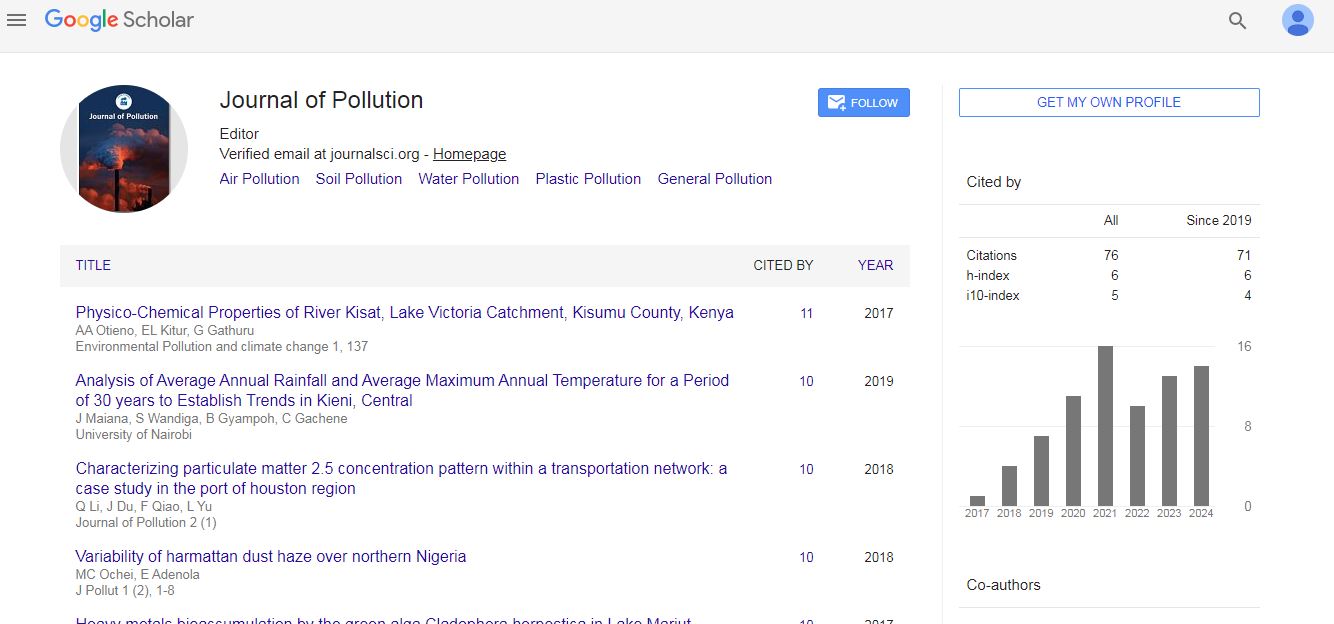
Journal of Pollution received 64 citations as per Google Scholar report