Commentary - (2025) Volume 10, Issue 4
Received: 01-Aug-2025, Manuscript No. arwm-26-182722;
Editor assigned: 04-Aug-2025, Pre QC No. P-182722;
Reviewed: 18-Aug-2026, QC No. Q-182722;
Revised: 22-Aug-2025, Manuscript No. R-182722;
Published:
29-Aug-2025
Citation: Silva, Jorge. ”Sustainable Metal Recovery from Industrial Waste Streams.” Adv Recycling Waste Manag 10 (2025):412.
Copyright: © 2025 Silva J. This is an open-access article distributed under the terms of the Creative Commons Attribution License, which permits unrestricted use, distribution and reproduction in any medium, provided the original author and source are credited.
The growing global demand for resources and the increasing generation of industrial waste necessitate the development of efficient and sustainable methods for recovering valuable materials. Significant efforts are being directed towards extracting metals from diverse waste streams, thereby promoting a circular economy and mitigating environmental impact. One area of focus is the advancement of techniques for recovering valuable metals from electronic waste, which often contains a complex mixture of valuable and hazardous components. These methods aim to enhance recovery efficiency and reduce the ecological footprint associated with traditional disposal [1].
Printed circuit boards (PCBs) are a particularly rich source of valuable metals, including copper, gold, silver, and palladium. Research into selective leaching agents has shown promise in efficiently extracting these metals while minimizing the dissolution of unwanted matrix materials. Optimizing process parameters such as temperature, pH, and reagent concentration is crucial for maximizing metal recovery and obtaining high-purity products [2].
Traditional methods for recovering precious metals from electronic waste often involve hazardous chemicals like cyanide. However, more environmentally friendly alternatives are being explored, such as electro-dissolution techniques. These electrochemical approaches can operate at ambient temperatures and generate fewer hazardous byproducts, offering a greener pathway for precious metal recovery, including gold and silver [3].
Beyond electronic waste, other industrial byproducts also present opportunities for metal recovery. Phosphogypsum, a major waste product from phosphate fertilizer production, has been identified as a potential source of rare earth elements (REEs). Developing methods for selective leaching and precipitation of REEs from phosphogypsum is essential for both waste valorization and securing critical raw material supply chains [4].
Spent lithium-ion batteries are another significant waste stream containing valuable metals like cobalt and nickel. Bio-hydrometallurgical processes, utilizing microbial consortia to leach these metals, are emerging as a sustainable and less energy-intensive alternative to conventional chemical methods. Understanding the kinetics and influencing factors of bioleaching is key to optimizing these processes [5].
Industrial effluents often contain dissolved metals that can be harmful to the environment if not properly managed. Ion exchange resins offer a versatile solution for the recovery of metals from such wastewater. The selection of appropriate resins and the optimization of adsorption and desorption processes are critical for effective metal management and achieving high recovery rates [6].
Steel slag, a byproduct of steel manufacturing, can also be a valuable source of metals such as copper and zinc. Techniques like ultrasonic-assisted leaching have demonstrated the ability to significantly enhance mass transfer rates, leading to faster dissolution kinetics and improved metal recovery yields compared to conventional methods [7].
Platinum group metals (PGMs) are crucial for many industrial applications, particularly in automotive catalysts. Recovering PGMs from spent automotive catalysts presents both challenges and opportunities. Reviewing established pyrometallurgical and hydrometallurgical routes, alongside exploring novel extraction techniques, is vital for improving the economic viability and environmental performance of PGM recovery [8].
Deep eutectic solvents (DESs) are gaining attention as sustainable alternatives to traditional organic solvents for metal extraction. Their tunable solvation capabilities and low volatility make them promising for the selective extraction of valuable metals from various industrial waste streams, including copper and nickel [9].
Finally, integrated approaches are being developed for the simultaneous removal and recovery of heavy metals from complex industrial wastewater. Electrochemical membrane reactors, for instance, offer high removal efficiencies and produce concentrated metal solutions, facilitating further processing or recovery and addressing the challenges of heavy metal pollution [10].
The burgeoning field of industrial waste valorization is driven by the imperative to conserve resources and minimize environmental pollution. A comprehensive review of advancements in recovering valuable metals from diverse industrial waste streams highlights sustainable and cost-effective approaches. This includes progress in hydrometallurgical and pyrometallurgical techniques, alongside emerging bio-based processes, all aimed at reinforcing circular economy principles by enhancing recovery efficiency, reducing environmental impact, and facilitating metal reuse in manufacturing [1].
Within the realm of electronic waste management, the recovery of specific metals from spent printed circuit boards (PCBs) is a significant area of research. Investigations into selective leaching agents have demonstrated efficacy in the recovery of copper and other valuable metals. The optimization of process parameters, such as temperature, pH, and reagent concentration, is crucial for maximizing metal dissolution while minimizing the co-dissolution of undesired matrix components, with subsequent purification steps yielding high-purity metal products [2].
For precious metals like gold and silver, often found in electronic waste, electrochemical methods are emerging as environmentally superior alternatives to conventional cyanide-based leaching. An electro-dissolution approach, operating at ambient temperatures and producing fewer hazardous byproducts, offers a more sustainable recovery pathway. The efficiency of this process is closely examined in relation to factors such as current density and electrolyte composition [3].
Beyond e-waste, the recovery of critical raw materials from other industrial byproducts is gaining traction. Phosphogypsum, a substantial waste stream from the phosphate fertilizer industry, has been targeted for the recovery of rare earth elements (REEs). Evaluations of various acid leaching conditions and the proposal of selective precipitation methods contribute to the valorization of this industrial waste, thereby bolstering supply chains for essential REEs [4].
Circular economy principles are also being applied to the management of spent lithium-ion batteries, which contain valuable metals such as cobalt and nickel. Novel bio-hydrometallurgical processes, employing specific microbial consortia for metal leaching, present a more sustainable and less energy-intensive alternative to traditional chemical extraction methods. The kinetics and influencing factors of the bioleaching process are key areas of investigation [5].
Industrial wastewater treatment and metal recovery are often addressed through the application of ion exchange resins. A comprehensive review details the use of these resins for recovering metals from industrial effluents, covering resin selection, optimization of adsorption and desorption processes, and strategies for handling complex waste matrices to promote sustainable metal management [6].
The recovery of valuable metals from materials like steel slag is also being explored. Ultrasonic-assisted leaching, for instance, has shown significant promise in enhancing the recovery of copper and zinc from slag. The application of ultrasound markedly improves mass transfer rates, leading to accelerated dissolution kinetics and superior metal recovery yields compared to conventional stirring techniques. Process parameters such as power intensity and duration are key considerations [7].
Platinum group metals (PGMs), vital for various high-tech applications, are often found in spent automotive catalysts. The recovery of these precious metals is reviewed, examining established pyrometallurgical and hydrometallurgical routes. Furthermore, the potential of novel extraction techniques, including solvent extraction and selective precipitation, is discussed for their role in enhancing the economic feasibility and reducing the environmental impact of PGM recovery [8].
Deep eutectic solvents (DESs) are emerging as promising green solvents for metal recovery from industrial waste. Their unique properties, such as low volatility and tunable solvation capabilities, allow for selective extraction of metals like copper and nickel from simulated waste streams, offering an alternative to conventional organic solvents [9].
Finally, integrated technological solutions are being developed for the simultaneous removal and recovery of heavy metals from complex industrial wastewater. Electrochemical membrane reactors, for example, demonstrate high removal efficiencies and yield concentrated metal solutions suitable for further processing, effectively addressing the dual challenge of wastewater remediation and resource recovery [10].
This collection of research explores advanced methods for recovering valuable metals from various industrial waste streams, emphasizing sustainability and cost-effectiveness. Techniques discussed include hydrometallurgy, pyrometallurgy, bioleaching, electrochemistry, and the use of specialized solvents and resins. Specific waste sources examined are electronic waste, spent lithium-ion batteries, phosphogypsum, industrial effluents, steel slag, and automotive catalysts. The overarching goal is to promote circular economy principles by improving metal recovery efficiencies, minimizing environmental impact, and enabling the reuse of recovered materials in manufacturing processes. The research highlights the development of selective extraction methods, optimization of process parameters, and the creation of greener, less hazardous alternatives to traditional metal recovery techniques.
None
None
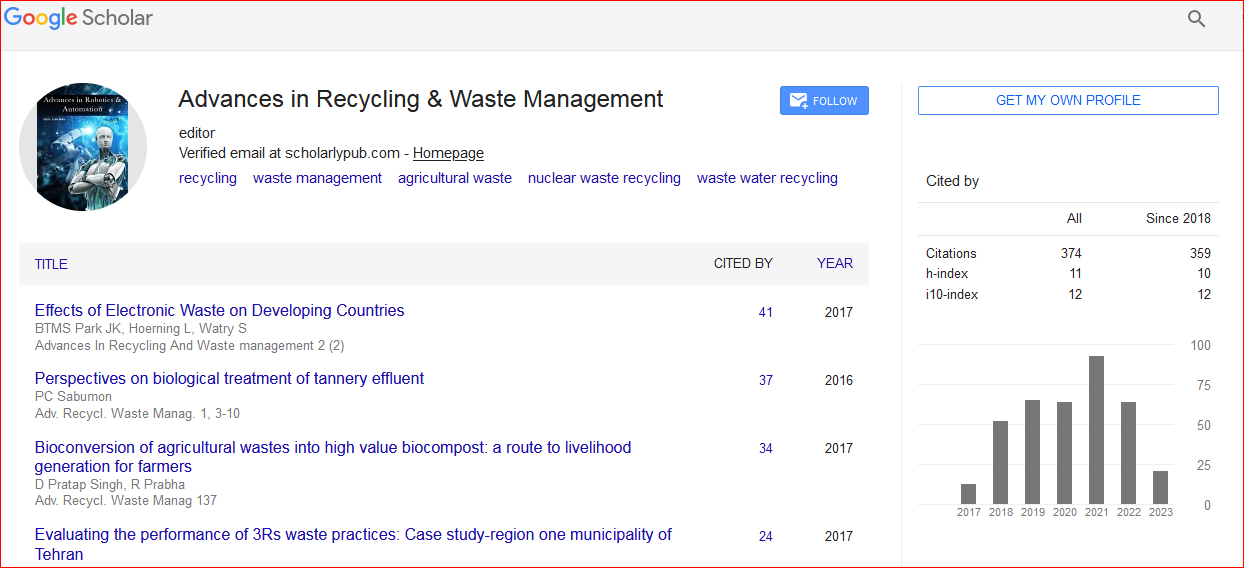
Advances in Recycling & Waste Management received 438 citations as per Google Scholar report