Perspective - (2025) Volume 10, Issue 6
Received: 01-Nov-2025, Manuscript No. jfm-26-183011;
Editor assigned: 03-Nov-2025, Pre QC No. P-183011;
Reviewed: 17-Nov-2025, QC No. Q-183011;
Revised: 24-Nov-2025, Manuscript No. R-183011;
Published:
29-Nov-2025
, DOI: 10.37421/2472-1026.2025.10.448
Citation: Bianchi, Matteo. ”Forensic Sharp Force Injury Interpretation: A Comprehensive Analysis.” J Forensic Med 10 (2025):448.
Copyright: © 2025 Bianchi M. This is an open-access article distributed under the terms of the Creative Commons Attribution License, which permits unrestricted use, distribution and reproduction in any medium, provided the original author and source are credited.
The forensic interpretation of sharp force injuries is a complex and critical area within forensic pathology, demanding meticulous analysis of both clinical observations and autopsy findings. The intricate relationship between the characteristics of wounds and the implements that caused them forms the cornerstone of investigations into violent acts. Understanding these nuances is paramount for reconstructing events and identifying potential assailants, as highlighted by detailed examinations of wound dimensions, depth, and margins in sharp force injuries, which correlate with weapon characteristics. [1] The biomechanical properties of various materials, particularly clothing, significantly influence the appearance and depth of sharp force trauma. The resistance and tear patterns of textiles can alter the morphology of wounds, thereby complicating the interpretation of autopsy findings. Research in this domain provides valuable data for distinguishing between different types of blades and estimating the forces involved in stabbing incidents. [2] A specific aspect of sharp force injuries that warrants careful examination is the presence of hesitation marks. These superficial injuries can be crucial in differentiating between self-inflicted wounds and those inflicted by others. Detailed microscopic examination is vital for accurately identifying and interpreting these subtle yet significant forensic indicators. [3] The morphological differentiation of stab wounds based on the type of knife used is another area of extensive research. Comparative analyses of wound dimensions, shape, and internal characteristics aid in weapon identification. This underscores the necessity of meticulous autopsy documentation for effective forensic casework. [4] Assessing the reliability of wound depth measurements in determining the length of a penetrating object presents considerable challenges. Variability introduced by soft tissue elasticity and the presence of clothing can lead to discrepancies between external wound measurements and the actual dimensions of the weapon. Consequently, the advocacy for standardized protocols in autopsy examinations is crucial. [5] Distinguishing between incised wounds and stab wounds is a fundamental task in forensic pathology. Incised wounds, characterized by slicing actions, possess distinct features such as length, width, and margins. Careful analysis of these characteristics assists in reconstructing the sequence of events and identifying the type of implement used. [6] The effect of the post-mortem interval on the appearance of sharp force injuries is a significant consideration. Tissue decomposition and autolytic changes can alter wound morphology, potentially impacting interpretation. Guidelines for assessing the reliability of wound characteristics at different post-mortem times are essential for accurate forensic analysis. [7] Advanced imaging techniques, including CT scanning and digital radiography, are increasingly utilized in the post-mortem assessment of sharp force injuries. These technologies offer detailed three-dimensional information about wound trajectories and internal damage, thereby aiding in reconstruction and weapon characterization. [8] Defense wounds, sustained by victims while attempting to protect themselves, carry significant forensic implications. Analyzing their typical locations, patterns, and characteristics is vital for reconstructing the dynamics of an attack. Recognizing these wounds aids in understanding the interaction between the assailant and the victim. [9] The field of forensic interpretation of sharp force injuries is continuously evolving, addressing challenges and incorporating advancements. The integration of morphological analysis, biomechanical principles, and digital tools enhances accuracy in wound assessment and weapon identification. Continuous research and training are imperative for progress in this specialized domain. [10]
The forensic investigation of sharp force injuries relies heavily on the correlation between clinical observations and autopsy findings, emphasizing the detailed examination of wound characteristics such as dimensions, depth, and margins to infer details about the weapon used. This systematic approach is fundamental for reconstructing events and potentially identifying assailants. [1] A critical factor influencing the interpretation of stab wounds is the biomechanical interaction between the weapon, clothing, and the body. The properties of different fabrics, including their resistance and tearing patterns, can significantly alter the appearance and depth of sharp force trauma, presenting challenges in distinguishing between various blades and estimating applied forces. [2] In the analysis of sharp force injuries, the presence and characteristics of hesitation marks are particularly important. These superficial wounds can serve as a key differentiator between self-inflicted injuries and those inflicted by another person. Precise microscopic examination is indispensable for the accurate identification and interpretation of these subtle but crucial forensic markers. [3] Comparative studies focusing on the morphological differences between stab wounds inflicted by single-edged versus double-edged knives are essential for forensic casework. By analyzing variations in wound dimensions, shape, and internal morphology, forensic pathologists can gain insights into the nature of the weapon. This highlights the imperative for thorough and detailed autopsy documentation. [4] The reliability of measuring wound depth to ascertain the length of a penetrating object is often compromised by factors such as soft tissue elasticity and the presence of clothing. These variables can introduce discrepancies between external measurements and the actual dimensions of the weapon, leading to the need for standardized examination protocols. [5] Forensic pathologists must adeptly distinguish between incised wounds, produced by slicing actions, and stab wounds. The specific characteristics of incised wounds, including their length, width, and the nature of their margins, provide vital clues for reconstructing the sequence of events and identifying the type of implement employed. [6] The impact of the post-mortem interval on the appearance of sharp force injuries is a crucial consideration, as decomposition and autolytic changes can modify wound morphology. Understanding these alterations is vital for accurate interpretation, and guidelines are needed to assess the reliability of wound characteristics over time. [7] Advanced imaging modalities, such as computed tomography (CT) and digital radiography, are proving invaluable in the post-mortem evaluation of sharp force injuries. These technologies provide detailed three-dimensional data on wound trajectories and internal damage, significantly enhancing the capabilities for reconstruction and weapon characterization. [8] Defense wounds, typically observed on the extremities of victims attempting to ward off an attack, are critical indicators in sharp force injury cases. Their characteristic locations, patterns, and morphology assist in reconstructing the dynamics of the assault and understanding the interaction between the victim and the assailant. [9] The forensic interpretation of sharp force injuries benefits from the integration of multiple analytical approaches, including morphological examination, biomechanical principles, and advanced digital tools. Ongoing research and continuous professional development are essential to address the inherent challenges and advance the accuracy of wound assessment and weapon identification in this field. [10]
This collection of research explores various facets of forensic interpretation of sharp force injuries. Studies delve into the correlation between clinical and autopsy findings, the impact of textile properties on wound characteristics, and the differentiation of self-inflicted versus inflicted wounds using hesitation marks. The morphological analysis of stab wounds inflicted by different types of knives, the reliability of wound depth measurements, and the distinction between incised and stab wounds are also examined. Furthermore, the influence of the post-mortem interval on wound appearance, the application of advanced imaging techniques for injury assessment, and the significance of defense wounds are discussed. The research collectively emphasizes the importance of meticulous examination, standardized protocols, and integrated analytical approaches for accurate wound interpretation and weapon identification in forensic investigations.
None
None
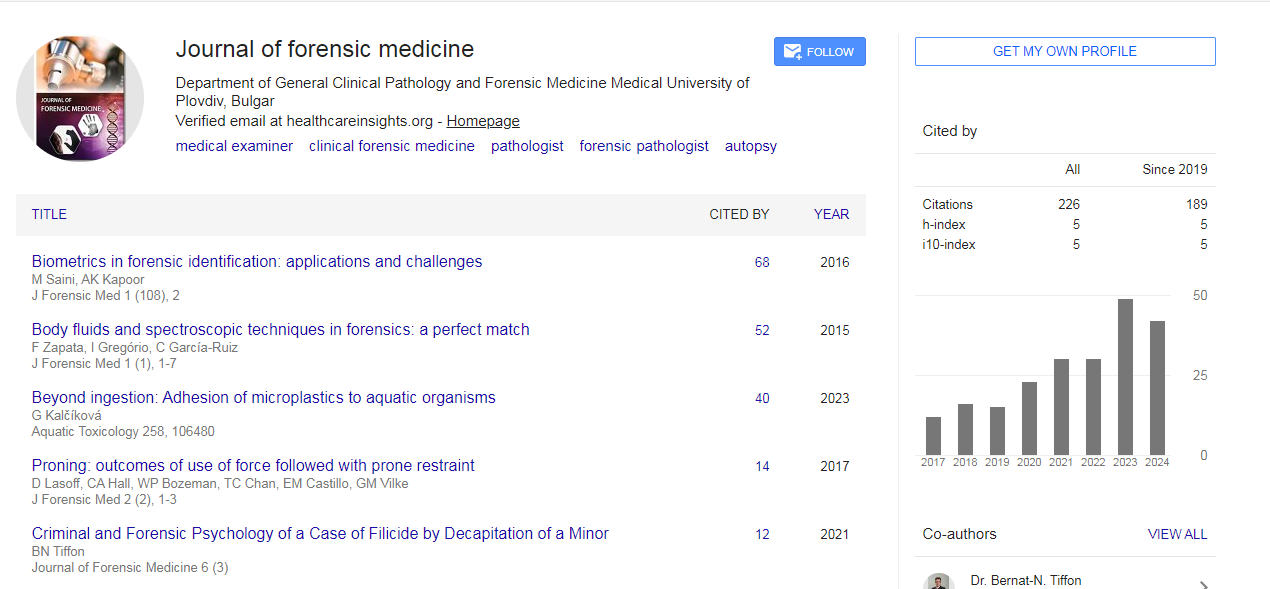
Journal of Forensic Medicine received 165 citations as per Google Scholar report