Perspective - (2025) Volume 12, Issue 5
Received: 02-Oct-2025, Manuscript No. fmoa-26-187943;
Editor assigned: 06-Oct-2025, Pre QC No. P-187943;
Reviewed: 20-Oct-2025, QC No. Q-187943;
Revised: 23-Oct-2025, Manuscript No. R-187943;
Published:
30-Oct-2025
, DOI: 10.37421/2476-2296.2025.12.357
Citation: Kim, Jong-Hoon. ”Flow Instabilities in Gas-Liquid Systems: Mechanisms and Prediction.” Fluid Mech Open Acc 12 (2025):357.
Copyright: © 2025 Kim J. This is an open-access article distributed under the terms of the Creative Commons Attribution License, which permits unrestricted use, distribution and reproduction in any medium, provided the original author and source are credited.
Flow instabilities in gas-liquid systems are a complex and critical area of study with broad implications across various engineering disciplines. These phenomena arise from the intricate interactions between gas and liquid phases, leading to dynamic behaviors that are crucial to understand for safe and efficient operation of many industrial processes. This introduction will explore the foundational aspects of these instabilities, drawing upon recent research to provide a comprehensive overview. The intricate interplay between gas and liquid phases in multiphase flows is the genesis of flow instabilities, a subject that demands rigorous investigation for numerous engineering applications. Such instabilities, manifesting as phenomena like slugging, churning, and annular flow transitions, are driven by a complex interplay of physical mechanisms including interfacial waves, momentum exchange between phases, and pressure gradients within the system. Understanding the transition criteria between different flow regimes is paramount for accurate modeling and prediction in critical sectors such as oil and gas transport, nuclear reactor cooling, and chemical processing. The identification of dominant physical mechanisms is key to unraveling these complex dynamics [1].
The fundamental dynamics of interfacial waves play a pivotal role in instigating flow regime transitions within vertical upward gas-liquid flows. The growth and subsequent breakdown of these waves are directly implicated in the development of instabilities, most notably the transition from bubbly flow to slug flow. Advanced visualization techniques coupled with theoretical analysis are instrumental in quantifying wave characteristics and establishing their correlation with flow instability. A profound understanding of these wave phenomena is indispensable for accurately predicting the onset of chaotic flow patterns and optimizing system performance in processes characterized by dynamic gas-liquid interactions [2].
Investigating the influence of pipe inclination on flow instabilities in horizontal and near-horizontal gas-liquid flows reveals how alterations in gravitational forces significantly modify the development and progression of instabilities. This includes transitions between stratified, wavy, slug, and annular flow regimes. Empirical data and modeling insights into critical angles and conditions that either promote or suppress specific instability modes are vital for effective pipeline design and operational strategies within the oil and gas industry [3].
The application of computational fluid dynamics (CFD) has emerged as a powerful tool for simulating and analyzing flow instabilities in gas-liquid systems. Advanced numerical methods are employed to meticulously capture the complex interfacial dynamics and phase interactions that precipitate these instabilities. Validation of CFD models against experimental data demonstrates their robust capability in predicting flow regime transitions and characterizing the behavior of turbulent multiphase flows, thereby equipping engineers with potent tools for design and optimization [4].
The specific geometry of microscale systems, such as channel width and shape, exerts a significant influence on the development of flow instabilities in microscale gas-liquid environments. In these confined spaces, surface tension effects become dominant, leading to instability mechanisms that diverge from those observed in macroscale flows. These findings offer crucial insights for the design of microfluidic devices and their applications in lab-on-a-chip technologies, drug delivery systems, and microreactors, where precise control over multiphase flow is of utmost importance [5].
Fluid properties, including viscosity and surface tension, profoundly affect the onset and characteristics of flow instabilities in gas-liquid systems. Variations in these properties can substantially alter interfacial behavior and energy transfer mechanisms, thereby influencing the resulting flow regimes and instability patterns. These insights are critically important for the judicious selection of appropriate fluids and operating conditions in a wide array of industrial processes [6].
Dynamic instabilities encountered in boiling two-phase flows are a critical concern in heat transfer applications, particularly in power generation and refrigeration systems. The complex interplay between phase change, interfacial phenomena, and evolving flow patterns can lead to instabilities such as flow excursion and oscillations. Understanding these mechanisms is essential for preventing detrimental thermal-hydraulic instabilities and for devising effective mitigation strategies [7].
Turbulence exerts a notable influence on flow instabilities within gas-liquid systems. Turbulent fluctuations in both the gas and liquid phases can act as triggers or modifiers of instability mechanisms, leading to more intricate and less predictable flow behaviors. Advanced experimental techniques and sophisticated turbulence modeling are employed to quantify these effects, thereby enhancing the understanding required for designing turbulent multiphase flows [8].
The development of advanced sensors and diagnostic tools is crucial for the accurate characterization of flow instabilities in gas-liquid systems. Techniques such as high-speed imaging, particle image velocimetry (PIV), and electrical impedance tomography (EIT) enable real-time monitoring of interfacial dynamics and flow patterns. These advanced measurement capabilities are indispensable for validating theoretical models and deepening the comprehension of complex multiphase flow phenomena [9].
Finally, the compressibility of the gas phase introduces a significant factor influencing flow instabilities in gas-liquid systems, particularly in high-pressure applications. The degree of gas compressibility directly impacts the propagation of pressure waves, interfacial dynamics, and the overall stability characteristics of the two-phase flow. This research provides valuable insights pertinent to the design and operation of systems where gas compressibility is a dominant influence on flow behavior [10].
The study of flow instabilities in gas-liquid systems is a vital field for numerous engineering applications, as these phenomena dictate the behavior and efficiency of multiphase flows. Research has illuminated the fundamental mechanisms driving these instabilities, including the complex interplay of interfacial waves, momentum exchange, and pressure gradients. Identifying the dominant physical processes is crucial for understanding the transition criteria between various flow regimes, which is essential for accurate modeling and prediction in critical areas such as oil and gas transport, nuclear reactor cooling, and chemical processing. Hao-Ran Li et al. provide a comprehensive overview of the mechanisms and modeling of flow instabilities in gas-liquid two-phase flows, emphasizing the importance of experimental validation and advanced simulation techniques for characterizing and controlling these dynamic behaviors [1].
Interfacial wave dynamics are central to understanding flow regime transitions in vertical upward gas-liquid flows. The growth and breakdown of these waves are key contributors to instability, particularly the shift from bubbly to slug flow. Advanced visualization and theoretical analysis allow for quantification of wave characteristics and their correlation with instability. Kai-Tai Chang et al. explore these dynamics, highlighting their importance for predicting chaotic flow patterns and optimizing system performance in processes involving dynamic gas-liquid interactions [2].
The orientation of flow conduits significantly impacts gas-liquid instabilities. In horizontal and near-horizontal systems, pipe inclination alters gravitational forces, thereby affecting the development and progression of instabilities like stratified, wavy, slug, and annular flows. Jae-Hoon Kim et al. offer empirical data and modeling insights into the critical angles and conditions that govern these instability modes, which are crucial for the design and operation of oil and gas pipelines [3].
Computational Fluid Dynamics (CFD) has become an indispensable tool for analyzing gas-liquid flow instabilities. Advanced numerical methods are employed to capture intricate interfacial dynamics and phase interactions that lead to instabilities. Wei-Guo Huang et al. validate CFD models against experimental data, showcasing their effectiveness in predicting flow regime transitions and characterizing turbulent multiphase flows, thereby providing engineers with powerful tools for design and optimization [4].
In microscale gas-liquid systems, geometric factors like channel width and shape play a critical role in flow instability development. The confinement effects and dominant surface tension forces lead to distinct instability mechanisms compared to macroscale flows. Ling-Ling Zhang et al. investigate these influences, providing essential insights for the design of microfluidic devices used in lab-on-a-chip technologies, drug delivery, and microreactors where precise multiphase flow control is paramount [5].
Fluid properties, specifically viscosity and surface tension, exert a substantial influence on the onset and characteristics of flow instabilities in gas-liquid systems. Changes in these properties can significantly alter interfacial behavior and energy transfer mechanisms, leading to diverse flow regimes and instability patterns. Shun-Quan Yu et al. demonstrate how variations in fluid properties impact these phenomena, offering crucial guidance for selecting appropriate fluids and operating conditions in industrial processes [6].
Dynamic instabilities in boiling two-phase flows are of critical importance for heat transfer applications, such as power generation and refrigeration. The interplay between phase change, interfacial phenomena, and flow patterns can result in instabilities like flow excursion and oscillations. Qiang Li et al. examine these mechanisms and their consequences, providing insights into potential detrimental thermal-hydraulic instabilities and suggesting mitigation strategies [7].
Turbulence significantly affects flow instabilities in gas-liquid systems. Turbulent fluctuations in both phases can trigger or modify instability mechanisms, leading to more complex and unpredictable flow behaviors. Wen-Feng Li et al. analyze these effects using advanced experimental techniques and turbulence modeling, enhancing the understanding necessary for designing turbulent multiphase flows [8].
Accurate characterization of flow instabilities requires sophisticated experimental techniques. High-speed imaging, particle image velocimetry (PIV), and electrical impedance tomography (EIT) are among the advanced diagnostic tools used for real-time monitoring of interfacial dynamics and flow patterns. Zhong-Hua Chen et al. discuss these methods, emphasizing their importance for validating theoretical models and improving the comprehension of complex multiphase flow phenomena [9].
Gas compressibility is a key factor influencing flow instabilities, especially in high-pressure applications. The compressibility of the gas phase affects pressure waves, interfacial dynamics, and the overall stability of the two-phase flow. Jing-Bo Song et al. investigate the impact of gas compressibility, providing valuable insights for the design and operation of systems where this property significantly dictates flow behavior [10].
This collection of research addresses the critical topic of flow instabilities in gas-liquid systems, exploring their mechanisms, influencing factors, and methods of characterization and prediction. Studies investigate how interfacial dynamics, fluid properties, system geometry, turbulence, and gas compressibility contribute to flow regime transitions such as slugging and churning. Advanced techniques including computational fluid dynamics (CFD) and sophisticated experimental diagnostics like high-speed imaging and PIV are employed to analyze these complex phenomena. The research emphasizes the importance of understanding these instabilities for optimizing performance and ensuring safety in diverse engineering applications, ranging from oil and gas transport to microfluidics and heat transfer systems.
None
None
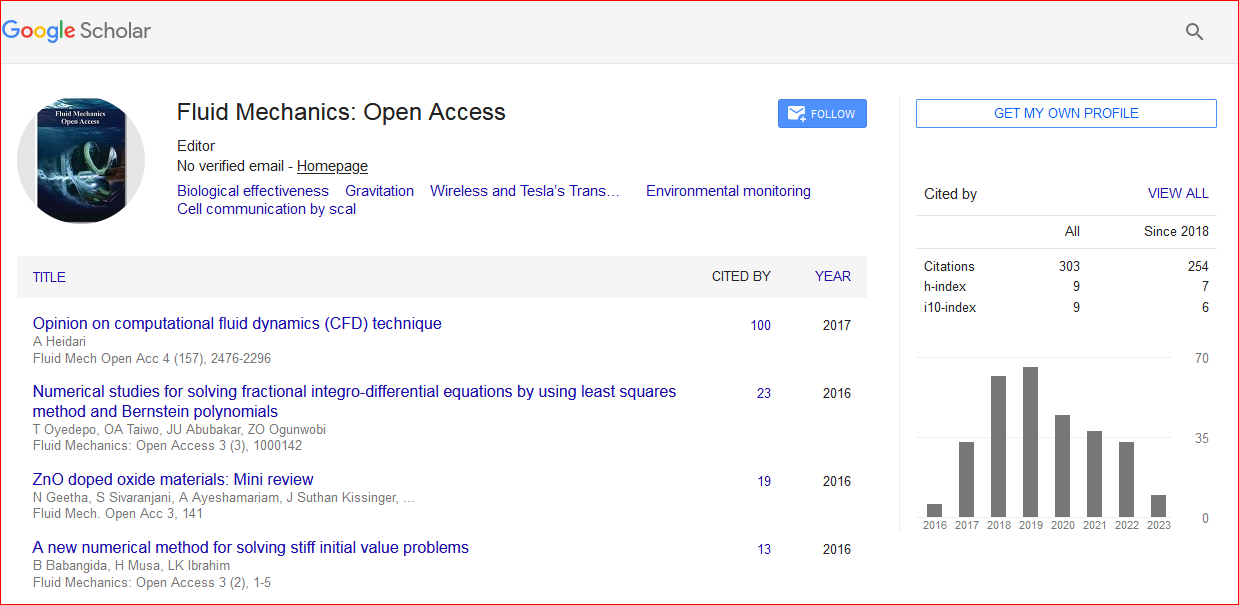
Fluid Mechanics: Open Access received 291 citations as per Google Scholar report