Perspective - (2024) Volume 7, Issue 3
Received: 20-Jul-2024, Manuscript No. POLLUTION-24-142596;
Editor assigned: 23-Jul-2024, Pre QC No. POLLUTION-24-142596 (PQ);
Reviewed: 06-Aug-2024, QC No. POLLUTION-24-142596;
Revised: 14-Apr-2025, Manuscript No. POLLUTION-24-142596 (R);
Published:
21-Apr-2025
, DOI: 10.37421/2684-4958.2025.8.370
Citation: Kang, Shiting. "Features of Aerosol Water Content and its Effect on the Formation of Secondary Inorganic Aerosols during Sandy Haze in a Chinese Inland City." J Pollution 8 (2025): 370.
Copyright: é 2025 Kang S. This is an open-access article distributed under the terms of the creative commons attribution license which permits unrestricted use,
distribution and reproduction in any medium, provided the original author and source are credited.
Air pollution is a significant environmental challenge, particularly in urban areas. One of the key contributors to air pollution is aerosols, which are tiny particles suspended in the air. These particles can have various origins, including natural sources like dust storms and anthropogenic activities such as industrial emissions and vehicle exhaust. In recent years, there has been growing interest in understanding the role of aerosol water content and its effect on the formation of Secondary Inorganic Aerosols (SIAs) during sandy haze events, especially in inland cities of China. This article explores the features of aerosol water content and its impact on the formation of SIAs during sandy haze episodes in a Chinese inland city.
Air pollution • Secondary inorganic aerosols • Environmental challenge • Vehicle exhaust
Sandy haze events are common in northern China, particularly during the spring season. These events are characterized by high concentrations of Particulate Matter (PM) due to the transport of dust from arid and semi-arid regions. The interaction between dust particles and atmospheric pollutants can lead to the formation of SIAs, which include Sulfate (SO42-), Nitrate (NO3-) and Ammonium (NH4+). These aerosols can have adverse effects on human health, visibility and climate.
Aerosol water content plays a crucial role in the chemical processes that lead to the formation of SIAs. Water in aerosols acts as a medium for aqueous-phase reactions, which can enhance the conversion of precursor gases (e.g., SO2, NO2, NH3) into SIAs. Understanding the features of aerosol water content and its effect on SIA formation during sandy haze events is essential for developing effective air quality management strategies.
Aerosol water content
Aerosol water content refers to the amount of water associated with aerosol particles. This water can be in the form of liquid water on the surface of particles or absorbed within the particles themselves. The amount of water in aerosols is influenced by several factors, including Relative Humidity (RH), temperature and the hygroscopic properties of the particles.
Relative humidity: RH is the most significant factor affecting aerosol water content. Higher RH leads to increased water uptake by aerosols, enhancing their size and mass. During sandy haze events, RH can vary significantly, influencing the water content of dust particles and other aerosols.
Temperature: Temperature affects the equilibrium between water vapor and liquid water in aerosols. Lower temperatures generally favor the condensation of water vapor onto aerosol particles, increasing their water content.
Hygroscopic properties: The ability of aerosols to absorb water depends on their chemical composition. Hygroscopic particles, such as those containing sulfates and nitrates, readily absorb water, whereas hydrophobic particles, such as dust, have lower water uptake.
Formation of secondary inorganic aerosols
The formation of SIAs during sandy haze events involves several complex chemical processes, many of which are influenced by aerosol water content. The primary pathways for SIA formation include gas-phase reactions, aqueous-phase reactions and heterogeneous reactions on particle surfaces.
Gas-phase reactions: In the atmosphere, gases like Sulfur Dioxide (SOâ??) and Nitrogen Oxides (NO ) undergo oxidation to form Sulfuric Acid (Hâ??SOâ??) and Nitric Acid (HNOâ??), respectively. These acids can then react with Ammonia (NHâ??) to form Ammonium Sulfate ((NHâ??)â??SOâ??) and Ammonium Nitrate (NHâ??NOâ??). The presence of water in aerosols can enhance these reactions by providing a medium for the dissolution and subsequent reaction of these gases.
Aqueous-phase reactions: In the presence of sufficient water content, aerosols can host aqueous-phase reactions. For example, dissolved SOâ?? can be oxidized by various oxidants (e.g., hydrogen peroxide, ozone) to form sulfate. Similarly, nitrate formation can be enhanced through aqueous-phase oxidation of nitrogen oxides. These reactions are often faster and more efficient in the aqueous phase compared to the gas phase.
Heterogeneous reactions: Dust particles can act as surfaces for heterogeneous reactions, where gases adsorb onto particle surfaces and react to form SIAs. For instance, nitrate formation can occur through the reaction of Nitrogen Dioxide (NOâ??) with mineral dust surfaces. The presence of water can facilitate these reactions by providing a liquid medium for the reactants.
Impact of aerosol water content on SIA formation
Aerosol water content significantly influences the formation of SIAs during sandy haze events. The key impacts include:
Enhanced aqueous-phase reactions: Higher aerosol water content increases the availability of a liquid phase, promoting aqueous-phase reactions. This leads to more efficient conversion of precursor gases into SIAs, resulting in higher concentrations of sulfates, nitrates and ammonium in the atmosphere.
Increased particle growth: As aerosols absorb water, their size and mass increase. This growth can enhance the deposition of gases onto particle surfaces, further promoting heterogeneous reactions and SIA formation.
Modification of particle properties: Water uptake can alter the physical and chemical properties of aerosols. For example, hygroscopic growth can change the optical properties of particles, affecting their visibility and radiative impacts. Additionally, the increased water content can influence the acidity and ionic strength of the aerosol liquid phase, affecting reaction rates and pathways.
Enhanced deposition and transport: Larger, water-laden particles have different deposition velocities compared to dry particles. This can affect the transport and distribution of SIAs during sandy haze events. Additionally, the increased water content can enhance the wet deposition of SIAs, influencing their removal from the atmosphere.
Case study: Sandy haze event in a Chinese inland city
To illustrate the impact of aerosol water content on SIA formation, we examine a case study of a sandy haze event in a Chinese inland city. This event was characterized by high concentrations of PM, including both dust particles and anthropogenic aerosols.
Meteorological conditions: During the event, RH varied significantly, with periods of high humidity promoting water uptake by aerosols. Temperature fluctuations also influenced the water content of the particles.
Aerosol composition: Measurements indicated high levels of sulfates, nitrates, and ammonium, suggesting significant SIA formation. The presence of dust particles provided surfaces for heterogeneous reactions, while the high RH facilitated aqueous-phase reactions.
Chemical analysis: Detailed chemical analysis revealed that the formation of sulfates and nitrates was strongly correlated with periods of high RH, indicating the importance of aerosol water content. The data also showed increased particle growth and modification of aerosol properties during these periods.
Health and environmental impacts: The elevated levels of SIAs during the sandy haze event had significant health implications, including respiratory and cardiovascular effects. Additionally, the increased particle size and altered optical properties impacted visibility and local climate.
Aerosol water content plays a critical role in the formation of secondary inorganic aerosols during sandy haze events in inland Chinese cities. The interaction between dust particles, atmospheric pollutants and varying meteorological conditions creates a complex environment where SIA formation is significantly influenced by water uptake. Understanding these processes is essential for developing effective air quality management strategies and mitigating the adverse health and environmental impacts of sandy haze events. Future research should focus on improving our understanding of the mechanisms involved and developing predictive models to better anticipate and manage these events.
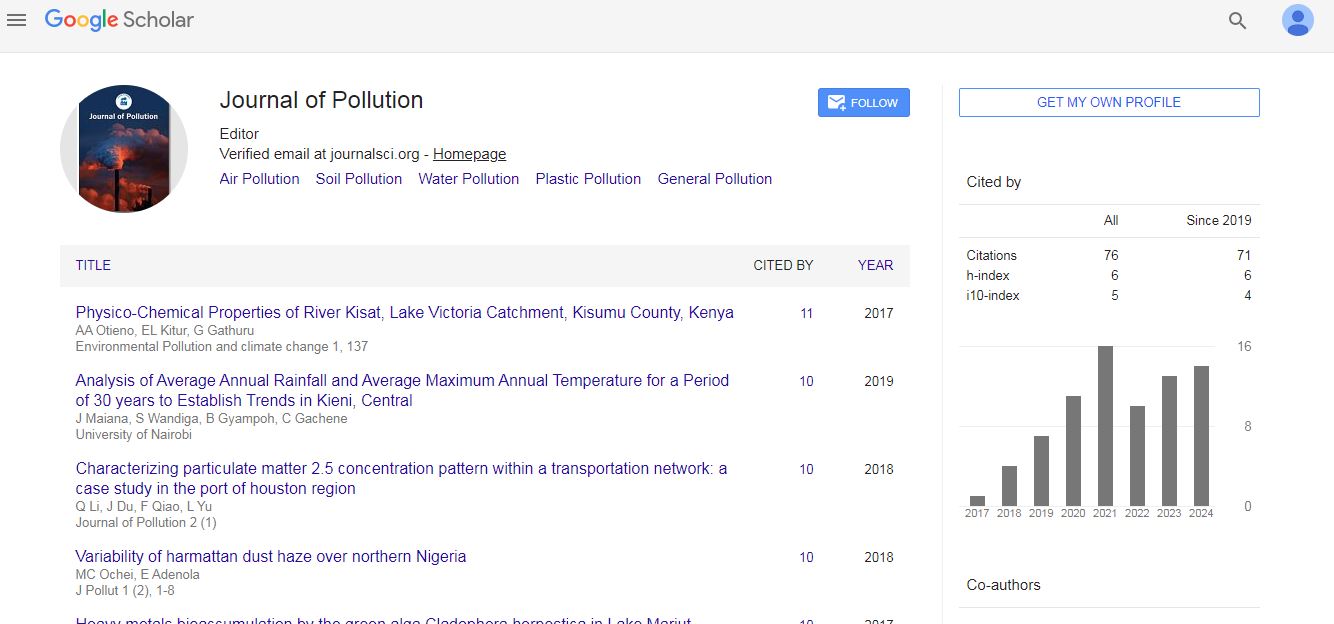
Journal of Pollution received 64 citations as per Google Scholar report