Brief Report - (2025) Volume 13, Issue 3
Received: 02-Jun-2025, Manuscript No. jcdd-25-176783;
Editor assigned: 04-Jun-2025, Pre QC No. P-176783;
Reviewed: 18-Jun-2025, QC No. Q-176783;
Revised: 23-Jun-2025, Manuscript No. R-176783;
Published:
30-Jun-2025
, DOI: 10.37421/2329-9517.2025.13.669
Citation: Evans, Noah. ”Echocardiography: Advancements in
Cardiac Diagnosis and Management.” J Cardiovasc Dis Diagn 13 (2025):669.
Copyright: © 2025 Evans N. This is an open-access article distributed under the terms of the Creative Commons Attribution License, which permits unrestricted use, distribution
and reproduction in any medium, provided the original author and source are credited.
Echocardiography continues to be an indispensable diagnostic tool in cardiology, with ongoing advancements and refined guidelines shaping its application. Recent updates offer a comprehensive framework for assessing diastolic function, moving beyond previous recommendations to emphasize an integrative approach. This method carefully considers multiple echocardiographic parameters alongside the patient's clinical context, leading to a more accurate diagnosis of diastolic dysfunction, a critical step in managing complex conditions like heart failure with preserved ejection fraction (HFpEF)[1].
The field is also embracing technological innovation, with Artificial Intelligence (AI) rapidly transforming echocardiography. Current AI applications include automated image acquisition, sophisticated interpretation, and precise quantification of cardiac structures. Let's break it down: integrating AI into clinical workflows stands to significantly enhance efficiency, reduce variability in assessments, and ultimately improve diagnostic accuracy and patient outcomes[2].
While new technologies emerge, established techniques remain foundational. Stress echocardiography, for instance, is a cornerstone for diagnosing ischemic heart disease and comprehensively assessing valvular heart disease. This review details its current evidence, clinical indications, and applications of various stress modalities, including both exercise and pharmacological stress. It highlights the non-invasive nature and ability to provide crucial functional information, making it an invaluable tool in cardiology[3].
Furthermore, echocardiography plays a critical role in the broader management of valvular heart disease. It guides clinical decisions from initial diagnosis to severity assessment, intervention planning, and long-term follow-up, covering native valve diseases, prosthetic valves, and emerging transcatheter therapies. What this really means is comprehensive patient care is ensured through detailed imaging strategies[4].
In acute care settings, Point-of-Care Ultrasound (POCUS) has demonstrated significant utility. A systematic review and meta-analysis confirms POCUS's high diagnostic accuracy in the emergency department for various cardiac pathologies. It reliably detects conditions such as pericardial effusion, severe left ventricular dysfunction, and right ventricular strain. This means POCUS can rapidly assess cardiac emergencies, effectively guiding immediate patient management and triage[5].
Echocardiography also provides comprehensive recommendations for congenital heart disease (CHD), addressing technical considerations, diagnostic work-up for various types, and its role in clinical management throughout a patient's lifespan. What this really means is that accurate echocardiographic assessment is paramount for early diagnosis, surgical planning, and long-term surveillance in CHD patients[6].
The versatility of echocardiography was further evidenced during the COVID-19 pandemic; a systematic review and meta-analysis summarized its findings, identifying a high prevalence of cardiac abnormalities, including left and right ventricular dysfunction, and pericardial effusion. The key takeaway here is that echocardiography played a vital role in understanding the cardiac manifestations of COVID-19 and in guiding appropriate management strategies for these patients[7].
Advanced echocardiographic assessment continues to refine our understanding of left ventricular (LV) function. Beyond traditional measures like ejection fraction, newer techniques, such as global longitudinal strain, offer a more nuanced evaluation of myocardial mechanics. Let's break it down: a comprehensive LV assessment is fundamental for diagnosing various cardiomyopathies, guiding therapy, and predicting patient prognosis[8].
Myocardial strain imaging, in particular, is highlighted as a powerful new clinical tool, offering a more sensitive and specific measure of subtle myocardial deformation than traditional methods. It can detect early signs of cardiac dysfunction in various conditions, providing valuable prognostic information and aiding in earlier intervention, proving its worth in clinical practice[9].
Ultimately, echocardiography is indispensable for both diagnosing and prognosing heart failure with preserved ejection fraction (HFpEF). While ejection fraction might be preserved, other echocardiographic parameters, including diastolic function, left atrial size, and pulmonary pressure, are crucial for identifying and risk-stratifying HFpEF patients. This means echocardiography is indispensable for accurate HFpEF characterization and for guiding effective management strategies[10].
Echocardiography is a continuously evolving and critical tool in cardiovascular diagnostics, providing essential insights into cardiac function and pathology. Recent guidelines have significantly updated the framework for assessing diastolic function, moving beyond previous recommendations to emphasize an integrative approach. This method considers multiple echocardiographic parameters alongside the clinical context, leading to a more accurate diagnosis of diastolic dysfunction, which is crucial for managing conditions like heart failure with preserved ejection fraction (HFpEF)[1].
The field is actively integrating technology, with Artificial Intelligence (AI) rapidly transforming echocardiography. Current AI applications streamline image acquisition, interpretation, and quantification. Let's break it down: AI enhances efficiency, reduces assessment variability, and potentially improves diagnostic accuracy and patient outcomes by optimizing clinical workflows[2]. Concurrently, stress echocardiography remains a cornerstone for diagnosing ischemic heart disease and assessing valvular heart disease. This non-invasive tool provides crucial functional information using various stress modalities, proving invaluable in cardiology[3].
Echocardiography's critical role extends to the comprehensive management of valvular heart disease. It guides clinical decisions from initial diagnosis and severity assessment to intervention planning and follow-up, covering native valves, prosthetic valves, and emerging transcatheter therapies. What this really means is comprehensive patient care is supported through tailored imaging strategies[4]. In acute care, Point-of-Care Ultrasound (POCUS) is a highly accurate diagnostic tool. A systematic review confirms its reliability in the emergency department for detecting cardiac pathologies such as pericardial effusion, severe left ventricular dysfunction, and right ventricular strain. This means POCUS can rapidly assess cardiac emergencies, guiding immediate patient management and triage effectively[5].
Furthermore, echocardiography provides extensive recommendations for congenital heart disease (CHD), covering technical aspects, diagnostic work-up, and clinical management throughout a patient's lifespan. What this really means is accurate echocardiographic assessment is paramount for early diagnosis, surgical planning, and long-term surveillance in CHD patients[6]. During the COVID-19 pandemic, echocardiography proved vital. A systematic review identified a high prevalence of cardiac abnormalities, including ventricular dysfunction and pericardial effusion, playing a key role in understanding cardiac manifestations and guiding management strategies[7].
Advanced echocardiographic assessment continues to refine our understanding of left ventricular (LV) function. Beyond traditional ejection fraction, newer techniques like global longitudinal strain offer a more nuanced evaluation of myocardial mechanics. Let's break it down: a comprehensive LV assessment is fundamental for diagnosing cardiomyopathies, guiding therapy, and predicting patient prognosis[8]. Myocardial strain imaging, as a powerful new clinical tool, provides a sensitive and specific measure of subtle myocardial deformation, detecting early signs of cardiac dysfunction. Here's the thing: it offers valuable prognostic information and aids in earlier intervention, proving its worth in clinical practice[9]. Ultimately, echocardiography is indispensable for diagnosing and prognosing HFpEF. Parameters like diastolic function, left atrial size, and pulmonary pressure are crucial for identifying and risk-stratifying HFpEF patients, ensuring accurate characterization and management strategies[10].
Echocardiography is a cornerstone in cardiac diagnosis and management, with recent updates refining its application across various conditions. Guidelines now offer a more thorough framework for assessing diastolic function, promoting an integrative approach for accurate diagnosis of diastolic dysfunction, especially crucial for managing heart failure with preserved ejection fraction (HFpEF)[1]. The field is also seeing a rapidly evolving role for Artificial Intelligence (AI) in echocardiography, where AI enhances efficiency, reduces variability in assessments, and improves diagnostic accuracy through automated image acquisition and interpretation[2]. Stress echocardiography remains vital for diagnosing ischemic heart disease and evaluating valvular heart disease, providing crucial functional information through non-invasive means[3]. Its importance extends to the comprehensive management of valvular heart disease, guiding clinical decisions from initial diagnosis to intervention planning and follow-up[4]. Point-of-Care Ultrasound (POCUS) proves highly accurate for rapidly assessing cardiac emergencies in the emergency department, effectively detecting conditions like pericardial effusion and severe ventricular dysfunction[5]. Furthermore, echocardiography provides comprehensive recommendations for congenital heart disease (CHD), paramount for early diagnosis, surgical planning, and long-term surveillance[6]. It played a vital role in understanding cardiac manifestations of COVID-19, identifying prevalent abnormalities like ventricular dysfunction and pericardial effusion[7]. Advanced echocardiographic assessment of left ventricular (LV) function now includes newer techniques such as global longitudinal strain, offering a more nuanced evaluation of myocardial mechanics beyond traditional ejection fraction, aiding in diagnosing cardiomyopathies and predicting prognosis[8, 9]. This advanced imaging also proves indispensable for characterizing and managing HFpEF by evaluating diastolic function, left atrial size, and pulmonary pressure[10].
Indexed at, Google Scholar, Crossref
Indexed at, Google Scholar, Crossref
Indexed at, Google Scholar, Crossref
Indexed at, Google Scholar, Crossref
Indexed at, Google Scholar, Crossref
Indexed at, Google Scholar, Crossref
Indexed at, Google Scholar, Crossref
Indexed at, Google Scholar, Crossref
Indexed at, Google Scholar, Crossref
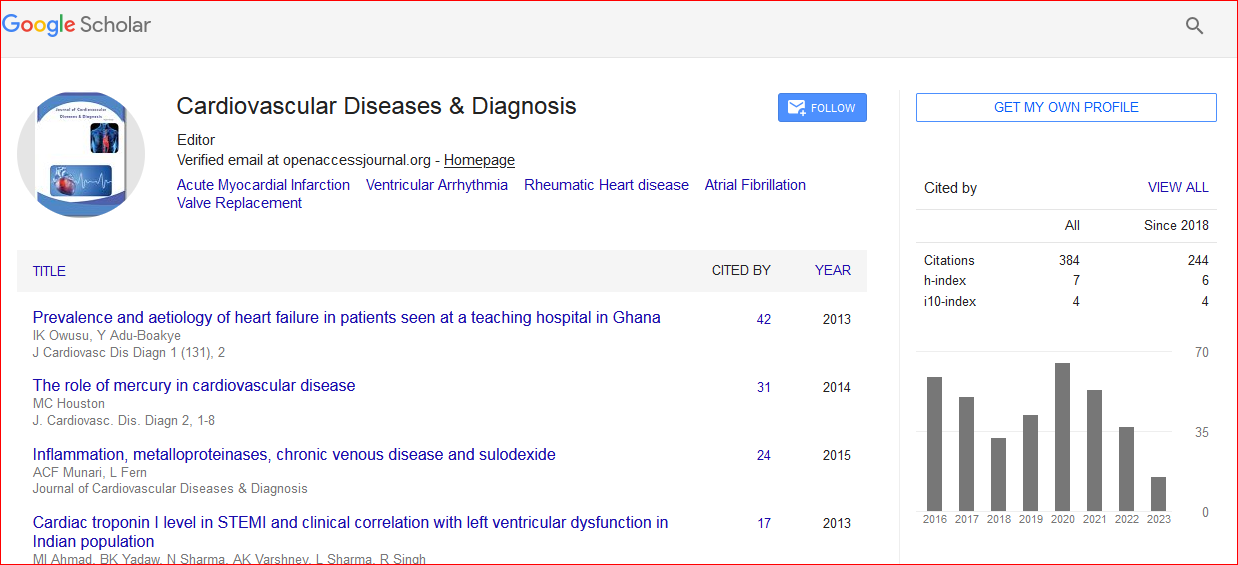
Cardiovascular Diseases & Diagnosis received 427 citations as per Google Scholar report